


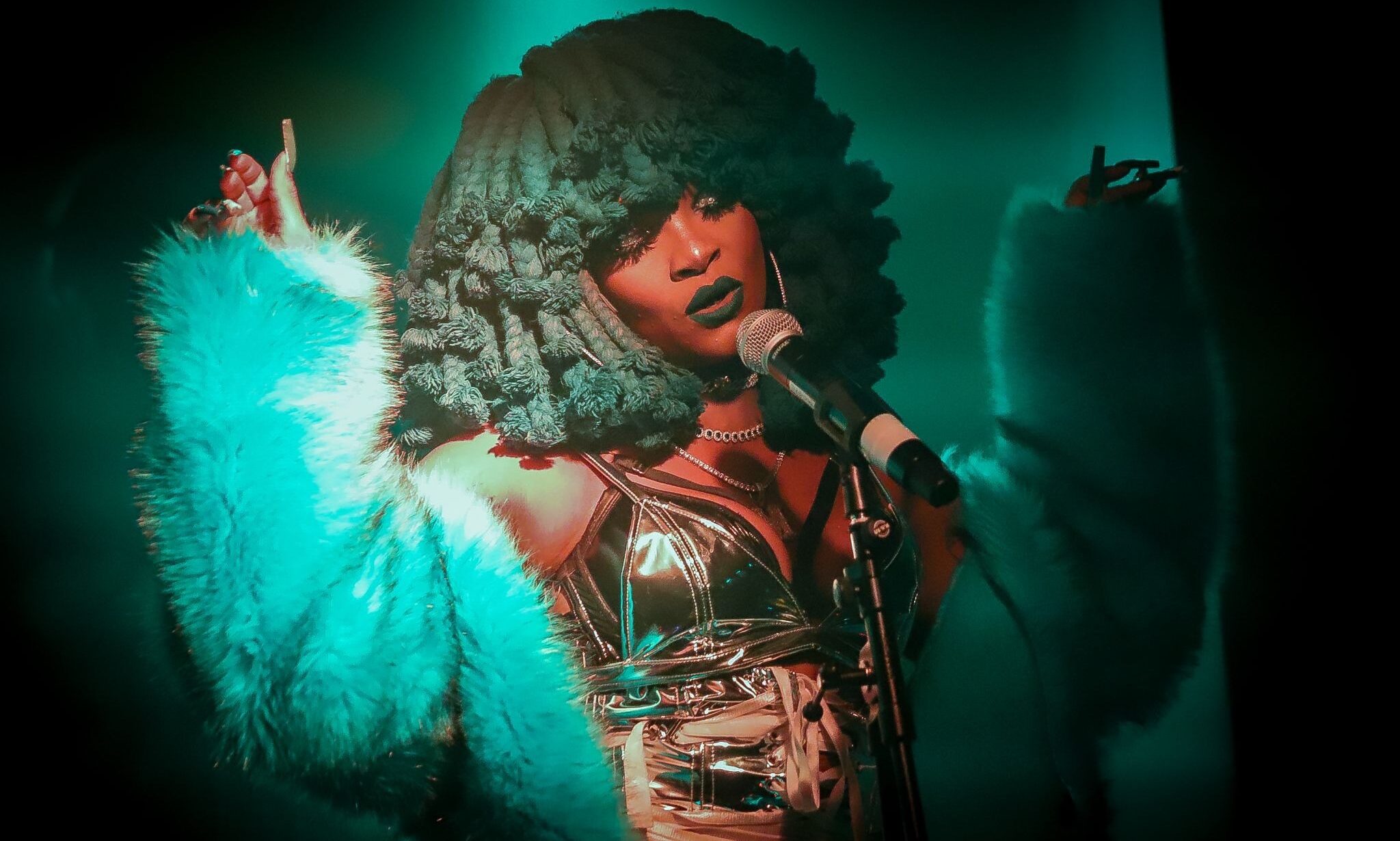















































Seyi Shay on music, Accra and the men of Afropop
19 Mar 2019 - 10:49


Seyi Shay parries a particularly persistent fly.
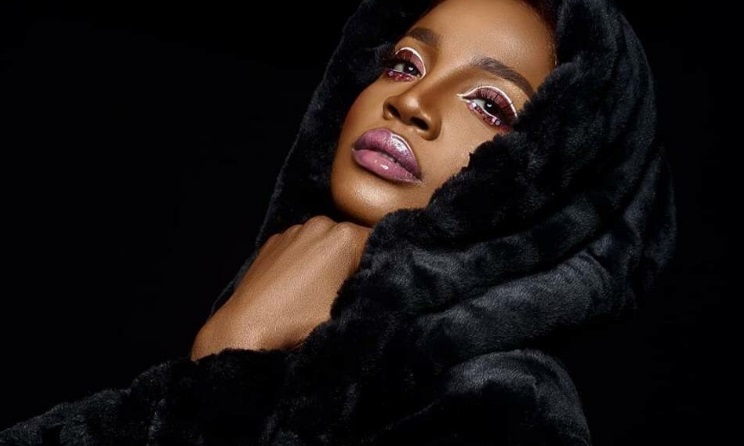
She readjusts the gold-rimmed sunglasses on her face—which serve as her defense against the rays of Accra’s sun, settles properly in her seat, and resumes the story of her love affair with Ghana’s capital.
“I love the vibe, the people, the food, the jollof,” she says in a voice that recalls her Tottenham childhood. “There’s just an energy that keeps pulling me here.”
Over the past few years, Seyi Shay’s Accra trips have become frequent, either to promote a song or to play a gig. Today, it’s the singles ‘Gimme Love’ and ‘Ko Ma Roll’ that have brought her here. Known privately as Deborah Oluwaseyi Joshua, the sultry chanteuse enjoys appreciable celebrity in this town, but she’s looking to really “blow here very soon”.
Both ‘Gimme Love’ and ‘Ko Ma Roll’ herald Electric Package, Vol. 2—her soon-to-be-released EP. Its predecessor harvested indigenous West African sounds and featured the likes of DJ Spinall, Vanessa Mdee, Distruction Boyz, and Flavour. This new installment has fewer guest appearances and supplies what she calls an “intentional sound”.
Throughout her career, Seyi Shay has used multiple musical elements: reggae, ska, hip hop, R&B, salsa, Afrobeat. She accepts the Afropop label, seeing as she’s a practitioner of “popular African music”. And while she may not have a song that leans towards, say, the shaku shaku sound—which ranks among the reigning rhythms these days—she believes that her music is relevant to the times and caters to current trends in its own way.
I ask how many influences one has to absorb to produce music in so many genres. The answer, she says, lies in her upbringing.
Born and raised in London by Nigerian parents, Seyi Shay visited Nigeria every year after her second birthday. By the time she decided to settle in Nigeria, years ago, her cultural roots were fully intact. Growing up in 1980s and 1990s London also exposed her to numerous sounds, nurturing her ability to appreciate all kinds of music. For her vocal discipline, she credits her church choir background. She also read music in college, before studying business management.
Seyi began performing as a teenager and joined the London Community Gospel Choir during their world tour. Prior to announcing her solo career, she belonged to the now-defunct girl bands Boadicea and From Above, which supported pop megastar Beyoncé on the UK leg of her I Am… World Tour.
In 2011, she met veteran Nigerian musician Sound Sultan. He suggested that she take her music back to the West African country that governs African music. It took some convincing but she finally agreed. She hasn’t looked back since.
Our unsolicited guest re-emerges as I confess that ‘Yolo Yolo’ is a personal favourite because of how excellently it balances a danceable rhythm with a powerful sermon of hope and taking stock of one’s blessings. Seyi projects a grateful smile and simultaneously throws a delicate back-handed slap over her shoulder to dismiss a fly. She suspects it’s a mosquito; I think it’s a housefly.
When ‘Yolo Yolo’ landed in 2017, I assumed that her infatuation with Cuban rhythm was a one-off affair, but subsequent joints have proven her attraction to Afro-Cuban fusion is not a mere fling. Seyi credits Fela Kuti for pioneering that style, stressing that “more than anything, he influenced my affair with Afro- salsa”.
On that record, produced by DJ Coublon, Seyi Shay manages to credibly relay the daily truths of ordinary people. What is the technique there?
“I sing my truth,” she says. “I sing from my soul. Some people would say I’m a soul singer.” If she takes any other route, she’s convinced that listeners would not believe it—it would be just another pop record that disappears after a couple of months. She was in an unhappy place around the time she recorded ‘Yolo Yolo’, so it was written as encouragement. It's why the song is both reflective and hopeful. Ultimately, “everybody loves a positive song,” she says.
I bring up a specific line from the record: “Pikin wey they carry for back no know say journey far” (The child strapped to a mother’s back has no idea how long a trek is).
“You can picture the line,” she says. “As babies, when our mothers carry us on their backs, we don’t think of the troubles of life ahead. In fact, we cannot even see where our mothers are carrying us to. All we know is that we’re going somewhere. We have no worries—and that is when you’re a child. As you get older, you start to realise that what you felt then is not forever. You start to realise the journey.”
When she was lamenting to Klem—with whom she penned the song—about how discouraged she was, he spoke that proverb to reassure her. The words invoked tears and then a masterpiece.
Seyi Shay is thankful for her talent for many reasons, key among them the fact that it provides an avenue for her to navigate her emotions, so that she doesn’t have to resort to drugs or “extra crazy shit” to safeguard her sanity. She acknowledges that “a lot of artists are hiding behind stardom and fake shit. But for me ooh, I just say my truth, and it’s my therapy,” she says, allowing a strong West African drawl.
“I know that there are other girls and guys out there who can relate to my truths. There must be—because we’re not all pushing Bugattis and Ferraris. If people can relate to artists like me, who are just being real, that’s an outlet for them.”
Why?
“Nobody is perfect, and you cannot be perfect. You cannot be perfect,” she repeats. “Maybe to your mother, or to your father.” Even to our parents, Seyi is quick to add, there’s always one thing we fall short with. “Once you embrace your imperfection and try to do your best all the time and just be happy with yourself, that’s the height of perfection.”
Well what about the following theory then: that it is artists we often look to, to make sense of the world? Is it not by aspiring to an artist’s heights that we aspire to perfection; the glamour of her videos and her model-type contours that shape our conception of the ideal body? In other words, is it not the duty of an artist to, therefore, be perfect?
“No,” she says, smiling in the way your grandmother would before serving insightful advice. “The duty of an artist is to be flawed. A lot of artists hide behind a façade; a lot of artists hide behind a world they have created for themselves—one that they expect people to buy into.”
One other characteristic of Seyi’s songs is that they arrive with superior vocal technique, embellished with superb adlibs and elegant high notes. However, she observes, the Nigerian music consumer doesn’t really care for singing, whether it’s E-flat or F-sharp. “They just want you to make them dance. That is it!”
The art of singing technically may be waning, and auto-tune is seemingly allowing many the temerity to label themselves “singers”, she says—but thankfully, acts like the fast-rising Teni and sister Niniola have maintained a certain standard, even if they’re singing on a pop record.
“Real voice—not just labalaba music,” Seyi says. “So, there are people who are really breaking that status quo—thank God.”
One more thing on the perfection question and she wants to be perfectly clear about this: when she sings, the overall intent is not to necessarily hit perfect notes; the intention is to connect: “If my vocals are perfect—well, that’s just because of where it’s coming from.”
I don’t remember what next set of questions land us here, but somewhere during the dialogue, we are discussing how songs—in their varying forms—come about for Seyi. She notes that there isn’t a single way to construct music. 'Gimme Love', for instance, emerged in the spur of the moment. She didn’t have to write it. In the studio, she just got behind the microphone, and began “speaking in tongues”—but with melody. She then decided to record lyrics. “Honestly, with a melody that comes from heaven like that, you can’t even fight it—there’s no more perfection than that, so you just do it that way.”
Creating ‘Murda’ happened differently: During a studio session, Shaydee (who is on the song alongside Patoranking) did a freestyle that would end up as the hook. The melody hooked her immediately. As she recalls this story, she cracks a smile, and then immediately finds herself singing it: “She say she want murder / she say she want do that thing / she say she want murder…”
She also didn’t write ‘Ko Ma Roll’. Ace Tune, an act she recently signed, did, but she made sure to deliver it as convincingly.
My next question has to do with stereotypes of the contemporary female pop singer; that she can only truly hit commercial accomplishment by staying within a specific set of subject matters, mainly, dance, love and sex. She disagrees: “I don’t think so, sha” and she submits a piece of evidence she knows all too well—her 18-track debut album Seyi or Shay.
“The subject matters are so vast—a spiritual one, a love one, a baby making one, a balling one, a flossing one, a down one, a hopeful one, a prayerful one... music is music, and whatever occupies your mind or heart as an artist, you have a duty to deliver and speak it.”
Seyi or Shay wasn’t a perfect project for the singular reason that she shouldered every aspect of its making; from recording, to mixing, through mastering. It was not the best version of herself in terms of sonics or delivery, she says. The revelation surprises me, because Seyi or Shay stands, to me, as a very effective project, pouring with high-profile features and singles that were quickly picked up by radio. She notices my surprise, and compensates me with her next sentence: the album’s excellence rests in the fact that she was just being herself.
Seyi has to be on a plane back home soon, but she will take a final question: how does she manage to hold her ground in the same ecosystem as Davido, Tekno, Wizkid, Mr Eazi et al? Afropop is male-dominated and only a handful of female acts are true 'A-list. Indeed, one can count—with a single hand—singers who lead the female contingent. Seyi is one of them. Tiwa Savage and Yemi Alade are two others.
She doesn’t have an answer but is happy “to be part of those pioneering new-age Afrobeats. I just thank God, because I don’t know if I really know how popular or influential I am—and I don’t really look at that because I’m still trying to a certain place that I don’t believe I have reached yet.”
That being said, she remains thankful that people are familiar with her music and know her by name, affording her the chance to “make a livelihood from what I love”.
“That is dope,” she says.


Most popular

Top Naija songs of 2026
31 Mar 2026

Top amapiano songs of 2026
16 Feb 2026

Call for applications: ACCES 2026 Emerging Artist Spotlight Competition
01 Oct 2026

Top Afrobeats songs of 2026
19 Mar 2026
AFRIMA 2026: All the winners
12 Jan 2026
CAPASSO backs global principles for fair generative AI music licensing
06 Oct 2026
Disclaimer: Music In Africa provides a platform for musicians and contributors to embed music and videos solely for promotional purposes. If any track or video embedded on this platform violates any copyrights please inform us immediately and we will take it down. Please read our Terms of Use for more.

Subscribe to our monthly Newsletter
Follow us on social media


Please log in to post a comment.