














































Zambia is a country of vast cultural diversity, with 73 ethnic groups generally grouped into six official language groups: Bemba, Tonga, Nyanja, Luvale-Mbunda, Lozi and Kaonde. Traditional music can be studied from several possible angles that are in no way mutually exclusive, but rather complementary. This integrated approach establishes a framework for the holistic demonstration and appreciation of traditional Zambian music.
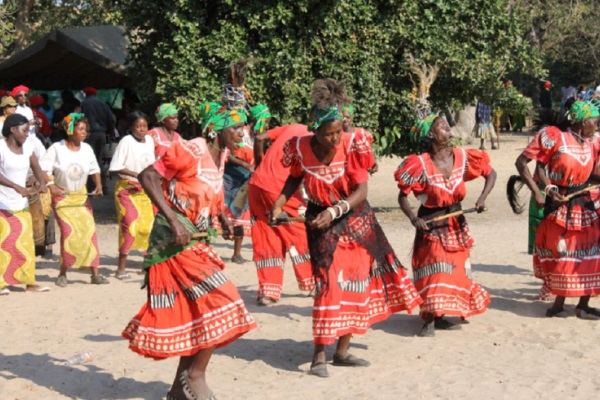
Music in community life
Music is generally organised as a social event; musical activities belong to the community as a whole. Because of the high level of practical community participation, music is a legitimate way of looking at the people of Zambia in that music activities are functional and an integral part of everyday personal, religious, social and economic life.
- Life cycle and social significance
Several examples of musical situations and rites exist that accompany the educational ceremonies of initiation among Zambian ethnic groups. Rites of passage (the rituals that help people to navigate their changing status in society) are related to birth, initiation, marriage and death. For example, the Makishi masquerades of the Luvale people and Chisungu rituals of the Bemba people both developed out of the need to assist young people to learn cultural values, norms and lessons about adulthood responsibilities through music.
Musical instruments, together with the ideas they express, also serve as a reflector of Zambian life. As such, the dynamics of life have often served as the conditions for the birth and growth of musical instruments. Thus, traditional methods of ensuring prosperity, good health, security, normal development of outlook and character, order and orderly behaviour have created the need for rituals that employ the use of ethnic traditional music and instruments.
- Rituals of good health, prosperity and security
Therapeutic music and rituals are common in Zambia. There are some that involve the exorcism of spirits so that they do not torment their mediums unduly, while others (such as the uwangu of the Luvale) are purely therapeutic. Some types of spirits are believed to imbue people with spiritual visions, sooth-saying or musical abilities, and provide guidance to rare medicinal herbs (such as mashabe among the Nsenga and the myela among the Bemba of Eastern Province and Northern Provinces respectively). A large variety of dances, costume, props and music have developed through these traditions: for instance, the vimbuza of the Tumbuka and the cibitiko of the Soli/Lenje groups have contributed greatly to this phenomenon.
- Social control and order
Musical arts are a mechanism of ensuring social control. Societal values are directed to all (and expected of everyone without discrimination) and are constantly adapted to modern life contexts through musical performances. For example, it is common for a group of female performers to be seen ridiculing a conceited school-educated youth in a chimtali song among the Tumbuka of Eastern Province. Likewise, the stylish, subtle wriggling dance of young Nsenga girls censures young girls about early sexuality in the ndendeule performance in the same province, while the chisungu initiation ceremony in Luapula, Northern and Muchinga Provinces aims to inculcate orderly behaviour among girls.
Apart from their musicality, instruments also serve as symbols of authority. For example, the maoma royal drums of the Lozi people of Western Province not only symbolise this authority but also express political stability in the chiefdom.
Indigenous music instruments
There are more membranophones and ideophones than any other category of instruments in Zambia. The ecology of the land largely determines what instruments can be made and played locally. For example, Western Province has relatively bigger drums due to the big forest trees in this region. The music traditions of Zambia reveal ingenious techniques for the exploitation of vast resources, resulting in a wide variety of devices, including musical instruments, some of which are outlined below.
Traditional styles of music and dance
Music making in Zambia is rarely an isolated occurrence devoid of dance and other dramatic acts. The performance of music is usually accompanied by dance, such that there is little or no distinction between the names given to the dance and its accompanying music. For instance, the music played for the moba dance in Central Province is equally referred to as moba music.
Similarly, nyakasanga music is an integral part of the nyakasanga social dance of the North Western Province. The music is sung in a call-and-response pattern by both men and women, accompanied by a chime of drums usually played in a group of five. Among the five drums is the leading drum and supporting drums, graduated according to pitch and sonority levels. Nyakasanga performance depicts peoples’ everyday life activities in highly styled, dramatized dance movements relived through songs.
Kalela music is synonymous with the social stylistic kalela dance of the Bisa, Ngumbo and Ushi people of Luapula Province. There are two versions of Kalela performance: one that depicts modernity and the other portraying rural life. Huge drums made out of disused oil drums are used in the kalela performance amidst heavy whistle blowing. Unlike elsewhere in Zambia, kalela drums are played with sticks. Kalela is performed by both men and women in a circular formation expressing intimate social gestures while songs are sung in call and response.
Chig’ande is the music of the Tonga of Southern Province, it is performed during a social courtship dance also known as ching’ande. It is performed on three drums: ngoma mpati and two tusunto (singular: kasunto ). Ngoma mpati is the master drum that provides cross rhythms to the smaller drums. A hard percussive stick known as lukonkoolo (plural: nkonkoolo) is used to tap rhythms on the side of a drum. Additionally, a muyuwa rattle (a closed tin can with stones inside) or nsakalala (a flat, long wild fruit) is used besides hand claps.
Vimbuza of the Tumbuka people of Eastern Province is a type of therapeutic dance music associated with spirit possession. A vimbuza performance is only held when there is a need for healing spiritually possessed people. It is performed by both men and women. Driven by music, a vimbuza performer may tell the type of evil spirits that possess the patient. Rattles or small iron balls provide beautiful striking sounds, punctuated by hand-clapping and singing that enhances the vimbuza performance.
Fwandafwanda is performed in Central Province among the Kunda, Lima, Lenje, Sala, Soli, Luano and Lala ethnic groups. It is performed by both men and women for social and recreational purposes in unison styles with the accompaniment of drum and clap rhythms. Musical themes are usually current and topical in nature, played out on a combination of five graduated drums of different sizes with the accompaniment of percussive beats, including whistle sounds.
The Lenje and Lamba speaking women of Central and Copperbelt Provinces perform the manchacha. It is celebratory and mainly featured at weddings and ceremonies that mark the coming-of-age of young girls. Manchacha music is fast paced, played on a set of four to five drums. Despite being a feminine genre, it is not uncommon to find male drummers accompanying the females during public performances.
Performed by the Lozi of Western Province, siyomboka is a girls’ initiation genre. A unique combination of instruments consisting of drums (milupa), a hard percussive stick (mukakashi), a triangular wooden drum (singubu) and a xylophone (silimba) characterise the siyomboka performance. Siyomboka drums are conical in shape and played with the hands. The kapalanga, kanjakili, sikumwata and omutuna are the most commonly played, while the omutuna serves as a master drum, establishing a variety of standard rhythmic patterns. During a siyomboka performance in which the singubu plays a subservient role, the kanjakili is used to accompany it. The mukakashi is tapped on the side of the drum to produce a rhythmic background similar to the rhythm produced by hand-clapping. Additionally, the silimba is also played by two men, along with the rest of the instruments. Also of high artistry is the accompaniment of songs, dances and the costumes.
Impact on Zambian popular music
Zambia’s indigenous traditional music styles have significantly contributed to shaping the country’s popular music landscape and clearly influence the creativity of contemporary musicians.
The impact of local traditional music styles on popular genres is particularly evident especially among artists such as the band Amayenge (on albums such as Mao in 1989, Mangoma kulila in 2006 and Chishango in 2011), Pontiano Kaiche (on Insaka from 2013); Mulemena Boys (1984’s A Tribute to the Late Emmanuel Mulemena), Serenje Kalindula Band (Elyo Yalila in 1990), Sakala Brothers (on albums such as Londole in 1998, Sandra in 2001, Manzi Amoyo in 2002 and Born in Matero in 2013).
Most local popular musicians can easily be identified with one or more local traditional styles, based on their music orientations that are deeply rooted in tradition.
Further reading
- Jaspan, M.A. 1953. The Ila-Tonga peoples of North Western Rhodesia. African Institute, London.
- Jones, A.M. 1949. African music in Northern Rhodesia and some other Places. Rhodes–Livingstone Institute.
- Kay, G. 1967. A Social Geography of Zambia. University of London Press.
- Lamba, P.F.M. 2010. Dance Africa Study Guide on Zambian Music and Dance. New York City: Brooklyn Academy of Music
- Macnamara, C.J. 1912. Natives of the Zambezi.
- Mapoma. I.M. 1974. Ingomba: The Royal Musicians of the Bemba people of Luapula province in Zambia. M.A. Thesis. University of California, Los Angeles, USA.
- Mensah, A.A. 1971. Music and Dance in Zambia. Zambia Information Services.


Most popular

Top Naija songs of 2026
31 Mar 2026

Top Afrobeats songs of 2026
19 Mar 2026
Ghana: Mr Eazi and MOLIY’s ‘Comfort’ earns Urban Music Awards nomination
21 Oct 2026

Top amapiano songs of 2026
16 Feb 2026
Open call: CANEX Music Business Lab and Songwriting Camp
15 Oct 2026
Nigeria: CANEX WKND unveils 2026 programme
21 Oct 2026
Disclaimer: Music In Africa provides a platform for musicians and contributors to embed music and videos solely for promotional purposes. If any track or video embedded on this platform violates any copyrights please inform us immediately and we will take it down. Please read our Terms of Use for more.

Subscribe to our monthly Newsletter
Follow us on social media


Please log in to post a comment.