






















































By Uchenna Ikonne
“No place for a woman.” That’s what was said about any number of spheres of Nigerian social life, whether it was the corridors of political power, the church pulpit, a sports field, and definitely the nightclub bandstand.
Actually, nightclubs in general were not viewed as a place that any “decent” woman would ever be found, the common assumption being that a woman socializing in a club, unaccompanied by an upstanding male escort must by definition be of dubious virtue. Since the nightclubs functioned as the primary site for the production and consumption of popular music, this prejudice essentially excluded women from contributing significantly to the arena of music.
Oh yes, there was the occasional girl singer who might warble a few tunes with one of the more established orchestras, but her time in the spotlight was usually brief as she almost invariably exited the stage as soon as she got married. Singing could be tolerated as an innocent distraction for a young girl before she settled down to the serious work of raising a family but music was definitely not a viable career course for a respectable woman.
The notion of a woman leading a band on a professional level was ludicrous to even imagine. Even more so was the idea that women could play musical instruments. In indigenous music genres such as waka, egwu ekpili or mkpukpo, a female vocalist might accompany herself with some sort of basic rattle, bell or gourd, but women were not expected to do so much as lay a finger on the formidable brass and rosewood instruments of the Western-oriented dance ensemble.
Playing the trumpet required a capacity of lung and resilience of lip regarded as far beyond the scope of the fragile feminine constitution. Dainty distaff fingers could hardly hope to bow the rigid catgut strings of the bass fiddle or display the digital dexterity to successfully navigate the fretboard of the guitar. Mastering the musical scales that served as the lexicon for an assortment of tuned instruments demanded a mental acuity that was not the stuff of the flighty female mind. All of this was conventional wisdom, of course, incontestable by any reasonable person. That is, until Hubert Ogunde appeared on the scene.
The contribution of Herbert Ogunde
Ogunde (1916-1990), a policeman with a keen interest in opera, established in 1945 the African Music Research Party: Nigeria’s first modern, commercially-driven professional theatre group. Ogunde’s troupe was innovative for a number of reasons, chief amongst them being the inclusion of several young women as performers. This, at a time when no sensible girl would openly strut her stuff on stage in the barely-there costumes Ogunde designed—no girl who hoped to one day find a good husband, anyway. (The polygamist Ogunde would eventually remedy this problem by marrying all his female troupers himself, thus rewarding them with the social respectability denied them by participation in his productions.)
In time, Ogunde recognized that his girls were the main attraction of his act but he was interested in utilizing them as more than just sex objects. As such, he had them learn orchestral instruments. The sight of voluptuous beauties manning the trap drums and saxophones to kick out swinging jazz numbers was a marvel to behold for audiences in the nineteen fifties.
The introduction of Victoria Iruemi
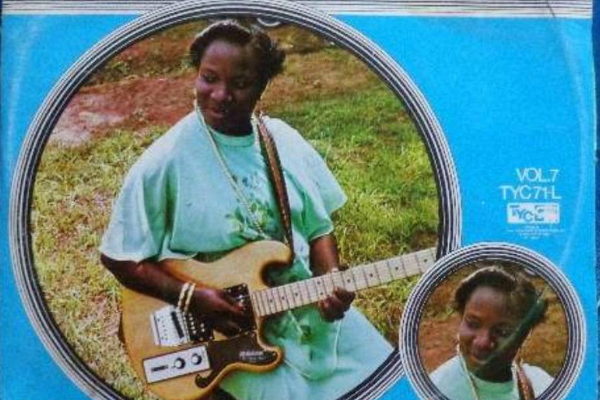
Around the time Ogunde was showing that women could play in the band, a young woman named Victoria Iruemi (1938 - ?) was getting ready to take things a step further. Intending to train as a seamstress, Iruemi left her native Sapele (in present-day Delta State) for Lagos in 1952 - the exact moment when dance bands from the Gold Coast were starting to infiltrate Nigeria’s nightspots and airwaves, stirring up a craze for highlife music. Nigerians were especially mystified by the skill of the Ghanaian guitar players; Iruemi found herself falling in love with the sound of the instrument and vowed to master it herself. Her first teacher was a Ghanaian guitarist identified only as “Ben,” who instructed her in the rudiments. When Ben went back home, she continued her tutelage with Papa Jay of Roy Chicago’s Abalabi Dandies.
By late 1963, Iruemi had become good enough to join one of the top bands in Lagos, the Cool Cats Orchestra (led by Kobina Biney). It was on the Cool Cats bandstand that she was spotted by Kole James, proprietor of the Roadhouse Hotel in the Idi-Oro section of Lagos, who promptly installed her in front of the nine-piece Roadhouse Dance Band, making her Nigeria’s first woman bandleader.Predictably, Iruemi faced harsh criticism and discouragement, mostly from members of her own sex who saw a gross degradation of womanhood in her public exhibition of herself in clubs (usually dressed in trousers - insult upon injury!). Still Iruemi expressed the hope that she could inspire enough women to pick up instruments so that she could lead an all-female band.
Vic Iruemi didn’t remain on the scene long enough to see her dream come to fruition; she seems to have disappeared by the mid-1960's, presumably to get married. But her pioneering work was already inspiring followers. The Sunflowers were a razor-sharp ensemble of young soul musicians, mostly male; the lone woman in the group was also its leader, singer Mona Finnih (b. 1949). Finnih was not an instrumentalist but she approached running the Sunflowers with a hands-on verve. All the group’s gear was bought and owned by her. She handled the development of repertoire and booking of engagements. She produced and promoted shows featuring The Sunflowers and other soul and pop acts. Shortly thereafter, in Benin City an all-female band finally did emerge: The Originators, played a rousing repertoire of highlife, rumba and pop music, led by guitarist Maggie Aghomo.
The effect of the Civil War
Perhaps tellingly, the musical rise of these women coincided with the Nigerian civil war, which raged from 1967 to 1970. Wartime has historically afforded women opportunities for social mobility: The men march out to the battlefield, the women take on the roles in society they leave behind. Sometimes they have to join the armed forces themselves (even if it is in a non-combatant capacity). During the civil war, many Nigerian musicians were conscripted into military bands that entertained the troops, and the ladies were not left out. Aghomo was recruited by the Army Medical Service in Lagos to form a new all-girl group called The Tranquilisers.
Erstwhile Originator, organist Roselyn Golliey formed The Diamond Girls, who were a major draw at the renowned Caban Bamboo Nite Club in Lagos. (Other members of The Originators and The Tranquilisers such as Grace Ogbodu and Grace Ekpenyong would also go on to lead their own bands in the nineteen seventies). Even in the ancient northern city of Kano, traditionally a stronghold of Islamic conservatism where good Muslim women veiled their heads with hijab, the nights were animated by the blaring rhythms of the all-female Metropolitan Band, founded by order of state administrator Audu Bako.
Even the association of performance and bandleading with “loose” single girls would wither away. One of the most hippest stars of the Yoruba juju genre in the aftermath of the war was Queen Oladunni Decency, the stylish singer and guitarist who fronted the popular Unity Orchestra.
Revered as “Mummy Juju” amongst her ardent fans, offstage Decency was Serifatu Oladunni Oduguwa, a young wife and devout muslimah who performed with full support from her husband - quite literally: he played percussions in her band! Likewise, Igbo singer Miss Helen Williams found no good reason to disrupt her leadership of the Young Timers highlife band when she became Mrs. Helen Nkume. Only when she transformed to Prophetess Helen Nkume of the Eternal Sacred Order of the Cherubim & Seraphim did she give up the highlife - at which point she switched to helming the Galilee Gospel Band.
Women leading bands would have their golden age in the 1970s and early 1980s, but their visibility has dwindled in recent decades - largely due to the fact that preponderance of computer-based recorded production and the decline of live music culture have led to the decline of Nigerian bands in general. But in music, most things tend to be cyclical. The bands might very well make a comeback. And when they do, we will have no doubt that they can be led by the ladies.


Most popular

Top Naija songs of 2026
31 Mar 2026

Top amapiano songs of 2026
16 Feb 2026

Top Afrobeats songs of 2026
19 Mar 2026

Call for applications: ACCES 2026 Emerging Artist Spotlight Competition
01 Oct 2026
AFRIMA 2026: All the winners
12 Jan 2026

CAPASSO backs global principles for fair generative AI music licensing
06 Oct 2026
Disclaimer: Music In Africa provides a platform for musicians and contributors to embed music and videos solely for promotional purposes. If any track or video embedded on this platform violates any copyrights please inform us immediately and we will take it down. Please read our Terms of Use for more.

Subscribe to our monthly Newsletter
Follow us on social media


Please log in to post a comment.