

















































Few hours before the Alaba International Market closes, a tall, skinny man comes to a CD stand where I stand speaking with a sales boy.
“You wan promote your song?” he asks.
How much?
He strokes the paper jackets of some CDs in front of us. The boy watches quietly. Our visitor tells me the cost of the service depends. There are monthly fees if I want to be included in several mixes; there is a fee for a single inclusion in a compilation disc. “You bring your song?” he asks.
“Na my first time be dis. I just came to ask questions.”
“Make we go up,” he says pointing, “make I show you our oga.” He mentions the name of man in charge.
I tell him to give me some time: I want to buy some CDs. He says he’ll return.
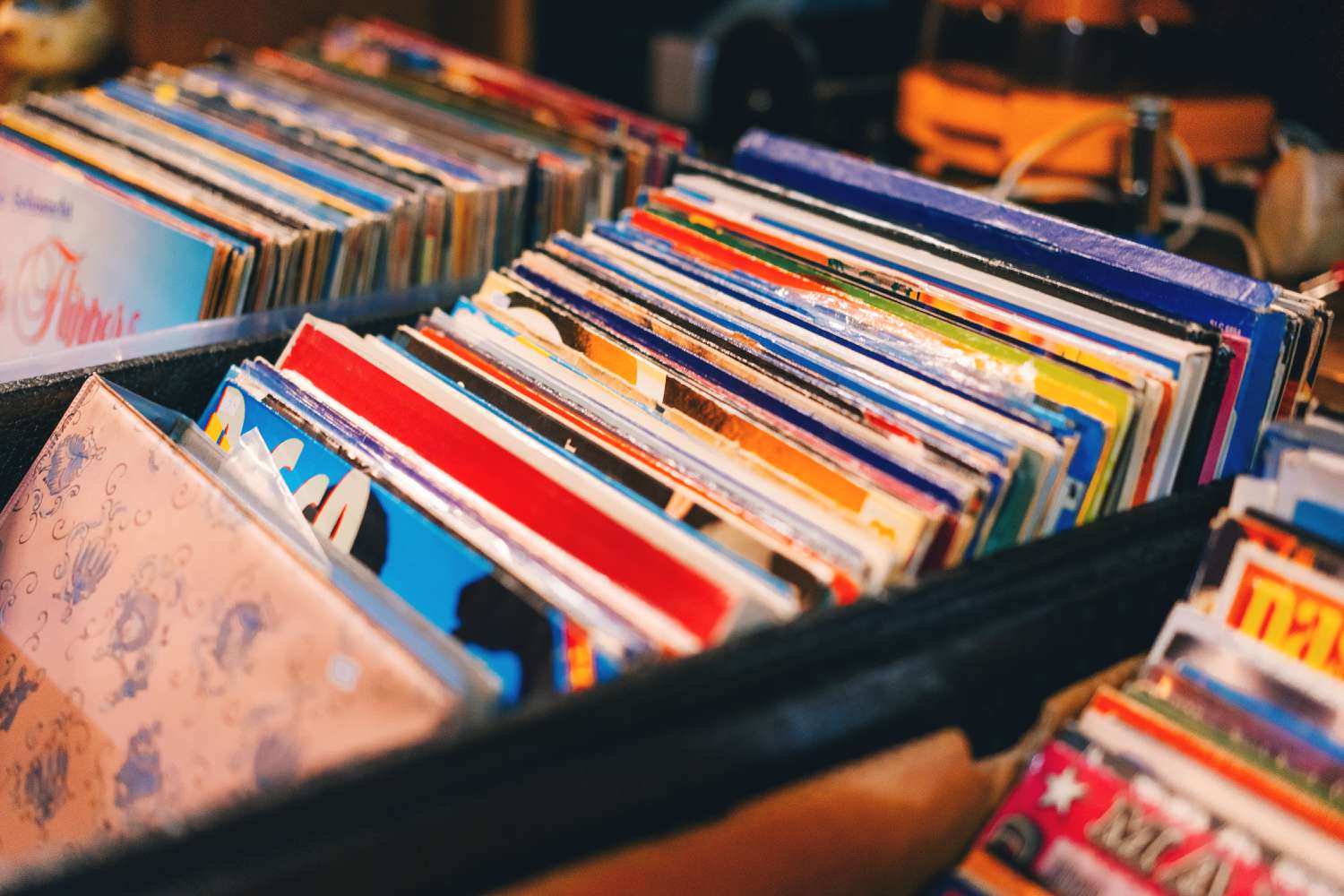
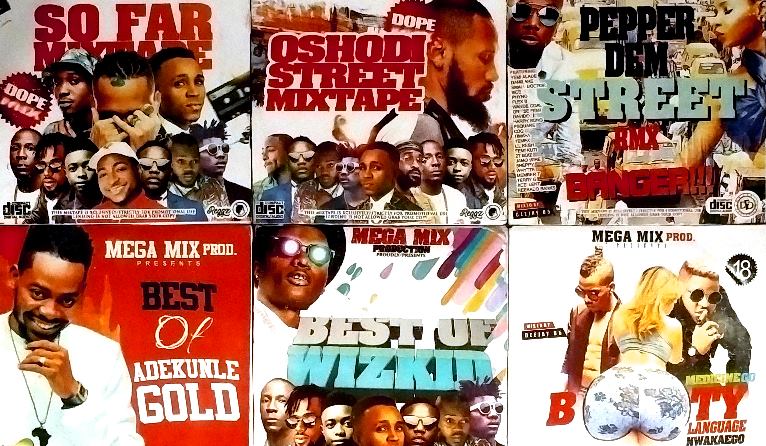
The sales boy—let’s call him Emeka—doesn’t look too pleased. But he’s happy to make the sale. Emeka has worked for his boss for just under a year and is involved in manning the store but not in the promotion of artists. He is, however, quite proud of the establishment, showing me his boss’s logo and phone number at the back of a number of CDs. He tries to show me just how well his boss’s clients fare by pointing out an artist on a large banner hoisted up between rows of single storeyed-shops, and then finding the guy’s name and image on some of the disc jackets. This exercise proves “street promotion”, as his boss later calls it, is both an art and an imprecise science.
The art: New acts looking to break into the pop music market pay to have their songs in compilations featuring hit songs by famous artists. A compilation disc featuring up to 30 songs with such heavy hitters as Wizkid, Tekno, Burna Boy will also host a song or two by unknown acts. If the mixtape becomes popular, then the artist might also “blow”—become famous, that is. The science: the promoter makes several compilations, each having the unknown artist’s song sandwiched between recognisable names. It’s a game of numbers. The more copies and compilations are produced the higher the probability of success. The imprecision: Emeka produces a couple of products with the client’s image. On one of them, the artist’s song is absent from the track list. He quickly finds another one with both the client’s image and song. At the time I had never heard of the artist. Weeks later, a song from the artist became notorious online for featuring a politician in its video.
Established in the 1970s, Alaba Market is the largest electronics market in West Africa, but by the 1990s it had acquired a widespread reputation as the den of piracy in Nigeria. The market’s ability to distribute and offer merchandise cheaply caused major problems for the creative industry—notably the film and music industries. To make money from their own products, Nollywood film producers seek profits early, taking what it is possible before pirates swoop in. At the 2014 Nigerian Entertainment Conference, the economist Pat Utomi put the loss of revenue due to piracy at $2 000 000 000.
One of its influences on the music scene was the reduction of the price of CDs, after a series of interventions and raids failed to curb the problem. Perhaps to fit with the lower prices, the album as product became a mere paper packet hosting a compact disc. Plastic jackets disappeared; genuine albums and counterfeit ones became essentially the same thing. D’Banj once claimed he had never been pirated because the products are interchangeable.
To further complicate the problem, before digital downloads became widespread in the country, some major contemporary acts recorded albums, took it to marketers in Alaba, were said to receive various sums—some say Burna Boy got 10 million naira for his LIFE album; P-Square 60 million naira for Game Over; MI Abaga 20 million naira for MI2—and then left the logistics of distribution and sales to marketers.
But over the past few years, Alaba has pushed back, insisting on its importance to the music industry. “They come and ask us to sell their music,” a marketer said on a TV interview last year. “Alaba mixtape allows a musician’s music to be everywhere. You can buy [an] Alaba mixtape in Aba.”
At his office, Emeka’s boss, a beefy affable man, agrees. “If you want to blow,” he tells me, “you need street promotion. Everybody will hear your music.”
How long will it take?
“If you want to blow in two weeks na money,” he says.
The association of Alaba promoters—a group, Emeka's boss says, is registered with the Corporate Affairs Commission—has an active membership of about 40 persons. Each will receive 50 000 naira ($140) from the aspiring artist and his team. “But that’s big money,” he says, sizing me up and, I suppose, finding me wanting. Every member then makes compilation discs featuring songs from pop music’s A-list and songs from the unknown act.
“Any type of song will blow. People say they don’t like a song once, but when they hear it again and again they will like it.” His confidence appears founded: there are a few award trophies on his table.
He offers one of the plans mentioned by the skinny man earlier, one that would fit my presumed budget: pay 50 000 naira for a month’s worth of work, during which 15 different mixtapes will be made, with each mixtape reproduced several hundred times. Alternatively, he’d receive 10 000 naira ($30) for inclusion on a single mixtape.
The service is worth the charge, he says. A popular song opens an artist to invitations to perform at concerts and to brand endorsements—both of which have become a major means of revenue for Nigerian musicians as corporations seek affiliations with pop music. But as Efe Omorogbe, who has managed 2Baba, one of Nigeria’s biggest artists for over a decade, tells me later, “Only about five percent of artists get endorsements. What happens to the others?”
If Omoregbe is understandably unhappy, Obi Asika, an industry expert and former record label head, is resigned. “Those mixtape compilations are an evolution of a hip hop model,” he says. “They are all about discovery and allow established artists and unknowns to be in the same space. Everybody is seeking to be heard and music is mostly more about experience in this market. Owners receive almost no revenue but because they are popular almost all artists use it.”
Edward Israel-Ayide, a senior manager at the popular record label Chocolate City isn’t quite as detached on the subject. “Alaba is hurting everybody,” he says. “The long term effects of piracy outweigh the revenue. If the only way people could get music was through Boom Player, MTN Music Plus, Spinlet or any of the other streaming platforms, the revenue would be larger.”
Israel-Ayide is aware that artists take their music—“one or two singles” from an underperforming album—to Alaba, but he believes it is “a lazy approach that has become the norm. How did the guys in the west do it? How do artists like Timi Dakolo and Bez still get called to shows? They are not even singing pop music. You have to build relationships.” His view is echoed by Omorogbe, who tells me that “Nigeria is a place where you are expected to thank someone for stealing from you.”
At Alaba when I ask Emeka’s boss if the mixtape model isn’t illegal since many acts with songs on the discs have not given him permission for use, he says the true pirates are bloggers: “They download an entire album from iTunes and put on their websites a day after.”
His fingers are pointed elsewhere, but there are probably artists who agree with him. Last year, highlife act Adekunle Gold tweeted that he was considering legal action against some blogs who put up his debut album Gold online for free downloading. When news of his plan was reported by music blogs, some commenters accused him of ingratitude. These actions were intended to make him famous, they said.
Israel-Ayide had a similar encounter. He contacted a blog with South African connections that had posted music from a Nigerian artist for free online, and was told, “I am a fan and I only wanted him to be popular in South Africa.” He believes Alaba has contributed to making a bad situation worse. “A big producer in Nollywood, an enlightened man,” he says, “took songs and used it in a film that is making millions. Instead of licensing the music, he said he was doing the artist a favour. Everybody now thinks that’s how it works.”
To the general manager of the Copyright Society of Nigeria (COSON), Chinedu Chukwuji, “Crime is crime. It takes sweat and blood to put out a hit song, to put out any song. A lot of money goes into recording, and a CD with 20, 30 songs is 50 naira or 100 naira at Alaba. The person promoting does not incur any costs. So when you buy a compilation, you are paying for the plastic. The more music you put on it, the more you devalue the CD. Everybody loses. The artist is unable to pay his taxes, the government doesn’t receive revenue and investors won’t come in.”
COSON has had several meetings with the government on the issue. Recently the organisation talked with the Inspector General of Police about enforcement of the laws. But it has been mired in its own troubles over the years. The organisation and its head, Tony Okoroji, have been involved in several lawsuits, which haven’t done much for the body’s image. Speaking about piracy, Michael Odiong of Premier Music, one of the oldest record labels in Nigeria, says the problem is division among the copyright bodies. “COSON, MCSN [Musical Copyright Society of Nigeria]—everybody seems to be doing their own business,” he said. “As long as you do not have a structure and united body to fight piracy, government will not do anything about it.”
For its part, COSON has tried to get stakeholders to come together so demands can be made of the government. Some of what they want is stricter laws, stronger enforcement of the laws and an activation of a clause in the Copyright Act that requires importers or manufacturers of digital storage devices to pay a small levy which goes to the industry.
Intellectual property is important, Chukwuji says, pointing out that some of world’s richest men—Jeff Bezos, Mark Zuckerberg, Bill Gates—deal in some way with intellectual power. “If our crude oil was been filtered away to various places, to other countries, what do you think the government would do?” he asks, then answers: “The Federal Government of Nigeria will go to war.”
The question then is: How do artists seeking an audience go about it? Times have changed, says Chukwuji, as artists can find an audience by using the internet. When I bring up payola, he acknowledges its existence on Nigerian radio, but insists that “if your work is good, you will get airplay.”
As the workday winds down at the Alaba International Market, Emeka’s boss insists street promotion is cheaper than the traditional radio route to pop music success, especially for independent artists: the new act with meagre means doesn’t have to pay the many gatekeepers on the many radio stations in Lagos. For rich artists, it is even better: the compilation discs multiply for maximum effect. He name-drops a few famous acts, telling me about Davido, son of a billionaire, who at the start of his career “spread money everywhere”.
He then hands me his card, locks his office and we both watch traders below heading out on bikes, buses, tricycles. After some time, he turns to smile at me. “If you have any more questions," he says, "call me".
Update: Since the interviews conducted for this piece, COSON has undergone some changes.





Disclaimer: Music In Africa provides a platform for musicians and contributors to embed music and videos solely for promotional purposes. If any track or video embedded on this platform violates any copyrights please inform us immediately and we will take it down. Please read our Terms of Use for more.

Subscribe to our monthly Newsletter
Follow us on social media


Please log in to post a comment.