
















































This article provides an overview of folk music in Northern Nigeria, providing a historical perspective before looking at the contemporary role and status of folk music in the region.
Folk music before Islam
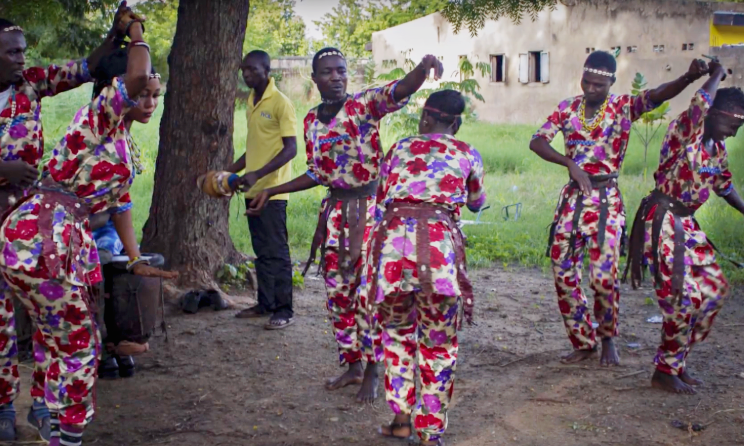
Music has always played a part in the social lives of the Fulani and Hausa people of Northern Nigeria, long before traders from the East introduced Islam to the region in the 14th century. This was especially true during the cold and windy Harmattan months (December to January), when cultural and traditional activities were held to celebrate the end of the year and the beginning of the new one. During this period, entertainment was usually performed by girls at marketplaces, with dances and folk songs passed down orally from one generation to the next. The folk music performed took its character from the culture, myths and legends of the various communities in the region[1].
Before Islam, Bori was a prominent traditional religion of the Hausa people. It involved animism, magic and spiritual possession. The Bori priestess, known as Inna (Mother), would lead adherents to channel powerful forces through spiritual dance, rituals and music. The belief was that, if controlled, these spirits or forces could be used for healing and protection, and for bringing good luck to individuals or society at large. This music was usually showcased during Bori festivals like the Girka initiation ritual. On occasions such as this, a dance would be scheduled for about two hours before sundown, and the sounds of goye (fiddles) and molo (tunable harps), complemented by the beats of koko (calabashes), would fill the air. The priestess would then step forward to dance, leaping and falling back to Earth, symbolically communing with spirits through the dances and folk music of the Bori tradition[2].
Impact of Islam on folk music
In his book Music in Nigerian Society, RC Okafor observes that folk music in Nigeria has never been static but has consistently undergone a process of metamorphosis through continued exposure to diverse musical styles from foreign cultures[3].
The introduction of Islam into the region from the 14th century brought with it new influences on the folk music of Northern Nigeria. One prominent cultural activity, which continues to this day, is the tashe, a form of religiously approved drama performed after the first 10 days of the fasting month of Ramadan. Children and teenagers participate in the tashe, which includes folk dancing, traditional songs and comedic plays acted out to entertain people. The young players go from house to house performing routines such as 'Kayi Rawa Malam', where a child, dressed as a religious scholar, is tempted by the beating of the kalangu (a traditional drum), but is initially reluctant to dance due to a sense propriety. He keeps denying that he is dancing, even as his body begins to rock and sway to the beat of the drum, before eventually giving up and dancing freely[4].
The establishment of the Sokoto Caliphate in Northern Nigeria at the turn of the 19th century refined Islamic practices and challenged traditions such as those of the Bori. This led to the censure and suppression of this form of folk music. The survival of Bori traditions over the years of Islamic rule in Northern Nigeria has been through their reinterpretation, in new and subtle forms, by adherents who now mostly identify as Muslim[5].
Folk music in modern-day Northern Nigeria
Folk music attracts little popular interest from young people in contemporary Northern Nigeria. It is generally confined to rural areas where it is still practised by older generations, usually to accompany daily agricultural activities.
Despite the lack of interest in folk music on the part of young people, numerous traditional folk musicians and groups still exist in Northern Nigeria. These include BBC Lon Bworok (in Jos South, Plateau State) and Bakah Club 100 (in Makurdi, Benue State). According to David Teveh, bandleader of Bakah Club 100, the group is primarily influenced by the traditional dances and music of the Tiv people[6].
Another folk music tradition alive and well in present-day Northern Nigeria is that of the Hausa beggar minstrels. These individuals were defined by the authorities of the past as “all persons who shout the praises of any person, whether or not they play musical instruments and sing.” Beggar minstrels usually move in groups of three adults and one or two children, who serve as danjagora (guides) in a chain formation, forming a troupe. They do not use any form of musical accompaniment, thus differentiating them from the maroka (praise singers), who will often use one instrument or another. Each troupe is made up of a voice master, who is the lead narrator, and a choir of two backing singers. Their repertoire consists of quoting verses from the Quran to merchants in shops and market stalls in exchange for donations[7].
Koroso: A fusion of folk and contemporary music
The seeds of koroso music were planted in Kano in 1972. According to the records kept by the state’s History and Culture Bureau, some Fulani pastoralists visiting the city taught locals new dance steps accompanied by the traditional Fulani flute (an instrument known as the sarewa). The style caught on quickly, and those simple flute melodies were developed and enriched with the addition of other Hausa musical instruments[8].
The idea of mixing the sarewa with select movements from various traditional dances of the Fulani and Hausa people to form a single dance fusion was conceived by Malam Umaru Kiru, an employee of Kano Community Commercial College, in collaboration with Malam Musa Lambu, a dancer. The name of the dance group (and later the dance itself), Koroso, was derived from the sound of the rattle tied around the dancers’ legs, and the group gained recognition when it represented the state at the 1972 National Festival of Arts and Culture in Kaduna, before going on to feature at the Second World Black and African Festival of Arts and Culture (FESTAC '77) in Lagos[9].
Koroso dancers usually perform in pairs, sometimes assisting each other in their acrobatic stunts. In 1987, a new choreography called marwalle, which drew on a traditional festive dance performed by young people during harvest season, was introduced by the Koroso troupe’s entry into Nigeria’s National Festival of Arts and Culture. Today, numerous small dance groups have created their own unique versions of koroso by blending in dance steps from musicians like MC Hammer and Michael Jackson, or the Congolese makossa star Awilo Longomba[10].
Folk music is deeply rooted in the culture of Northern Nigeria, and this has been true since pre-Islamic times, when it served as the basis of religious rituals and other community traditions. Today, despite diminished popular interest, it remains a rich aspect of the customs of the region. The folk music of the area continues to metamorphose as the society also changes, and continues to be a source of pleasure, recreation and entertainment for the people of Northern Nigeria.
References and citations
- [1] Okafor, RC. Music in Nigerian Society. Enugu: New Generation Books, 2005
- [2] O’Brien, SM. Spirit Possession and Muslim Practice in Northern Nigeria. Bloomington: Indiana University Press, 2013
- [3] Okafor, RC. Music in Nigerian Society. Enugu: New Generation Books, 2005
- [4] Falola, T. Culture and Customs of Nigeria. Westport: Greenwood Publishing Group, 2001
- [5] O’Brien, SM. Spirit Possession and Muslim Practice in Northern Nigeria. Bloomington: Indiana University Press, 2013 [6] http://kubanni.abu.edu.ng/jspui/bitstream/123456789/6942/1/FOLK%20MUSIC%20IN%20CONTEMPORARY%20NIGERIA%20CONTINUITY%20AND%20CHANGE.pdf
- [7] https://www.auadamu.com/phocadownload/Conference_Presentations/Media_and_Cultural_Communication_Presentations/2011%20Muslim%20Beggar-Minstrels%20and%20Street%20Oral%20Poetry%20Theater%20in%20Northern%20Nigeria.pdf
- [8] https://www.dailytrust.com.ng/43-years-on-koroso-dance-still-thrilling.html
- [9] ibid.
- [10] ibid.
This article is part of the Music In Africa Connects project, a multifaceted development initiative aiming to support the music sectors of African countries affected by conflict. To find out more about Music In Africa Connects, click here.
Disclaimer: Music In Africa's Overviews provide broad information about the music scenes in African countries. Music In Africa understands that the information in some of these texts could become outdated with time. If you would like to provide updated information or corrections to any of our Overview texts, please contact us at [email protected].
Editing by David Cornwell


Most popular

Top Naija songs of 2026
31 Mar 2026

Top amapiano songs of 2026
16 Feb 2026

Top Afrobeats songs of 2026
19 Mar 2026

Call for applications: ACCES 2026 Emerging Artist Spotlight Competition
01 Oct 2026
AFRIMA 2026: All the winners
12 Jan 2026
CAPASSO backs global principles for fair generative AI music licensing
06 Oct 2026
Disclaimer: Music In Africa provides a platform for musicians and contributors to embed music and videos solely for promotional purposes. If any track or video embedded on this platform violates any copyrights please inform us immediately and we will take it down. Please read our Terms of Use for more.

Subscribe to our monthly Newsletter
Follow us on social media


Please log in to post a comment.