











































NEFCISA
NEFCISA

The Music In Africa Foundation (MIAF) is proud of its partnership with the Industrial Development Corporation (IDC) as a Strategic Implementing Partner (SIP) for its Social Employment Fund (SEF). Through this collaboration, MIAF is running a national programme that is creating jobs, addressing skills gaps, and strengthening South Africa's creative industries — in line with the SEF's overarching goal to generate work for the common good and build community value through employment, social contribution, and inclusive economic participation. Operating under the banner NEFCISA (National Employment Facility for Creative Industries in South Africa), the initiative is recruiting and training participants, matching them with host organisations, and has already placed 1 500 workers across the country — surpassing its original target of 1 000. NEFCISA is delivered through a network of 20 host organisations spanning five provinces, who are actively hosting participants and contributing to work for the common good across South Africa's creative and cultural industries. Key Objectives: Support employment and entrepreneurship in the creative industries. Offer skills development and training programmes. Foster partnerships between public and private creative sectors. Promote South African creativity at both provincial and national levels Foster community development through social contribution.

ACCES
ACCES

ACCES Conference and Showcase Festival is Africa's leading music industry gathering, bringing together the people shaping the future of the continent's music business. Artists, entrepreneurs, executives, investors, policymakers and cultural leaders from across Africa and around the world come to ACCES to build partnerships, exchange ideas, discover talent and create new business opportunities. Since its launch in 2017, ACCES has become the continent's premier platform for professional exchange and music market development. Combining a high-level conference with a curated showcase festival, networking, exhibitions and industry programmes, ACCES offers a unique space where creativity meets business and where African music connects with the global industry.

Gender@Work
Gender@Work

Music In Africa Gender @ Work is a three-year training programme aimed at upskilling and increasing the participation of female professionals in the African music sector. Launched by the Music In Africa Foundation (MIAF) in April 2019, the programme is connected to the MIAF’s ACCES music conference – a pan-African event held in a different African country every year. This connection enables the programme to reach new participants in a different African country every year. The programme marks the beginning of a more concerted effort by the Foundation to support the participation and inclusion of women in all facets of its programmes and the music sector in Africa as a whole. Over the three years, the programme will aim to address gender imbalances in the sector through training, lobbying, facilitating knowledge exchange and dialogues that foster the interest of women. The broader objectives of the programme are to: Provide industry training for women on critical music industry skills, focusing on: Stage management Electronic music production and recording Music business management Technical knowledge Provide an opportunity for both professional and aspiring women to benefit from the Music In Africa network and its broad range of activities in 2019, 2020 and 2021. Provide a solution-based platform in the form of a round table at ACCES with a view to identify challenges, discuss opportunities and lobby for the interests of female practitioners. Offer participants the opportunity to benefit from programmes offered by MIAF’s partners. Increase access to educational materials. Integrate participants in the broader ACCES programme to maximise experience and exposure to the industry. Record and present training materials on the www.musicinafrica.net, including but not limited to tutorials, templates and other best-practice materials. Communicate women-based themes that support the initiatives and messages of the programme. MAIN TRAINING ACTIVITIES Training in first country (Ghana): In the first year, participants will be trained on all aspects of stage management by a team of experienced stage managers from 10 to 17 November 2019. The programme will offer robust classroom training as well as practical, hands-on training in which participants will also be given the opportunity to manage various aspects of the ACCES performance programme. Training in second country: The second training iteration will take place at ACCES 2020 when the programme will diversify its course to include music production lessons and training on other music business topics. A round-table platform will also be introduced to coincide with the ACCES programme. Training in third country: The third training iteration will take place at ACCES 2021 in a different country, offering an advanced course. HOW DO YOU GET INVOLVED?  As a participant, facilitator or trainer: The programme enrolls up to 12 trainees every year. All opportunities are advertised publicly on this website, and will be added to this page. Please keep checking this page for new calls (below under UPDATES & CURRENT OPPORTUNITIES). As a partner Please contact Claire Metais at [email protected]. APPLY The call for applications for 2020 will be announced soon. The Music In Africa Gender @ Work programme is made possible with the support of the Prince Claus Fund, Siemens Stiftung and Goethe-Institut.

Sound Connects Fund
Sound Connects Fund

For cultural and creative practitioners and organisations operating in southern Africa, access to funding remains a major challenge. The COVID-19 pandemic has also had a massive impact on government policy, spending and the economy in general, and has seen spending on culture being moved further down the list of priorities. Further, the cultural and creative industries repeatedly cite four main areas where investment is needed for growth, which are increased visibility, mobility including access to new markets, finance and support structures.

Instrument Building And Repair Project

Experience the Vibrations African Instruments Exhibition online in 3D

Features

Dumama + Kechou: The duo that went on a rare musical excavation

11 Jun 2020 - 18:41

cc-img flag-img

South Africa's folkloric spiritual jazz duo Dumama + Kechou (born Gugulethu Duma and Kerim Melik Becker) produces music that is almost meant for another era, yet it's rooted in the present with a narrative that carries the weight of oppressive history.
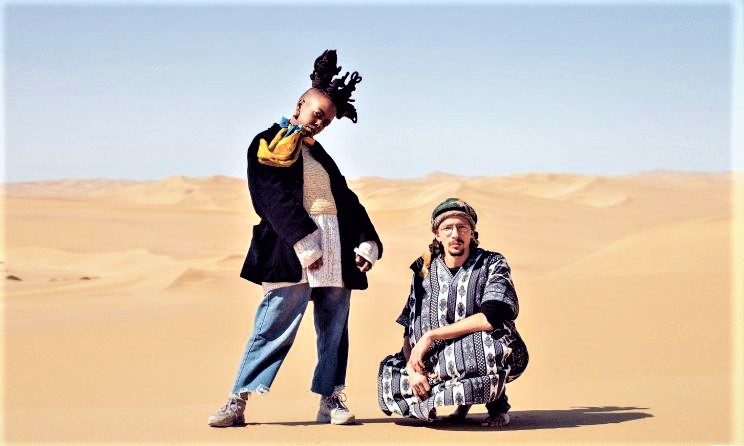
Future folk duo Dumama + Kechou.

They exude a vibrant force and strong harmony within a deep cultural resonance. Their perceptions were shaped on opposite sides of the globe: vocalist Dumama has roots in rural Eastern Cape in South Africa, while multi-instrumentalist Kechou is of Algerian-German descent, but born and raised in Germany. His non-alignment with the monolithic cultural context of the West has always pushed him to search deeply for some sense of belonging.

The duo met through a mutual friend and musician who believed Dumama and Kechou’s individual paths could come together "to break down the predisposed barricades of prejudice and alienation created by imperial, colonial and patriarchal thought and action,” Kechou says.

After pursuing his studies in African music with a particular interest to North African instrumentation, he found himself critiquing the repressive dynamics that surround the framing of African music. On the other hand, Dumama draws heavy influence from celebrated uhadi player and instrument builder Madosini Latozi Mpahleni, who is well known for her stage genius and improvisational ability. It's Madosini’s teachings, which include ukombela, a traditional practice of creating impromptu chants, that have shaped Dumama's craft.

The duo's musical journey has been about gravitating towards their own centres and back out into the world through a complex sonic labyrinth filled with artistic flow, interaction and engagement. Drawing inspiration from various urban realities, sounds and perspectives, the duo has now settled on calling their primary sound 'future folk'. But there is tension here.

"The alienation goes both ways though," Kechou says. "As much as we have a hard time grounding and existing in the urban West we also feel a strong sense of non-belonging within more rural and culturally integral parts of our communities. This gap within your own existence as a mirror of the sociocultural gap between communities all around the globe pushes us to become mediators and bridges.”

Dumama and Kechou's inimitable compositions rely on an organic process of creation infused with revolutionary zest, improvisation, and the vocals and chants of Dumama in her native Xhosa language. The music is not lyrically pervaded by design, yet Kechou – who has spent the past five years producing Afro-fusion music experiments in Germany, Uganda, Zimbabwe and South Africa – seamlessly delivers multi-layered instrumentation. With electronic loops, samples and warping traditional sounds, he leads the curious ear into deep contemplation.

The audience, too, is crucial in informing how the duo delivers its art. “Each show is a surprise and an opportunity to connect deeper with the instruments,” Dumama said in a previous interview.

Under the auspices of Mushroom Hour Half Hour, a South African alternative-focused imprint founded in Johannesburg, the duo released in March their debut album Buffering Juju, an eight-track sound journey that was primarily recorded during a two-week residency that Dumama and Kechou attended. On their latest single, ‘Leaving Prison’, a woman leaving a prison, immersed in the disturbing social landscape, captures the angst of the modern world and repels the fecklessness that colonialism built. The project puts pain into perspective: “There is clearly an imbalance that needs our attention,” Dumama says. “Leaving prison can support us as we transcend the limitations of what we’ve been taught.”

She also shares some thoughts on an earlier single off the album, titled ‘Mother Time’: “It was a result of ongoing improvisations at my performances with Kechou. Every performance, something new and memorable would emerge. It started out as a sort of interlude, where I was always channelling an elder storyteller woman who was somewhat eerie and deeply intense, going into this 'nothingness far worse than nothing'.”

There’s also a unity of purpose that, on selected tracks, brings together the talents of trombonist Siya Makuzeni, pianist Nobuhle Ashanti, vocalist Odwa Bongo and vibraphonist Dylan Greene. The album also features contributions from clarinet player Angel Bat Bawid and bassist Shane Cooper as well as synthesisers by Dion Monti.

With all of this, the group has duly attracted the attention of respected figures like renowned British DJ and tastemaker Gilles Peterson. When asked what the future of experimental music in South Africa holds, the duo says: “The future will show, provide and hold. We stay open. We’ll keep making contemplative music that attempts to process the mess and celebrate the changes.”

Please log in to post a comment.

Most popular

Disclaimer: Music In Africa provides a platform for musicians and contributors to embed music and videos solely for promotional purposes. If any track or video embedded on this platform violates any copyrights please inform us immediately and we will take it down. Please read our Terms of Use for more.

newsletter banner

Subscribe to our monthly Newsletter

Follow us on social media