






















































Ethiopian saxophonist Getachew Mekuria passes on at 81
07 Apr 2016 - 11:15


Influential Ethiopian jazz saxophonist Getachew Mekuria died on Monday 4 April, aged 81.
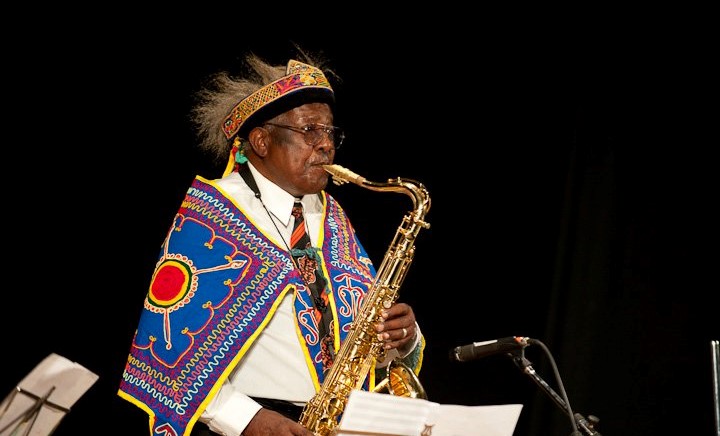
Getachew, whose career spanned 68 years, was a key figure in the history of modern Ethiopian music, playing important roles in synthesising cosmopolitan and Ethiopian sounds that led to what has been called the “golden age” of Ethiopian popular music.
Born in March 1935 in Yifat and Timuga region of the former Shoa province on a large farm with his eleven siblings, Getachew received a basic education at home. At the age of 13, he moved to Addis Ababa to attend primary school. In 1948 he was employed at the Municipality Theatre, where he was under the tutelage of the Armenian National Nerses Nalbandian who was assigned by the Imperial government for the purpose of training professionals. Having completed his training, Getachew became the lead saxophonist of the Municipality Theatre, a role he held for eight years. As such he was pioneer in playing the just introduced instrument.
When the Haile Selassie I Theatre (which became the National Theatre under the military government) was constructed in 1955, Getachew was one of the young musicians who were transferred to the music department of the theatre, along with Merawi Sitot and Wodageneh Filfilu. Under the guidance of the Austrian citizen France Zelwecher, Getachew became deeply involved in the music scene, performing a mixture of originals, contemporary material, and pop covers. In the 1960s he joined the Police Orchestra, where he served for 32 years as lead saxophonist, teacher and band leader. Getachew later recalled this period with Police Orchestra as "productive and dynamic".
During the Ethio-Somali war of the 1980s, Getachew was instrumental in reviving the spirits of the Ethiopian army with his shellela saxophone, something he was proud of and considered one the highlights of his career. Frenchman Francis Falceto in his influential book Abyssinia Swing defined shellela saxophone as a style “fashioned after the warlike and barking taunts that soldiers of yesteryear would hurl at the enemy to encourage their own troops.”
Getachew’s mastery of saxophone and clarinet won him accolades from fans and critics. His 2003 album Negus of Ethiopian Sax was one of the most famous recordings of the influential Ethiopiques series, produced by Falceto.
Getachew performed regularly in his twilight years, his recording and performing career undergoing a renaissance with his international tours with Dutch punk band The Ex since 2004. One of the most well-travelled artists in the country, Getachew went around the globe with The Ex, playing more than 100 concerts. They recorded two albums together, Moa Anbessa (2006) and Y'Anbessa Tezeta (2012). Between touring with The Ex as well as musicians such as Hirut Bekele, Getachew played on innumerable recording sessions of all kinds and spent afternoons giving music courses. His technique and flair came to be widely known and he was a central figure in the Addis music scene.
Tributes pour in for an 'inspiring mentor' and 'important professional'
At his funeral service on Tuesday 5 April in Addis Ababa's Petros we Pawlos churchyard, it was no surprise that the Police Orchestra came foremost in paying tribute to the musician. The Police Orchestra blasted a brief fanfare in between church liturgy. Commander Likemequas Ayele, head of the Police Orchestra and Theatre, later told this writer that Getachew "lived and breathed music and was never far from a saxophone, even at the end... He was a great musician. I was one of the few lucky enough to work with him and know him as a teacher - the most inspiring mentor of my life,” he said.
Paying tribute to the saxophonist, Mulatu Astatke noted that Getachew was someone he respected deeply. Mulatu and Getachew last shared a stage about three years ago in the UK, where Getachew performed with The Ex. Speaking at the sidelines of Getachew’s funeral, Mulatu said: “Ethiopia has lost an important music professional. I’ve had a chance to work with him when I came back from the US completing my studies in the 1970s. I did a new arrangement for him which he performed at the National Theatre. It was a tremendous success.”
Members of The Ex recalled Getachew's decision to join the band. “It was his choice after hearing us at one of our festivals. He recognized something in our music which reminded him of the early groups he was in, like the Fetan Band (speed band). He loved playing with us and for us, which was an incredible experience. He was always totally himself - full-on, intense and dedicated,” they wrote on the band's Facebook page.
Kaethe Hostetter, a fan of the saxophonist and a founder of the Debo Band currently based in Addis Ababa, said it was Getachew’s music that resulted in her relocating to Ethiopia. “Actually, his music is what brought me to Ethiopia. Now I live here. That was nine years ago. The first time I heard his music, I was moved by his shellela. I think that grabbed me so much. It had such a big effect on my life - it completely changed my life,” she said. Though Kaethe didn’t know Getachew closely, she found him to be gracious and humorous in her few meetings with him.
There were other groups influenced by him. In France, for example, a Parisian band that started off covering music from the Ethiopiques series six years ago named themselves Akalé Wubé after one of Getachew’s songs. Another of his tracks was sampled by Somali-born Canadian hip-hop musician K'naan on the song "I Come Prepared" featuring Damian Marley.
In the last few years, Getachew’s declining health forced him to retire and the death of his wife left a great void in his life. Last year, on October 2015, the Alliance Ethio-Française organized a tribute concert to him with The Ex at the National Theatre. Confined to a couch and unable to move, it was supposed to be to be an easy performance for the venerable artist, but he astounded fans and colleagues with his signature energetic performance. It became his farewell concert. Getachew is survived by his eight children.


Most popular

Top Naija songs of 2026
31 Mar 2026

Top Afrobeats songs of 2026
19 Mar 2026

Ghana: Mr Eazi and MOLIY’s ‘Comfort’ earns Urban Music Awards nomination
21 Oct 2026

Top amapiano songs of 2026
16 Feb 2026
Open call: CANEX Music Business Lab and Songwriting Camp
15 Oct 2026
Nigeria: CANEX WKND unveils 2026 programme
21 Oct 2026
Disclaimer: Music In Africa provides a platform for musicians and contributors to embed music and videos solely for promotional purposes. If any track or video embedded on this platform violates any copyrights please inform us immediately and we will take it down. Please read our Terms of Use for more.

Subscribe to our monthly Newsletter
Follow us on social media


Please log in to post a comment.