
NEFCISA
NEFCISA

The Music In Africa Foundation (MIAF) is proud of its partnership with the Industrial Development Corporation (IDC) as a Strategic Implementing Partner (SIP) for its Social Employment Fund (SEF). Through this collaboration, MIAF is running a national programme that is creating jobs, addressing skills gaps, and strengthening South Africa's creative industries — in line with the SEF's overarching goal to generate work for the common good and build community value through employment, social contribution, and inclusive economic participation. Operating under the banner NEFCISA (National Employment Facility for Creative Industries in South Africa), the initiative is recruiting and training participants, matching them with host organisations, and has already placed 1 500 workers across the country — surpassing its original target of 1 000. NEFCISA is delivered through a network of 20 host organisations spanning five provinces, who are actively hosting participants and contributing to work for the common good across South Africa's creative and cultural industries. Key Objectives: Support employment and entrepreneurship in the creative industries. Offer skills development and training programmes. Foster partnerships between public and private creative sectors. Promote South African creativity at both provincial and national levels Foster community development through social contribution.

ACCES
ACCES

ACCES Conference and Showcase Festival is Africa's leading music industry gathering, bringing together the people shaping the future of the continent's music business. Artists, entrepreneurs, executives, investors, policymakers and cultural leaders from across Africa and around the world come to ACCES to build partnerships, exchange ideas, discover talent and create new business opportunities. Since its launch in 2017, ACCES has become the continent's premier platform for professional exchange and music market development. Combining a high-level conference with a curated showcase festival, networking, exhibitions and industry programmes, ACCES offers a unique space where creativity meets business and where African music connects with the global industry.

Gender@Work
Gender@Work

Music In Africa Gender @ Work is a three-year training programme aimed at upskilling and increasing the participation of female professionals in the African music sector. Launched by the Music In Africa Foundation (MIAF) in April 2019, the programme is connected to the MIAF’s ACCES music conference – a pan-African event held in a different African country every year. This connection enables the programme to reach new participants in a different African country every year. The programme marks the beginning of a more concerted effort by the Foundation to support the participation and inclusion of women in all facets of its programmes and the music sector in Africa as a whole. Over the three years, the programme will aim to address gender imbalances in the sector through training, lobbying, facilitating knowledge exchange and dialogues that foster the interest of women. The broader objectives of the programme are to: Provide industry training for women on critical music industry skills, focusing on: Stage management Electronic music production and recording Music business management Technical knowledge Provide an opportunity for both professional and aspiring women to benefit from the Music In Africa network and its broad range of activities in 2019, 2020 and 2021. Provide a solution-based platform in the form of a round table at ACCES with a view to identify challenges, discuss opportunities and lobby for the interests of female practitioners. Offer participants the opportunity to benefit from programmes offered by MIAF’s partners. Increase access to educational materials. Integrate participants in the broader ACCES programme to maximise experience and exposure to the industry. Record and present training materials on the www.musicinafrica.net, including but not limited to tutorials, templates and other best-practice materials. Communicate women-based themes that support the initiatives and messages of the programme. MAIN TRAINING ACTIVITIES Training in first country (Ghana): In the first year, participants will be trained on all aspects of stage management by a team of experienced stage managers from 10 to 17 November 2019. The programme will offer robust classroom training as well as practical, hands-on training in which participants will also be given the opportunity to manage various aspects of the ACCES performance programme. Training in second country: The second training iteration will take place at ACCES 2020 when the programme will diversify its course to include music production lessons and training on other music business topics. A round-table platform will also be introduced to coincide with the ACCES programme. Training in third country: The third training iteration will take place at ACCES 2021 in a different country, offering an advanced course. HOW DO YOU GET INVOLVED?  As a participant, facilitator or trainer: The programme enrolls up to 12 trainees every year. All opportunities are advertised publicly on this website, and will be added to this page. Please keep checking this page for new calls (below under UPDATES & CURRENT OPPORTUNITIES). As a partner Please contact Claire Metais at [email protected]. APPLY The call for applications for 2020 will be announced soon. The Music In Africa Gender @ Work programme is made possible with the support of the Prince Claus Fund, Siemens Stiftung and Goethe-Institut.

Sound Connects Fund
Sound Connects Fund

For cultural and creative practitioners and organisations operating in southern Africa, access to funding remains a major challenge. The COVID-19 pandemic has also had a massive impact on government policy, spending and the economy in general, and has seen spending on culture being moved further down the list of priorities. Further, the cultural and creative industries repeatedly cite four main areas where investment is needed for growth, which are increased visibility, mobility including access to new markets, finance and support structures.

Instrument Building And Repair Project

Experience the Vibrations African Instruments Exhibition online in 3D

Features

Fela was not a prophet

20 Sep 2017 - 12:16

cc-img flag-img

Fela once sang of a friend, a low-level civil servant, who, because he was tired of sweating at night, decided to buy a fan.
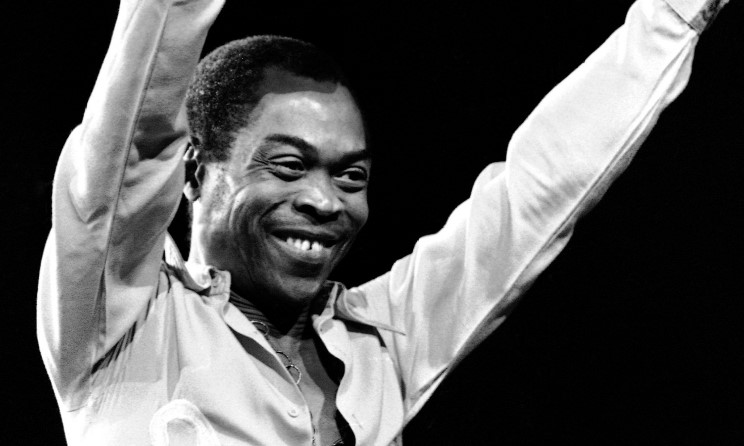
"To listen to Fela is to confront, again and again, the continual cycles of affirmation of Africa’s postcolonial condition."

It’s tough deciding what to call Fela’s friend—Sisyphus or Tantalus. In Greek mythology, both were condemned to Hades, the former to forever roll a boulder up a hill, the latter to never taste the water standing at his waist or the fruits hanging low from a tree over his head, just out of reach.

Perhaps Fela’s friend was both tragic figures in one. The fan, we learn, is 75 naira, which if it can’t buy a Nigerian decent bread now, was low-hanging fruit, but out of reach for a low-level civil servant in the late 1980s. “Every time he nearly buy the fan/Government go add ten naira” till it became 200 naira. Still, Sisypho-Tantalus couldn’t be deterred: “die die no dey for hin dictionary.” Up the hill he continued to roll his boulder, till, following government interventions, the fan became 750 naira. First tragedy, then farce. “Na laugh laugh catch monkey.”

As it was in the 1980s so has it been recently. How Nigeria came to be mired in its present circumstances is sufficiently ploughed ground, washed in all partisan colours of the country's political spectrum. The common denominator, as always, has been monumental malfeasance facilitated by government. All that seemed within grasp suddenly lurched further out of reach. The boulder rolled back to the bottom of the hill.

To listen to Fela, African China, and Oritse Femi, to read realist African fiction from Ayi Kwei Armah down to Chimamanda Ngozi Adichie, is to confront, again and again, the continual cycles of affirmation of Africa’s postcolonial condition. Nothing has changed, certainly nothing that isn’t cosmetic. These cyclical affirmations of disillusionment have no doubt informed the vastly exaggerated prophetic powers ascribed to Fela, none more than the prophetic theme of 2017’s Felabration.

He was not a prophet. Following his mother’s death, Fela began to dabble in mysticism. Even then, this was more for an otherworldly connection to his mother, the dynamo in the machinery of his creativity, than anything forward-looking. Fela was an astute chronicler, an incisive deconstructor of the Nigerian condition. This public intellectualism was the substance of his being a staple of the university lecture circuit in Nigeria. In song after song after song, Fela was all diagnosis; what seems like prognosis only seems so because it has so far been impossible to escape the centripetal force of the Nigerian tragedy.

Policemen and soldiers still routinely brutalize civilians. In 2009, trouble slept and yanga ushered it into the dastardly phenomenon the world now knows as Boko Haram. Substantial sums of money still waltz out of the public treasury into private pockets. The Nigerian elite still colludes with corporatist overlords from the West to wring Nigeria dry. Nigerian political leaders are still shameless perambulators. Religious leaders still lead lives on the fast lane. The masses still persevere with can only be described as a morbid dynamism. Obasanjo, Fela’s mortal enemy, is still a kingmaker—or at least a kingwrecker.

That said, Fela did tell Punch’s (now known as The Punch) Usman Abudah in 1982 that he was not going to die, despite all the evil visited upon him. “I am going to rule Nigeria but I don’t know when,” he said.

Fela had arguably led Nigeria once. Despite his withdrawal from FESTAC ’77, Black Africa came to pay homage at Kalakuta, where he had set up some sort of counter-festival. But in the decade leading up to his death, Fela’s star had dimmed considerably. Femi Kuti did win a Kora Award in 1999 but the son’s internationality far exceeded his national reputation. Afrobeat once was pop, but has become niche.

A series of events would return Afrobeat to the big time. Fela! debuted off Broadway in 2008 and by 2009 had made it to Broadway. By dint of its cross-cultural reception, Fela! was Hamilton before Hamilton was Hamilton. Is it curious that three of Femi’s four Grammy nominations came in the wake of this renaissance?

In 2014, Wizkid released first Jaiye Jaiye, and later Ojuelegba. Jaiye Jaiye, featuring Femi Kuti, still largely conformed to the shrill sonic program of Fela’s Afrobeat, but Ojuelegba problematized the sound by foregrounding its deep resonant Africanness and relegating its confrontational shrillness from its pride of place. Music being first sound, Wizkid, of course, was not going to heft the heavy mantle of politics that was central to Fela’s Afrobeat. A new wave of Afrobeat (not to be mistaken for whatever Afrobeats is supposed to mean) had been inaugurated. “I want to play music that is meaningful, that stands the test of time,” Fela once said. Yes, but not on your terms old fella.

The 2017 Felabration event takes place from 9 - 15 October

Please log in to post a comment.

Most popular

Disclaimer: Music In Africa provides a platform for musicians and contributors to embed music and videos solely for promotional purposes. If any track or video embedded on this platform violates any copyrights please inform us immediately and we will take it down. Please read our Terms of Use for more.

newsletter banner

Subscribe to our monthly Newsletter

Follow us on social media