































































“I want you to scream and shout more, because the more you shout, the more you convince me, that you all wish Afro-Beat music were a German music.” – Fela Anikulapo-Kuti
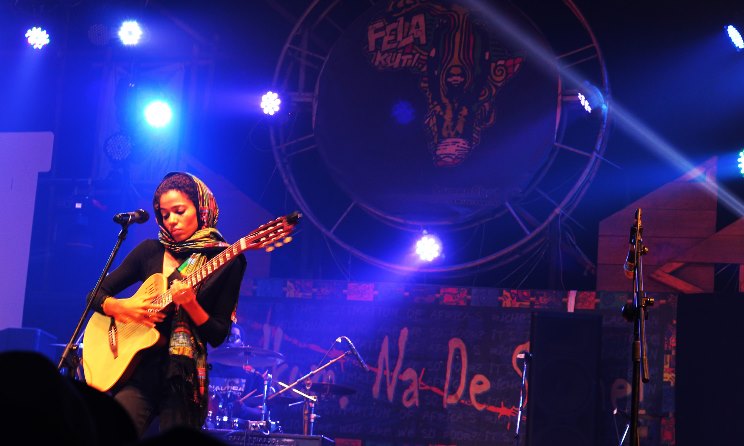
Let’s Start. Felabration is an annual event that has grown to become a week–long festival. The festival, conceived two decades ago as a cultural event to celebrate the lifework of Fela Anikulapo-Kuti, pushes the idea of Fela’s imagined continent. With The Prophecy as its theme this year, Patrice L. O Lumumba, a Kenyan Professor spoke at a symposium titled, ’40 Years after Festac, 20 Years after Fela, Wither the Pan – African Dream?’
Look and Laugh though, given its use as an epigraph for this essay, the quote above is in part Fela’s response to a booing crowd at the Philharmonic Hall, Berlin. For context, regarding the crowd’s reaction to Fela’s musicianship, the new and politically explosive African urban folklore music already attracted hundreds of thousands at his rare concerts in Nigeria and Africa. Hannes Schmidt, a critic, wrote about that controversial Jazz festival:
“One of the highlights of the autumn 1978 festival in Berlin was music from Africa. This return “back to the roots of jazz” is in step with a new movement among Africa’s black musicians. Political motivations and cultural interest are two important reasons why they are focusing their attention on Africa and on traditional African music and folklore, hitherto which are sectors that have virtually remained the domain of music ethnologists.
“But almost wholly neglected in the U.S.A. and Europe has been the contemporary music of African cities, the urban phenomenon of a type of “City Folklore”, which in turn has been influenced partly by Western and Caribbean popular music. In this phenomenon we can observe the process of cultural feed – back a development which is said to have become personified in the last few years in the figure of a musician extremely popular in Africa: Fela Anikulapo – Kuti from Lagos in Nigeria.”
Just Like That Fela’s performance was ‘received by the Berlin audience with boos and calls of “No disco” and “No Travolta”’, according to Ulrich Olshausen, because of the perception that his music was "unfortunately very Western, namely a variation of the most primitive disco with faint African undertones". Rudolph Ganz suggests that “[m]usically, he presented a long drawn-out and rather uninteresting show related to the commercial soul music, which becomes embarrassing when he puts aside his saxophone for the electric organ.”
Excuse – O, but in providing the more valuable feed-back that affords us a firm handle on both the crowd’s reaction and Fela’s own response, the music critic Holger Krusmann’s assertion that “he was booed for being a potentate and was misunderstood as a musician”, seems a most plausible explanation. However, "being the first musician in post-colonial Africa who had the strength to break the bounds of his continent", is it the case that Fela "does not care about the rules of musical composition" as Krusmann says?
Na Poi: In view of the instrumentation of Fela’s ensemble which included in its percussive section a tap-drum set of bass drum with roots reminiscent of certain rhythms of the Oro cult, the charge prompts the consideration that his choice of playing in the pentatonic scale was not only musically but ideologically motivated. This choice, it must be pointed out, allowed him reflect the tonal quality of the African speech pattern. Besides, the structure made it possible for the griot to assume his self-styled role as a Chief Priest.
Confusion Break Bone for the uninitiated newbie at his show in the Philharmonic Hall, Berlin, because “die-hard racists among the spectators who kept calling out for Ginger Bake”’ did not realize that Fela was “the personified search for an answer to colonialism” as Krusmann reminds his Des Tagesspiegel readers. It bears repeating that Fela, founder of Young African Pioneers (YAP), had already become a cult figure in Black Africa by 1978. Regardless, he took time to present himself as a representative of African folklore, saying:
“As a foreigner, I must be happy to be in Berlin because when I am in Berlin, I am here to learn something NEW. I don’t want to jive you here tonight my friends, brothers and sisters. I want to present myself as an African. I want you to look at me as something new, that you don’t have any knowledge about. Because most 99.9% of the information you get about Africa is wrong.”
Who No Know Go Know, yes. That both Fela’s presentation of himself and his subsequent response to the booing crowd was informed by his evolving, if yet to be articulated, Felasophy. That Felabration is a celebration of his musical composition as well as political practice which, even if provocative, remained consonant with an ideological outlook that held that, as Krusmann says, “no matter who you are, if you want to make any impact at all, you have to start from your home.”
Overtake Don Overtake Overtake, no doubt. Mulling over the fact that Felabration is held in same month that Nigeria celebrates her independence we cannot but spare a minute to think about Fela’s conception of his Movement of the People (MOP), the banned political party he founded as an instrument to agitate for, as author Idowu Kayode Mabinuori says, “the beginning of the struggle for our second independence”. It is impossible not to contemplate Fela’s work as less than the sum of his musicianship, political activism and cultural evangelism.
Everybody say yeah yeah, and why not, considering that 40 years after Fela resigned from the FESTAC committee, thus withdrawing his participation at the festival, and 20 years after his demise, Felabration has not only featured at the Notting Hill Carnival it is also listed as one of the top 300 festivals in the world by Fest300. All things considered, for drawing attention to the mixed criticism Fela’s performance drew at the 15th annual Berlin jazz festival, Felabration is a most fitting validation of his response to the booing crowd.
The 2017 edition of Felabration is ongoing
References
- Fela: Why Blackman Carry Shit by Idowu Kayode Mabinuori
- Afrobeat: Fela and the Imagined Continent by Sola Olorunyomi


Most popular

Top Naija songs of 2026
31 Mar 2026

Top Afrobeats songs of 2026
19 Mar 2026

Top amapiano songs of 2026
16 Feb 2026

Ghana: Mr Eazi and MOLIY’s ‘Comfort’ earns Urban Music Awards nomination
21 Oct 2026

Open call: CANEX Music Business Lab and Songwriting Camp
15 Oct 2026

Nigeria: CANEX WKND unveils 2026 programme
21 Oct 2026
Disclaimer: Music In Africa provides a platform for musicians and contributors to embed music and videos solely for promotional purposes. If any track or video embedded on this platform violates any copyrights please inform us immediately and we will take it down. Please read our Terms of Use for more.

Subscribe to our monthly Newsletter
Follow us on social media


Please log in to post a comment.