
























































By Njie Baldeh & Oko Drammeh
This text provides an overview of the live music scene in The Gambia, covering its history until the present day and providing examples of major live music venues, events and promoters in the West African nation.
History
The Gambian live music scene as we know it today has its origins in the 1950s and 60s. At this time there were few bands in the country, the most popular being the Super Eagles and the rivals the Fabulous Eagles. Heavily influenced by British and American sounds, these bands later forged their own brand of African Rock music. In the early days, tennis lawns where the primary venues for live music events and state functions hosted by British Governors and attended by invited civil servants and heads of government. These included the popular United African Company (UAC), which hosted Gerald De Pina and his Heartbeats from Sierra Leone; the Banjul Tennis Lawn, which hosted the Ryco Jazz band of the Congo; and the Tennis Lawn near the Arch 22 in Banjul, which hosted the Bembeya Jazz band of Guinea.
In the late 1960s a new venue was opened by a Ghanaian businessman called the Black Star Club. Run by Anthony Leon, the club was open all day and night and had its own resident band. Many popular Gambian and Senegalese artists played here, including Oussou Njie Senor, Laba Sosseh and Pap Touray of Super Eagles. The Sahara Night Club was owned and operated by Ousman Njie Sahara, a Gambian who in the 1950s had run a club in London. He introduced nightclub fixtures like double turntable for DJs and psychedelic lights. He also helped introduce Jamaican reggae music to the Gambia. Sahara was a modern club in these times and shaped the future of clubbing in the Gambia.
There was a strip in Banjul known as ‘the Talk of the Town’. In this area between Hill Street and Buckle Street in Banjul was the place where both Gambian and Senegalese boys and girls would meet in fashionable clothes and Afro hairstyles, drinking and smoking cigarettes. Club 98, Casurina Night Club, the Apollo Hotel and the Atlantic Hotel were hotel nightclubs that offered live music in Banjul. The Odeon and Ritz cinemas also hosted live music and band competitions. The Mask Club and Kangku Jare were bars in a predominantly Muslim country, places for outcasts as well as a breeding ground for free spirited musicians. Here you can hear music from American rock to the sounds of nearby Cape Verde. Other popular venues in the 1960s to the 90s were the Caribbean Bar, Lousiest Bar, Willies, Soto Koto, were City Pride, Mask Club, Tropical night club, Cave Night Club, Uncle Joe’s, Ngalam Afrique, Take 5 and Reform Club.
Some of the founding fathers of Gambian show business were the legendary Pa John Bright (of the Ritz Cinema), Alhaji Chamsu Coker, Malick Secka, Louis Cherry, Charlie Bruce, Anthony Leon, Pa Sawyer, Antoine Tabbal, Alieu Kah, Malamin Jobarteh (who ran the first sound system), Ousman Niie Sahara, Gibbi Jallow, Pa Lamin Drammeh, the late Samba Ngum and Tapha John.
Today’s live music scene
Today Banjul’s nightlife hub area has moved from the Talk of the Town area to the newly built tourism area called Senegambia, which today is the most consistent area for live music. The area is a part of the Tourism Development Area (TDA) reserved only for tourist, hotels, casinos and nightclubs. The big hotels hire and employ Gambian musicians in resident bands. While these musicians take hotel jobs to earn a salary and make a living, the hotels typically do not encourage these bands to play their own songs but instead tell them what to play. The bands therefore usually perform cover versions of familiar British and American songs for tourists. As a result, the magic of the old days is largely gone. The days when bands were started by school friends and street mates has gone, and the country’s popular touring bands are all now largely confined to the walls of big hotels.
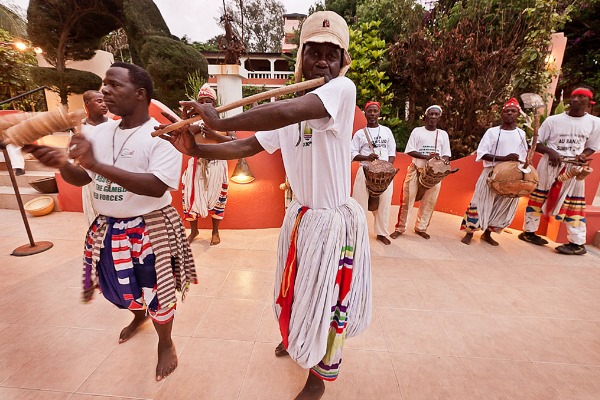
Outside the hotel circuit, Afro-Manding artists draw on local tribal languages and rhythms, using the Mandingo tribe’s 21-string Kora leading the music with tribal Wolof drumming on the Sabar Drums of Senegambia, as well as Bugarabu drumming from the Jola tribe (originating from nearby Guinea-Bissau), a Fulani violin (called the Riti) and singing girls. Afro-Manding bands do not frequently play in the westernized capital city. But they do play elsewhere in the Gambia, often as much as six or more concerts per week, sometimes even playing two gigs in one day, particularly at events such as childbirth ceremonies, weddings, naming ceremonies, commercialized social and cooperate events, school concerts and festivals. Some popular Afro-Manding or Kora bands include Jaliba Kuyateh, Tata Ding Din, Pa Bobo Jobarteh, Lamin Saho, Jalikebba, Sura Suso, Sona Jobarteh, King Kora,
Venues
The most professional and suitable venue in the Gambia for a controllable crowd is the national sport stadium, called the Independence Stadium, an open-air venue which can host up to 40 000 spectators, with a large stage and all the necessary equipment and logistics for a pop concert.
Another popular venue is the Panchi Mi Hall. This venue has two floors and the one used for concerts is the bottom floor the stage is about two meters high and six meters deep, length of 15 meters and equipped with a lighting system, a 5000 watt surround sound PA system (Public Address System). The Venue has a capacity of 2000 visitors. It is predominately for concerts but occasionally used as a dance hall for social and cooperate dance occasions. The usual entrance fee for attending concerts at the Panch Mi Hall per person regular price is $5 US dollars and there are also VIP patron tickets for privacy for $20 US dollars.
Old School a club playing mostly hip-hop and dancehall. Open five days a week, this doube-storey club includes a restaurant and can holds about 300 people on each floor. They don’t do live music, however, as it’s too small for a full PA system and mixing boards.
In the popular seaside tourist town of Bakau, 8km from Banjul, Sinatras used to be a grill and bar but later became a dancehall. Popular with tourists, the place used to host acoustic solo acts from the UK but more recently is hired out for performances by top Gambian artists. It can hold up to 500 people.
Lama Lama’s is another popular spot for local bands playing Mbalax or Kora pop. Lama is not very big but it’s busy every day of the week with a variety of bands from all of the country’s tribal groups and regions.
Wow Night Club, formerly called Sound City, is in the heart of the tourism strip and is the most popular nightclub in the Gambia, with DJs and local MCs playing dancehall. Wow can old about 500 people.
Ali Baba is a live music venue with an outdoor stage and a huge Mango tree in the center. Here you can see bands from Senegal, Liberia, Sierra Leone and Nigeria, playing all styles of music from country to rock, soul to salsa. It is predominantly a tourist hangout.
Jarkarlo Centre Stage, formerly known as Tropicana and then Spy Bar, has hosted touring Jamaican artists such as Richie Spice, Gregory Isaacs, Anthony B, Luciano, Frankie Paul and others. It is owned by the family of Anthony Tabbal and run by Jamil Tabbal. The Capacity is one thousand visitors; it’s a restaurant and a Centre stage for professional concerts. Gambian band use this place when the want to organize a campaign, album release parties, Rap Battles and on public holiday events. It is open air and close to the beach of Bakau and the tourism area of Senegambia and the famous Green Mamba restaurant.
Jokor Brikama is a popular hall in the musical village of Brikama, 30km from Banjul. It is the home town of Jaliba Kuyateh, Sona Joberteh in Kambujay, Tata Din Din, Pa Bobo and many other legendary griots, some of started here in Brikama and migrated to Mali. This is where Sidiki Jobarteh, father of the popular Malian artist Toumani Diabate came from. The Jokor in Brikama is an important stop for visiting bands from Guinea-Bissau, Cape Verde and Senegal. Jokar Brikama opens only for special events and public holidays.
Joko Westfield is in Serekunda town, a short distance from Banjul. People from the capital come on Wednesdays and Sundays to Westfield to enjoy top-notch local dance music. The venue hosts typical Senegalese Wolof tribal drumming that commands full houses every week during the tourist season.
Duplex is the most modern ‘red carpet’ nightclub in the Senegambia, with three dancefloors in a two-storey building. It is a place for both live music and DJs. The club is furnished with modern lighting and a state-of-the-art sound system. Most popular recording artists stage their shows here, including top Senegalese artists like Pap Diouf, Wally Seck and Vivian. Popular fashion events like the Banjul Fashion Week also take place here.
Most concert venues in the Gambia are located in the Greater Banjul area and the tourism district called Senegambia in Kombo Municipality. Live venues extend about 30km south of the capital to Brikama. Beyond this region, facilities for staging concerts are limited due to problems with poor energy, transportation and accommodation. Most of the villages outside Brikama are very small. All seven regions in the Gambia have a government-built community centre for both government and public events, which occasionally host dances and music events.
Festivals and promoters
Arguably the most popular festival in The Gambia is the Roots Festival. It is organised every two years, alternating with the Kanilai International Cultural Festival, with each event taking shifts year after year to showcase Gambian music in their own unique way and to avoid the dates colliding. Also popular is the Open Mic Festival, held each year around Christmas time.
Arguably the most renowned Gambian promoter is Oko Drammeh. He is the founder and organiser of the African Music Festival in Holland, which began in the early 1980s. Other influential Gambian promoters include Aziz Willan, Lamin Cham Champion sound, Waka Jagne, George Gomez, Black Lynx and Joluv Arts Entertainment. There is an association for promoters and producers in the country called the Gambia Association of Producers and Promoters (GAMPP), which is registered with the National Centre for Arts & Culture (NCAC) as a branch of the government and recognised by the Ministry of Tourism and Culture.
Driven by tourism and a vibrant regional music industry, live music has long been a popular form of entertainment for Gambians and those visiting the West African nation, a tradition that look set to continue for the foreseeable future.


Most popular

Top Naija songs of 2026
31 Mar 2026

Top Afrobeats songs of 2026
19 Mar 2026
Ghana: Mr Eazi and MOLIY’s ‘Comfort’ earns Urban Music Awards nomination
21 Oct 2026

Top amapiano songs of 2026
16 Feb 2026
Open call: CANEX Music Business Lab and Songwriting Camp
15 Oct 2026
Nigeria: CANEX WKND unveils 2026 programme
21 Oct 2026
Disclaimer: Music In Africa provides a platform for musicians and contributors to embed music and videos solely for promotional purposes. If any track or video embedded on this platform violates any copyrights please inform us immediately and we will take it down. Please read our Terms of Use for more.

Subscribe to our monthly Newsletter
Follow us on social media


Please log in to post a comment.