


















































Gnaoua and World Music Festival explodes in sound and colour as it marks 25th anniversary

15 Jul 2024 - 15:17


It is the third day of a long weekend packed with music, art, colourful performances and countless encounters between people from all around the world. At 5.30 in the afternoon though, everything comes to a sudden halt in the picturesque town of Essaouira – Morocco’s vibrant cultural hub, about three hours’ drive south of Marrakech. No more music, no more shows, no more interviews. The death of Lalla Latifa, mother of the ruling king, Mohammed VI, is breaking the news. But nothing can better describe the magnitude and importance of the Gnaoua and World Music Festival than what happens during the next 40 minutes.
While people in the streets, cafés and at the musical venues remain calm and relaxed despite the disappointing news, organisers in the background try their best to convince the government: This show must go on. By 6.10pm it is official: the festival continues as programmed.
With 300 artists, 50 concerts, seven stages and almost half a million visitors, the 25th edition of the festival – that took place from 27 to 29 June 2024 – has attained a standing that it’s just difficult, if not impossible, to stop.
The first edition of the Gnaoua Festival took place in June 1998 as a rather small event – at a time when this music, brought by former slaves from West Africa to Morocco, was almost about to disappear. According to the prevailing notion, in the ’90s Gnaoua was the music of beggars or doubtful healers seducing people into trance. Nothing worthy to be shown to a broader public, let alone on international stages.
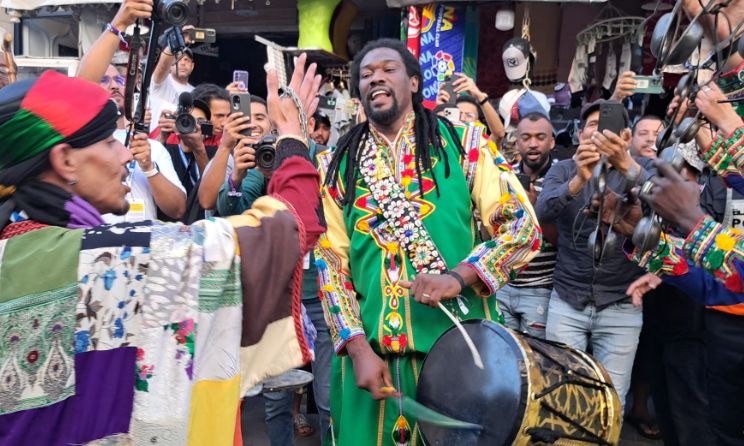
This perception quickly changed when musicians like Jimmy Page and Robert Plant or Santana, to name just a few, hopped on stage with the Gnaoua bands and their maestros, the so called Maalems, highly appreciating the fascinating rhythm of their music. A sound, which is marked by the gimbri, a three-string lute and large, heavy iron castanets known as qraqab – reminders of the slaves’ chains.
Soon the festival opened up to ‘world music’ and became famous for the fusion of different styles, such as jazz, rock, blues and ethnic rhythms from around the globe – combining them all with Gnaoua, which up to nowadays remains at the heart of the whole event.
Consequently, like all previous editions, this year the festival started with the splendid and energising opening parade of various Gnaoua groups. And while an almost monotonous sound echoed through the streets of Essaouira, the groups from different municipalities nevertheless displayed diversity in presentation, style and choreography.
A few hours later, the opening concert on the immense Moulay Hassan stage, situated right between the medina and the open sea, evoked a firework of sound, colours, rhythms and joy – joining Brazilian batucada (Ilê Aiyê), Spanish flamenco (Nino de los Reyes et Sergio Martinez), zaouli from Ivory Coast (Companie Dumanlé) and Gnaoua Maalem Hassan Boussou from Casablanca.
Meanwhile, harmonious coexistence was not limited to the artists performing on stage. Whether following the shows or trying to make their way to the event locations through the narrow streets of Essaouira, people remained calm, friendly and tolerant. A true off-stage fusion.
This went on throughout the concerts, which could have easily turned into a fierce political confrontation like when Saint Levant performed. Ason of a French-Algerian mother and a Serbian-Palestinian father, born in Palestine himself and living in the US, Saint Levant has recently gained a lot of attention for his support of the plight of people in Gaza. His song ‘Deira’, released in February 2024, talks about a hotel in Gaza that his father once owned, before the family had to flee to Jordan in 2007. A beautiful piece of architecture that was destroyed by the recent bombings during the Israeli-Hamas conflict.
Saint Levant’s music – a mix of R&B and hip hop - contained no rage or hatred though, and the crowd, waving the Palestinian keffiyeh here and there, equally stayed calm and joyful, just calling for peace and tolerance all over the world.
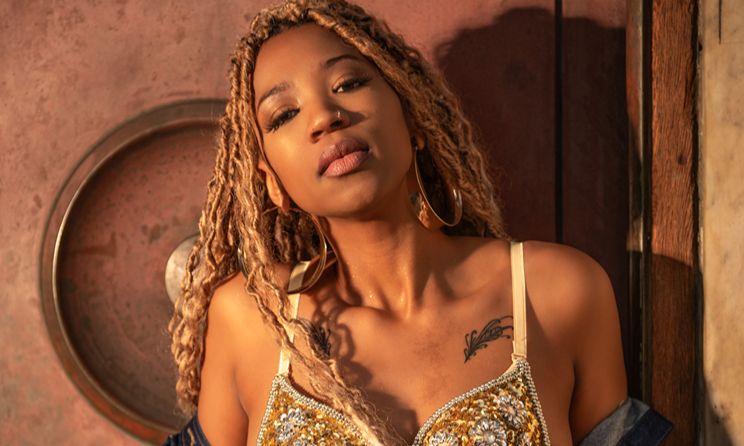
The concert of Asmaa Hamzaoui and her all-female band Bnat Timbouktou was another highlight, equally sending a strong message: Yes, women – who traditionally remained more in the background during Gnaoua rituals – can play a strong role as musicians and shake up the scene. The group fascinated the audience by their passionate performance and Asmaa’s remarkable voice. Being the daughter of a well-known Maalem, she learned to play the gimbri from her father at the age of six and was trained to become a Maalem herself – the first woman ever to do so.
“It was not an easy path,” Asmaa said after the show. “But I made it with the help of my family.” And she surely enjoys the international recognition she gets nowadays.
Nevertheless, not everyone is entirely happy with the direction the Gnaoua and World Music Festival has taken over the years. Abdallah Chfira is director of the cultural centre in Essaouira and one of the founders of the Gnaoua Festival. Over time he has distanced himself from the event.
“The festival has become very successful commercially but lost a bit the connection to its cultural roots,” Chfira says. His main criticism: “There is a separation between the Gnaoua as a ritual and therapy and the music nowadays. The festival does not provide much information about the meanings and roots of this tradition.”
Indeed, a replica to 25 years of festival history could not be found anywhere and for the broader public there were hardly any side-events helping to understand Gnaoua better. A small but fine collection of wooden gimbris was exhibited at Dar Souiri, one of the festival’s main venues. But no official sign led the way to this private initiative.
Perhaps something to improve on at the 26th festival edition next year? After all, there are concrete plans to create a chair for Gnaoua culture at the Centre d’études Africaines (CAS) of Mohammed VI Polytechnic University. A first step into the right direction, so it seems.
Monika Hoegen is a journalist, author and moderator specialised in intercultural topics, politics, society, music and art. www.monika-hoegen.com


Most popular

Top Naija songs of 2026
31 Mar 2026

Top Afrobeats songs of 2026
19 Mar 2026

Ghana: Mr Eazi and MOLIY’s ‘Comfort’ earns Urban Music Awards nomination
21 Oct 2026

Top amapiano songs of 2026
16 Feb 2026
Open call: CANEX Music Business Lab and Songwriting Camp
15 Oct 2026
Nigeria: CANEX WKND unveils 2026 programme
21 Oct 2026
Disclaimer: Music In Africa provides a platform for musicians and contributors to embed music and videos solely for promotional purposes. If any track or video embedded on this platform violates any copyrights please inform us immediately and we will take it down. Please read our Terms of Use for more.

Subscribe to our monthly Newsletter
Follow us on social media


Please log in to post a comment.