




























































How the East African Global Music Campus is shaping music education in Africa

28 Mar 2019 - 15:12


Educational initiative the East African Global Music Campus (EAGMC) is conducting a training project to enhance the knowledge of African music teachers, directors and administrators and to engage them in local and interregional markets.
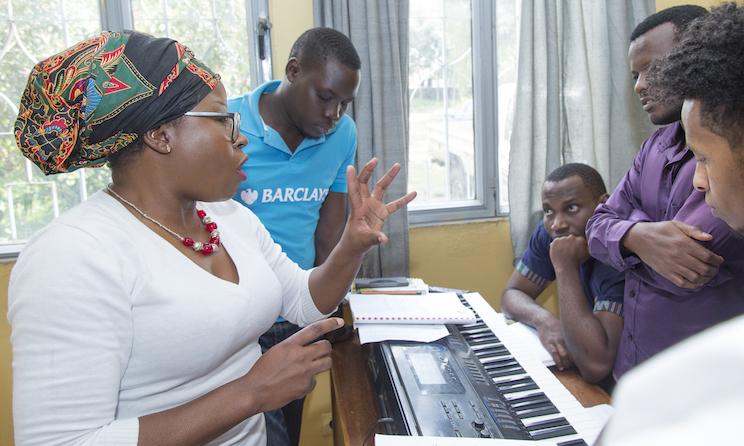
The first phase of the EAGMC project took place in Kampala, Uganda, and Addis Ababa, Ethiopia, in 2017 and 2018 respectively and involved music schools and academies from Ethiopia, Malawi, Mozambique, Uganda, Sierra Leone, South Sudan and Tanzania, Zimbabwe and Germany.
The EAGMC’s curriculum was designed by music schools in Africa and in turn enables partner organisations to offer professional music training in their institutions using a modular training system adapted from the European Credit Transfer System.
The EAGMC training covered such areas as music school management, bookkeeping, social entrepreneurship, cultural management, content management, accreditation, exchanging best practices and grant writing. The training also included modules in body percussion, rhythmic reading and writing, melodic reading, instrument technique, harmony and ear training, keyboard harmony, transcribing, arranging and pedagogy, among others.
The curriculum was designed so students can obtain a qualification through the technical and vocational training systems in their own countries as music educators and performers
The project enabled participants to network at a regional and inter-regional level and take part in a series of conference sessions to present and promote the project. With the second phase of the project scheduled for November 2019, the EAGMC will provide training in crucial aspects of business development including social entrepreneurship, fundraising/grant writing and advocacy.
This will allow the partners to develop a full two-year curriculum leading to a professional certificate in music to make a significant contribution to the development of the music industry in the countries concerned.
Music In Africa spoke to the Global Music Academy's Will Ramsay to reflect on the progress made in Kampala and Addis Ababa and plans for phase two of the EAGMC project.
MUSIC IN AFRICA: How effective was the training and how did it change the behaviour of the participants?
WILL RAMSAY: Most of the participants are self-taught musicians who were trying to learn from the Internet and just playing in bands. The concept of practicing your instrument on your own was quite new to them. They normally used to rehearse with bands without working on their instrumental technique. The idea of sitting down every day to practice with a routine and practicing technical exercises – or exercises which apply harmonic, melodic or modal concepts – was very new to them. It took a while before they understood how much playing on your own can improve when you do this.
How did you track the effectiveness of the training and what are your recommendations?
We were starting from scratch because we really wanted to create a completely new programme that really focusses on giving musicians the skills they need to play their own music. This was very hard because all the teaching materials out there focus on classical music, jazz or Latin and Brazilian music. Musicians in Africa tend to avoid schools because they don't learn the things they need there. We did a lot of testing and worked closely with the participants, rewriting teaching concepts when we found better ways to present the material. We tried to make the programme as practical as possible, by musicians for musicians. Also the majority of the teaching team came from Africa so they acted as role models. There was a dramatic improvement in the participants, which everyone noticed in the final concert in Addis Ababa in October 2018, but we still have a long way to go.
What challenges did you face during the training?
Access to good instruments was one of the biggest challenges. It's very hard to get instruments in Ethiopia and our partner there, Jazzamba School of Music, lost all their instruments in a fire so we struggled to work with the equipment we had. For the second phase of the training, Goethe-Institut has generously provided us with the instruments we need, which will make it a lot easier.
Another problem we faced was identifying potential trainees who were ready to commit to a long-term project like this. We went through teething problems there and had to replace some of the participants. Now it is much easier because the trainees themselves understand what kind of people they need to be looking for. In addition, we sometimes get young people coming through the training in the partner countries who perform better than the people teaching them. So we keep an eye out for this. It has also been very difficult to find women to join the teaching teams. There is still a lot of prejudice against women in music, not just in Africa but all over the world. We have always found that when we train women they tend to learn faster and often are the best students. However, this is something that can only be changed gradually.
What is the reason for choosing Uganda and Ethiopia to host the first phase of the project?
The campus dealt with two separate issues. The first was the ability of the partners to run a professional music school efficiently with an eye on sustainability. Of all the partners, the Bayimba Cultural Foundation was the most developed in this area and they have been running the East African Performing Arts Market (DOADOA) every May for a number of years. We decided to do this part of the training parallel with DOADOA to give the administration teams the opportunity to network and present their work as well. We chose Ethiopia to host the music training campus because the Goethe-Institut Ethiopia, along with the Erasmus+ programme of the European Union was one of the partners and they played a big role in developing the concept. In addition, Addis Ababa is an interesting city with a very big live music scene that is focused on local music. We thought this would inspire the other partners.
Why did the training only focus on participants from Ethiopia, Malawi, Mozambique, Zimbabwe, Tanzania, Uganda, Sierra Leone, South Sudan and Germany?
The countries involved in the project have been working together since 2010. Music Crossroads International has been running a similar programme in southern Africa since 2012. The East African countries, Uganda and Tanzania in particular, approached us about doing a campus in East Africa in 2014. We did a workshop tour of East Africa funded by Goethe-Institut in 2015 to select the participants for training. The curriculum we use is the same for both campuses and there is a lot of cross-pollination. We included the southern African countries in the organisational development training in Uganda to expand the network and give them the opportunity to work on this aspect of running an academy, which we neglected in the beginning in southern Africa only to realise that training musicians only works if there is a well-structured organisation that can make use of their skills effectively. Sierra Leone heard about what we were doing and somehow managed to find the money to take part in the first East African campus in 2016, so we included them in the East African grant. South Sudan is a latecomer. Goethe-Institut Ethiopia wanted them to take part and made it possible to help them develop some training structures, which are desperately needed there. They were only there with a small team but in the next phase they will become a full partner.
Who will you be working with in the next phase of the programme?
We will continue working with the same group of countries in the next phase. This is a long-term skills transfer and we always train the same people every year. They are multipliers who teach what we show them in the academies. That way the skills become available to all the musicians who are desperate to get good information and training. It took us two years to finish the first year of the curriculum. In the next two-year phase we will train them in the second year of the curriculum. It is a four-year programme, in fact. We will, however, have new participants because we are starting to train woodwinds and brass so we will select trumpet, trombone and saxophone players from each partner. These instruments were so important post-independence all over Africa and we would like to revive them as an essential part of every band. We are preparing a new curriculum for the horn players for this.
What is the end goal of such a long training programme?
Music is a huge field, it's quite normal to spend at least four years to acquire the skills you need to survive as a musician or a music teacher. In the last two years of the programme, the focus shifts to music education and performance skills. We're trying to encourage the participants to start using the skills to begin documenting and transcribing their own music cultures. There is still a lot of work to be done.
Are you planning to involve other African countries in the programme?
This is one of our biggest challenges. We have been approached by many countries. In fact, we will start a new programme in Khartoum, Sudan, in October 2019, which will be called the SAMA Music Campus. Goethe-Institut is again the driving force behind this. We really can only work with institutions, not individuals. It's hard to find the right partners who share the vision of the programme and are prepared to do the work to make things happen. We don't offer a quick fix, it's a slow process. We would love to start a West African campus at some point in the future and there are quite a few countries in Central Africa who have approached us as well.


Most popular

Top Naija songs of 2026
31 Mar 2026

Ghana: Mr Eazi and MOLIY’s ‘Comfort’ earns Urban Music Awards nomination
21 Oct 2026

Top Afrobeats songs of 2026
19 Mar 2026

Top amapiano songs of 2026
16 Feb 2026

Open call: CANEX Music Business Lab and Songwriting Camp
15 Oct 2026

Nigeria: CANEX WKND unveils 2026 programme
21 Oct 2026
Disclaimer: Music In Africa provides a platform for musicians and contributors to embed music and videos solely for promotional purposes. If any track or video embedded on this platform violates any copyrights please inform us immediately and we will take it down. Please read our Terms of Use for more.

Subscribe to our monthly Newsletter
Follow us on social media


Please log in to post a comment.