




























































How the music of an ancient rock painting was brought to life
01 Jul 2022 - 11:26


By Neil Rusch and Sarah Wurz
Archaeologists spend a lot of time examining the remains of distant pasts, which includes the study of rock paintings. This is largely visual work – but sometimes we can “hear” the ancient past using acoustic methods.
Our archaeoacoustic research is focused on bringing to life sounds made by people living in the past. No aural record remains but people did dance, sing and clap. Instruments either no longer exist or are extremely rare. One exception are the gong rocks, known as lithophones, which ring when struck and produce purposeful, percussive sounds. Occasionally, unfamiliar and rare musical instruments are depicted in rock paintings.
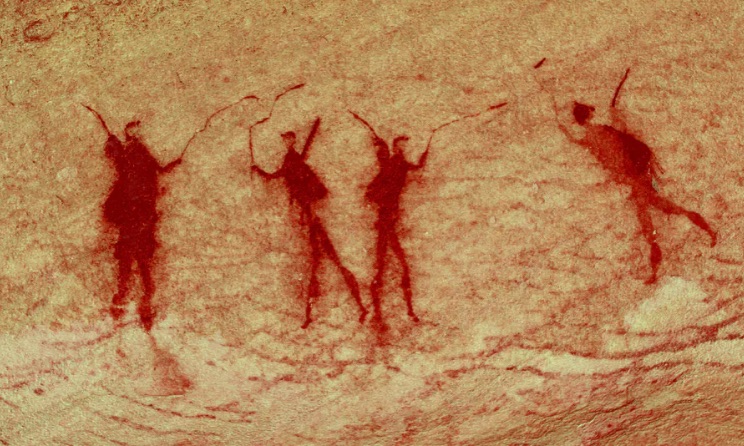
In a new study we turned our ears to a rock painting in the Cederberg Mountains in South Africa’s Western Cape province. The human figures in this painting have previously been interpreted as healers holding fly-whisks and doing a trance-dance. Fly-whisks were an important accessory for the dance because they were thought to keep arrows of sickness at bay.
But our results suggest that the fly-whisks are in fact musical instruments of a type known as a !goin !goin – a name that only exists in the now extinct ǀXam language that was spoken by hunter-gatherers in central southern Africa. The !goin !goin is an aerophone; these instruments produce sound by creating vibrations in the air when they are spun around their axes.
To reach this conclusion we combined digital image recovery techniques with instruments created from life-size templates based on our findings. The eight instruments were played in a Cape Town sound studio and the sounds were recorded. Sound produced by the recreated instruments convincingly matches the sound spectrum (90 – 150 Hz) produced by a similar 19th century model of the !goin !goin aerophone, which is archived in the Kirby Collection of Musical Instruments, curated by the University of Cape Town’s College of Music.
Our results suggest that !goin !goin type aerophones were used around or before 2000 years ago. This conclusion is based on the age of the image that is painted in the fine-line technique, which is a style of painting that disappeared with the arrival of pastoralists in the southern Africa region 2000 years ago.
The Cederberg painting is one of only four known examples of aerophone playing depicted in rock paintings in the southern Africa region. By contrast many paintings are identified as illustrating fly-whisks. Our findings suggest the need for greater nuance when studying rock paintings. Perhaps some of the fly-whisk depictions should be revisited with a “listening ear”?
Composition
The !goin !goin generates a distinct pulsating sound (visualised in the image below) due to the circular rotation of the player’s arm and the twisting and untwisting of the cord that attaches the rotating blade to the stick.
An unexpected finding was the compositional possibilities offered when two or more !goin !goin were played at the same time. Speeding up and slowing down the rotation subtly changes the sound. Two instruments, one played fast and the other slow, creates a composition. Playing in sync and out of sync adds another layer of musical creation.
It was not possible to play eight instruments in the sound studio at one time. An eight-instrument performance requires more space than the studio could provide. But a sound recording of three !goin !goin playing together suggests what group music-making with the !goin !goin may have sounded like.
This compositional aspect of the instrument was not well known at all so we delved deeper. In the Special Collections archive at the University of Cape Town we found an obscure description of the !goin !goin which confirmed, as does the Cederberg painting, that groups did play the instruments together.
An instrument consisting of a blade of wood attached to a little stick, which is held in the hand. The performer grasping the little stick whirls the blade about in the air, producing a whirring sound. It is used by both sexes among the Bushmen [another name used for the San and today considered derogatory by some] and, at times, by a number of persons together with the view to causing rain.
ǀXam-speaking hunter gatherers associated the sound of the !goin !goin with honey bees. They even went so far as to say that with the !goin !goin they could “move bees”. This complements the previous statement linking the instrument’s sound with “causing rain”. The archive statement also confirms that both men and women worked with rain, using the sound of the !goin !goin for this purpose.
Trance links
What of the trance healing dance suggested by earlier interpretations of the Cederberg painting? It is well known that all senses, not just vision, hallucinate in trance and that the aural hallucination of buzzing is construed as the sound of bees, rushing wind or falling water. So the painting does link to trance because of the association with bees and buzzing – but the items depicted in the painting are musical instruments, not fly-whisks.
Neil Rusch is a Research Associate at the University of the Witwatersrand while Sarah Wurz is a Professor at University of the Witwatersrand. This article first appeared on The Conversation.


Most popular

Top Naija songs of 2026
31 Mar 2026

Ghana: Mr Eazi and MOLIY’s ‘Comfort’ earns Urban Music Awards nomination
21 Oct 2026

Top Afrobeats songs of 2026
19 Mar 2026

Top amapiano songs of 2026
16 Feb 2026

Open call: CANEX Music Business Lab and Songwriting Camp
15 Oct 2026

Nigeria: CANEX WKND unveils 2026 programme
21 Oct 2026
Disclaimer: Music In Africa provides a platform for musicians and contributors to embed music and videos solely for promotional purposes. If any track or video embedded on this platform violates any copyrights please inform us immediately and we will take it down. Please read our Terms of Use for more.

Subscribe to our monthly Newsletter
Follow us on social media


Please log in to post a comment.