

























































Interview: Moussa Diallo talks music and children’s projects
05 Oct 2023 - 14:05


Having primarily performed for adult audiences throughout his musical career, Danish-Malian singer, songwriter and bass player Moussa Diallo, known affectionately as Moussa in Danish music circles, has made a significant shift in his focus.
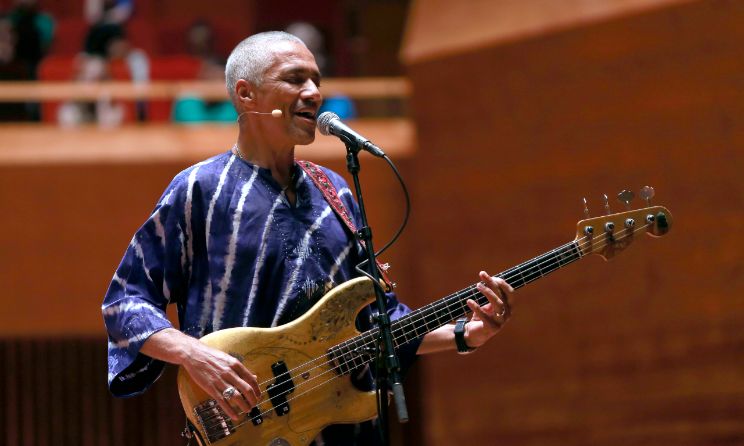
He has redirected his attention to a younger audience, particularly children. At the beginning of the 21st century, this shift has resulted in the writing and publication of several children’s stories and composition of music for animated films. One notable project, produced by French animation film producer Luc Perez, is titled Miniyamba – Walking Blues. Moussa has also composed music for Jannik Hastrup’s latest Danish children’s movie Cirkeline, Coco og det Vilde Næsehorn (Cirkeline, Coco and the Wild Rhino).
His children’s books, published in Danish, English and French, include titles like Der Var En Gang, Once Upon a Time in Mali, Mysteriet Om Himlens Barn and De Tre Brødre.
As a captivating children’s storyteller, Diallo writes and composes songs to accompany his publications, presenting them in music performances, dance and puppetry shows on his tours for kids, both in and outside Denmark.
Diallo grew up in Bamako before relocating to Denmark as a young bass player at the age of 18. His swinging style on the bass quickly caught the attention of top Danish acts who brought him into their fold. Diallo distinguished himself as one of the country’s most active bassists in the genres of pop, rock and funk. In the 1980s and ’90s, Moussa Diallo became known as the extremely swinging and musically empathetic rhythmic anchorman in the company of leading Danish female songwriters like Anne Linnet, Sanne Salomonsen, Lis Sørensen, Hanne Boel and Annisette Koppel.
In the studio as well as on tour, he provided a solid and swinging groove and always performed with great energy and personal outgoing charm, developing a rare ability to infuse his personality into his bass expression. Later, he began composing his own music and performing in a wide range of other contexts, including popular concerts for children.
Music In Africa spoke with Moussa Diallo about his paradigm shift and how he is nurturing creativity in children around the world.
MUSIC IN AFRICA: You’ve played and toured with all these big Danish acts, making good money. At what point did you decide to shift focus to younger audiences?
MOUSSA DIALLO: Yes, that’s true. I was making good money, but at some point, music just started feeling like a job. My creative side wasn’t being stimulated, and I was losing enthusiasm. Being on tour buses and big stages was becoming less fulfilling. I wanted more independence and to break free from the constraints of record companies and promoters. So, I made the decision to create my own record company and take control of my destiny.
Have you achieved that ambition?
For the past 20 or so years, I have been sustaining myself, booking my own tours, touring, and releasing my own records. I’m enjoying the freedom of shaping my own destiny.
Let’s talk about the books you have written and published. How many so far?
So far, I’ve written and published two children’s books and 10 small African story booklets. The first book, Der Var En Gang (Once Upon a Time), was translated into English and French.
Talk us through the process.
I wrote my first children’s book, Der Var En Gang, in 2003 and released music to accompany the stories. I approached a few Danish publishers who told me that the children’s book market was saturated and challenging to break into. So, I decided to take matters into my own hands. I published the book myself and simultaneously released a CD with songs related to the stories. Fortunately, it became an instant success and gained momentum, thanks to a collaboration with Levende Musik i Skolen (Live Music in Schools), the largest organisation in Denmark that engages artists to perform live music in schools. They used my book as educational material and booked me for concerts in schools and libraries across the country.
Following the success of our first tour in Denmark, Levende Musik i Skolen recommended my band and I to their counterparts in Norway, Rikskonsertene, which allowed us to perform in Norwegian schools for four consecutive years. Encouraged by this, I decided to translate the books into French and English. While the English version generated interest from a promoter in the UK, the concept didn’t materialise.
However, the French version caught the attention of a distributor in France. Although it wasn’t a financial success there, the book and live performances were making a significant impact in Scandinavia.
Feedback from the kids taught me that they preferred booklets to books because they were easier to carry in their school bags. Just before the pandemic hit, I released 10 small illustrated African stories. We also received proposals to perform children’s shows as well as family concerts in Indonesia, Zanzibar, Latvia, Sweden and China.
You’ve also been involved in animated films and had a proposal to tour in China. Can you tell us more about that?
As mentioned earlier, I had the opportunity to compose the score for the Cirkeline movie in 2019. During our first school tour in Denmark featuring the music from the movie, my band had a chance to do a showcase at the YAMAawards held in Denmark that year with representatives from different countries. After our performance, we were approached by two Chinese individuals who were in Denmark as part of a collaboration with Levende Musik i Skolen. They showed great interest in the Cirkeline project and immediately proposed inviting my band to tour major Chinese cities, including Hong Kong, Beijing, and Shanghai. We signed a contract, but unfortunately, the tour scheduled for June 2020 had to be cancelled due to the COVID-19 outbreak.
Since the borders to China remained closed throughout the pandemic, I suggested to my Chinese friends, in collaboration with the Royal Danish Cultural Centre in China, to translate the lyrics of the songs into Chinese and have young Chinese artists perform the tour instead. They warmly embraced the idea, and I wrote a storyline for them, offering some online coaching during their rehearsal of the show. The concerts were well-received by the Chinese audience, and I remain hopeful that our collaboration will continue in the future.
Looking ahead, what are your plans for the future?
This year, my band featuring Gambian percussionist Sal Dibba and Danish guitarist Preben Carlsen and myself toured in Latvia and Lithuania in the Baltic region. We were also invited to perform at the WOMAD Festival in South Africa in September, but unfortunately, our visit has been postponed. We have a full schedule of concerts in schools and libraries in Denmark during the autumn .
Towards the end of November, I will travel to Mali to prepare for the Spot on Mali Festival. This festival is an ongoing event where we scout music talents and bands, presenting them to the international market. In January 2024, we will celebrate its 10th anniversary. The festival is a collaboration between the Danish Royal Conservatory of Aarhus, local Malian promoters and CAMM (Malian Music Conservatory), with the support of the Danish Embassy in Bamako.


Most popular

Top Naija songs of 2026
31 Mar 2026

Top Afrobeats songs of 2026
19 Mar 2026

Top amapiano songs of 2026
16 Feb 2026

Open call: CANEX Music Business Lab and Songwriting Camp
15 Oct 2026

Ghana: Mr Eazi and MOLIY’s ‘Comfort’ earns Urban Music Awards nomination
21 Oct 2026
Nigeria: CANEX WKND unveils 2026 programme
21 Oct 2026
Disclaimer: Music In Africa provides a platform for musicians and contributors to embed music and videos solely for promotional purposes. If any track or video embedded on this platform violates any copyrights please inform us immediately and we will take it down. Please read our Terms of Use for more.

Subscribe to our monthly Newsletter
Follow us on social media


Please log in to post a comment.