




























































Jonas Gwangwa’s music and life embody the resistance against apartheid
20 Jun 2019 - 15:31


By Gwen Ansell
When South African President Cyril Ramaphosa recently sent good wishes to hospitalised trombonist and composer Jonas Gwangwa, it represented far more than a routine official courtesy. Even before he became president, Ramaphosa relished the South African jazz that spoke for and of the country’s liberation struggle. So, it was no surprise that during his inauguration speech in 2018 he famously invoked a Hugh Masekela song, ‘Thuma Mina’, (loosely translated to 'Send Me'). And there are few musicians whose opus embodies the political spirit of South African liberation more vividly than the 81-year-old Gwangwa.
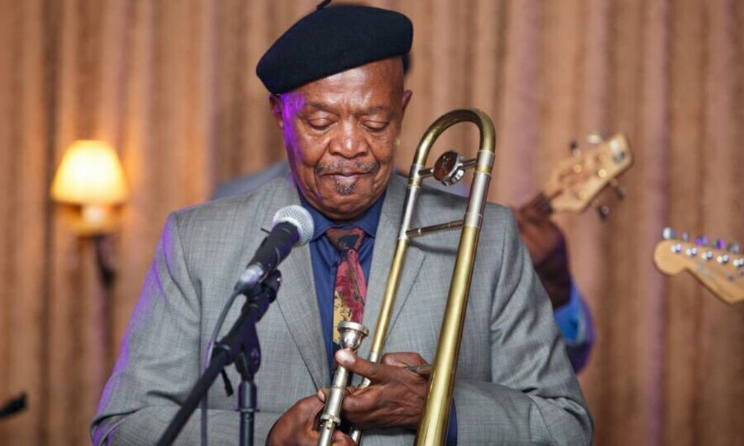
Resistance was the sub-text of Gwangwa’s early musical endeavours. The Jazz Epistles, the first outfit to foreground his voice as composer and player, was also the first black ensemble in South Africa to record an LP. Black bands had previously been confined to the territory of the single, for the country’s equivalent of the 'race records' market. Race records were made exclusively by and for African Americans, especially from the 1920s to the 1940s.
The Jazz Epistles’ repertoire asserted many characteristics that apartheid cultural policy suppressed: non-tribalism, originality and urban sophistication. But it also spoke of musicians’ conditions of production, in the Kippie Moeketsi track ‘Scullery Department’.
This song was a dedication to themselves and their peers: good enough to play for elite white patrons, but forced to take their interval meal on the steps of the back kitchen.
Dinner apartheid
That meal-break apartheid was only one aspect of much broader repression. Gwangwa was born in 1937 in Orlando East, the first township of Soweto, formally founded six years earlier. As Gwangwa grew up, Orlando exposed him to both the oppressions suffered by every black community – police raids, arbitrary arrests, pass laws and impoverished amenities – but also to an intensely political cultural milieu.
Orlando writers, visiting journalist Anthony Sampson noted in his essay Orlando Revisited, were very clear about their African nationalist identity: “We don’t just want to be writers,” Ezekiel Mphahlele said. “We want to be non-white writers’ – using the word in the proud way of people who are used to being non-everything – non-Europeans, non-voters, non-travellers, non-drinkers, non-starters.”
As Gwangwa began to work regularly in music, he was exposed to the routine brutality of the police. He recalled: “Sometimes those Boer boys just get so mean and take [your pass] from you. Otherwise they would make you perform in the middle of the night. In the middle of the street you’d be tap-dancing at 3am.”
The vivid memories of that and more – the segregated audiences for the musical King Kong; the privilege of white producers and promoters – travelled with Gwangwa into exile first in London and then at the Manhattan School of Music.
When he arranged singer Miriam Makeba’s Grammy-winning 1965 duo album with American artist Harry Belafonte, he was not simply supporting a fellow South African; he was participating in the politics of the project. He became impatient with the sometimes-shallow understanding of the music’s American patrons: “Because it was those back-to-Africa days, so you had to explain that it takes more than an Afro and a dashiki to be an African, you know? You have to think it and feel it.”
ANC talent
So, when in the early 1980s then ANC President OR Tambo called him to Angola to help develop the raw performance talent with which the ANC training camps teemed into a touring performance show for the movement, he did not hesitate. He brought everything he had learnt about production and stagecraft in the US to bear on the project: “I knew I could create a show that would have universal appeal: the musical structure is very simple, the rhythm will get you, the dances are attractive.”
Initially, the thought was to have a presentation of struggle songs; but Gwangwa and his team created a full musical. Theatrical interludes sandwiched the songs; the script was updated when political events (or musical fashions) in South Africa overtook it.
After a camp vehicle accident seriously injured his leg, Gwangwa began to spend more time in Botswana with his other band, Shakawe. There were politics there too: the politics of nonracialism and African regional solidarity, reflected in the mixed personnel of players, the outreach activities of Shakawe’s umbrella parent, the Medu Arts Ensemble, and repertoire. That spoke of both current regional events, political themes, and the rich wellspring of Setswana tradition in songs such as the wedding anthem ‘Kgomo di Tsile’.
South African military raids and death squads in the mid-1980s had forced Gwangwa away once more, to London. It was appropriate that Gwangwa was George Fenton’s collaborator on the soundtrack to the Steve Biko movie Cry Freedom, which went on to be nominated for an Oscar and to win an Ivor Novello and other awards.
Exile
The politics of Gwangwa’s music have stayed constant over the years, and are also apparent in the eight albums he has released in South Africa since returning from 30 years of exile. Reflecting on that, he told journalist Nechama Brodie: “Miriam Makeba organised me a Guinea passport. When that expired I got a Zambian travel document, then a Tanzanian one, then a Ghanaian passport. At airports you get immigration queues for ‘locals’ and for ‘others’. I had always been one of the others. Then, one day, I got my South African passport. And it was valid for 10 years. It was like: wow, you know, yeah. Hallelujah!
But his lyrics have never been uncritical praise singing. As he regularly sang: "Freedom for some is freedom for none." Perhaps that, as much as 'Thuma Mina', could also be a leitmotif for the Ramaphosa presidency?
Gwen Ansell is an associate of the Gordon Institute for Business Science at the University of Pretoria. This article first appeared on The Conversation.


Most popular

Top Naija songs of 2026
31 Mar 2026

Top Afrobeats songs of 2026
19 Mar 2026

Ghana: Mr Eazi and MOLIY’s ‘Comfort’ earns Urban Music Awards nomination
21 Oct 2026

Top amapiano songs of 2026
16 Feb 2026

Open call: CANEX Music Business Lab and Songwriting Camp
15 Oct 2026

Nigeria: CANEX WKND unveils 2026 programme
21 Oct 2026
Disclaimer: Music In Africa provides a platform for musicians and contributors to embed music and videos solely for promotional purposes. If any track or video embedded on this platform violates any copyrights please inform us immediately and we will take it down. Please read our Terms of Use for more.

Subscribe to our monthly Newsletter
Follow us on social media


Please log in to post a comment.