

























































The drum is a musical instrument with great power and presence that gives a pulse or backbone to the music it accompanies. Traditionally in Africa, a woman playing a drum was not the norm, it was considered taboo - but Kasiva Mutua has defied all odds to become one of the best female drummers in Kenya.
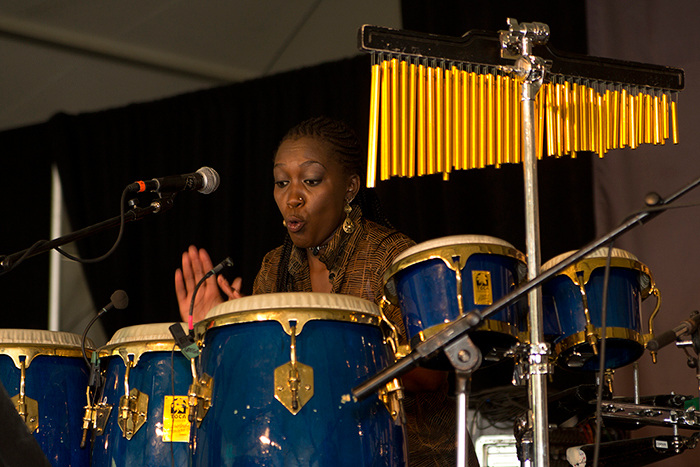
Sixteen years after she first discovered her love for the instrument, Kasiva has never grown tired of drumming - in fact, she loves it even more. She is so into her instrument that if she doesn’t play it, even for a single day, she feels like she will fall ill. From the waterfalls of Jinja to the festivals all over the world, she continues to share her story with the world through drumming and percussion. Her exuberant performances reflect a panoply of influences, including Afrobeat, zouk, samba, reggae and soul.
Kasiva's immense thirst of the drums started when she was 10. Describing her beginnings as a young drummer, Kasiva says: “I grew up a curious child. I listened carefully to every sound: bird calls, cricket chirps, cowbells and traditional drums are embedded in my mind and now I chant them in my sleep."
Her passion for the drums intensified while she was in high school. “My love for drums was so deep that at one time my grades dropped drastically and my mother tried to stop me from playing them,” she recalls. The school summoned her mother and Kasiva was asked to choose between playing drums and pocket money. To her mother’s surprise, Kasiva chose drums over money!
With this determination, Kasiva entered various Kenya music festivals and competitions. During her first competition while in high school, however, when playing the Luo drums she dropped her sticks. “My sweating palms made the sticks slippery. After this I just walked out of the stage and broke into tears," she says. She recalls while waiting for her turn to perform, her male competitors kept on taunting her: "I recall some of the boys asking whether I knew I was in the queue for the drumming competition."
After that dismal performance at her first competition. Kasiva stopped playing drums for some time. Her fear for the Luo drums set in and years down the lane, whenever she comes across this type of drum she is apprehensive at the start. Following her discovery of the Msondo drums, which is a hand drum, she immediately felt at ease again. When the next music festival season came beckoning again the following year, she couldn’t help but try out again.
Kasiva calls the drums her "babies" because of her love for them. “I felt my babies calling out to me and I had to play again,” she said. She then trained a schoolmate to drum so that they could enter the ensemble category. “I played for a record eight minutes, until my partner got tired. She had to nudge me to stop playing because I was in another zone and I was literally crying,” the artist says of her second attempt at the competition. Her efforts didn’t go down the drain as they emerged as one of the winners from thousands of other contestants (overwhelmingly male) who were competing.
After high school, Kasiva continued drumming at her local church. Her drumming skills were further enhanced when she joined Busoga University in Uganda. "When I got to Uganda I got a culture shock. I didn’t understand the language, the currency was confusing and I missed playing drums,” she recalls. When her sister went to Madagascar, part of her dilemma was solved as she came back with a small djembe drum for her.
Kasiva then learnt the local language of Busoga and Luganda. "I would travel from Iganga where I lived to Jinja with my drums over the weekends and play beside the waterfalls. The local fishermen would sing traditional songs to accompany my drumming,” she says.
Practice makes perfect. After she honed her skills, she would travel to Kenya and play drums for local Afro-fusion artists like Dela and Mutinda whenever she had free time. Back in Uganda, she teamed up with a local guitarist. Together they would play cover versions in local hotels over weekends to earn some extra cash.
After her university studies, Kasiva came back to Kenya. It was during the local Kikwetu Festival when she was approached by Kenyan-based Burundian artist Kidum, just as she left the stage after playing percussion for Dela. "At first he congratulated me and asked if he could play my drums," she said. "I lent them to him very willingly.” Not long after, Kidum called her to invite her to practice with his band. She did a good job and was subsequently invited to tour Burundi and Rwanda with him. “After coming back to Kenya, I approached him for a permanent job in his band and he agreed,” she says. Kasiva then started playing with the band every day, except on Mondays.
Kasiva credits Michelle Magoro and Kevin Chagala for her drumming skills. Kasiva has also drummed for veteran Kenyan artists such as Suzanna Owiyo and Iddi Achieng, as well as Denmark-based Simona Abdalla, who plays the Doumbek drum. She says that performing with Simona was one of the best moments in her career: "I felt like her drums were talking to me," she remembers.
In addition to drumming, the outgoing Kasiva also sings. She performed backing vocals for Jamaican reggae artist Anthony B when he toured Kenya. In 2016 Kasiva was part of the fourth gathering of the Nile Project. She has also participated in various artist exchange programmes, including the One Beat artist residency in the USA in 2013.
Considered the oldest instrument in the world, the drum holds an important place in societies worldwide - nowhere moreso than in Africa, home to innumerable rhythmic variations. Although drumming in Africa is still largely male dominated, women like Kasiva are proving that they also have a role to play in the instrument's development.


Most popular

Top Naija songs of 2026
31 Mar 2026

Top Afrobeats songs of 2026
19 Mar 2026

Top amapiano songs of 2026
16 Feb 2026

Ghana: Mr Eazi and MOLIY’s ‘Comfort’ earns Urban Music Awards nomination
21 Oct 2026
Open call: CANEX Music Business Lab and Songwriting Camp
15 Oct 2026
Nigeria: CANEX WKND unveils 2026 programme
21 Oct 2026
Disclaimer: Music In Africa provides a platform for musicians and contributors to embed music and videos solely for promotional purposes. If any track or video embedded on this platform violates any copyrights please inform us immediately and we will take it down. Please read our Terms of Use for more.

Subscribe to our monthly Newsletter
Follow us on social media


Please log in to post a comment.