






























































By Shishani Vranckx
This text provides an overview of the media in Namibia, particularly as it relates to the local music industry.
The Namibian media before independence
Namibian was initially a German colony from 1890 to 1918 and then given to South Africa after the First World War as a protectorate. During the 1960s, many African countries gained independence. Although the United Nations mandated South Africa to grant Namibia independence, it refused to do so due to the vast economic wealth Namibia offered through mining (especially diamonds) and fishery. Namibia – then referred to as South West Africa - was thus illegally occupied until 1990. During South African rule, Namibia was regarded as a fifth province of South Africa, subsequently falling under the rule of apartheid.
During this era of apartheid (1948-1990), what types of music were popularised throughout Namibia and how music was disseminated was highly controlled by the state. Broadcasting reached Namibian fairly late with radio starting in 1956 and television in 1981. Only in 1969 did radio start broadcasting in native languages, after having catered for “whites only” in English and Afrikaans from 1956. The South African Broadcasting Corporation (SABC) controlled Namibia’s broadcast media between 1956 and 1979. It later transformed into the South West African Broadcasting Corporation (SWABC) from 1979 to 1990. In line with apartheid policy in South Africa, it implemented Radio Bantu, a radio service aimed to control and pacify the “natives” through heavy censorship. From 1969, “native music” was recorded at the SABC and SWABC studios. SWABC conducted many field recordings throughout the country in the 1980s before independence. However, these recordings were typically used for broadcast purposes only, not for distribution.
During apartheid, all music with critical messages that attempted to undermine authorities was banned. Reggae, for example, was forbidden. Only gospel, romantic and dance (‘party’) music from the USA and South Africa were broadcast and distributed in the country. Due to this censorship, Namibian people for a long time were isolated from other African and globally popular music styles, such as reggae. The state was able to control and restrict the Namibian music industry, largely due to its control of the media.
Radio
After independence in 1990, the Namibian Broadcasting Corporation (NBC)[i] was set up in 1991, replacing SWABC. NBC is a state-owned broadcaster for both radio and television. It has eight language radio services: National Service (English), Oshiwambo, Herero, Nama/ Damara, Tswana, Rukavango, Lozi, Afrikaans and German.
The establishment of the Namibian Communication Commission in 1992 brought an end to the monopoly of the airwaves in the country, as had been the case under the SABC and SWABC. Since independence, broadcasting licenses were granted to both independent radio and television stations (Amupala 1998:4). In 1993 the first independent radio was launched, followed by various commercial and community radio stations, including: 99 FM, Energy FM, Base FM, Radio Wave, Hit Radio, Kosmos Radio, Fresh FM, One FM, Omulunga Radio, UNAM Radio, Radio Ecclesia, Channel 7, Westcoast FM, Kairos Radio and Oranjemund Community Radio.[ii]
All radio stations have their ‘niche’ of music (urban, rock, German, Afrikaans, ‘local’, etc.) catering to different socio- economic groups, particularly urban youths. Various stations and radio presenters are trying to push the local content on radio with the slogan: “Local is lekka!” (“Local is great!”). Today about 90% of the Namibian population listens to the radio daily, making radio an essential platform to grow the industry. Unfortunately people over 50 have little connection with the music played on radios as most commercial stations cater only for youths[iii].
Namibian radio is controlled by the Communications Regulatory Authority of Namibia (CRAN)[iv], which regulates telecommunication services and networks, broadcasting services, postal services and the use and allocation of radio spectrum.
Besides radio, there are reportedly about 10000 jukeboxes in shebeens (informal bars), which also play a role in music dissemination throughout Namibia.
Television
The NBC was the sole television broadcaster until 2001, when religious channel Trinity Broadcasting Network (TBN)[v] got a broadcasting license. This was followed by independent channel One Africa[vi] which was established in 2003. Today both NBC and One Africa are essential in promoting local and international music through their shows and music videos.
NBC has various music programmes such as Watagwan, which play a crucial role in getting the Namibian audiences to know and appreciate local artists. Good Morning Namibia[vii], a daily breakfast show, host artists to promote upcoming shows, new releases and other arts-related new. Sessions Studio 6 offers viewers the opportunity to get a behind-the-scenes look at what happens in studio while live bands showcase their musical talents to the country. Its recent launch brought together musicians from across the local music industry as well as advertising agencies and potential sponsors. The programme, produced by Christian Polloni, is an opportunity for Namibian artists to produce high-quality music without having to rely on neighbouring countries for equipment and studio support.
In 2015 the NBC started digital broadcasting, switching off analogue viewing in collaboration with TBC and One Africa[viii]. Now there are seven television channels: NBC 1, 2 and 3, One Africa TV, TBN, EDU TV and ThisTV[ix], a music channel launched in 2015 that broadcasts only Namibian music.
Print Media
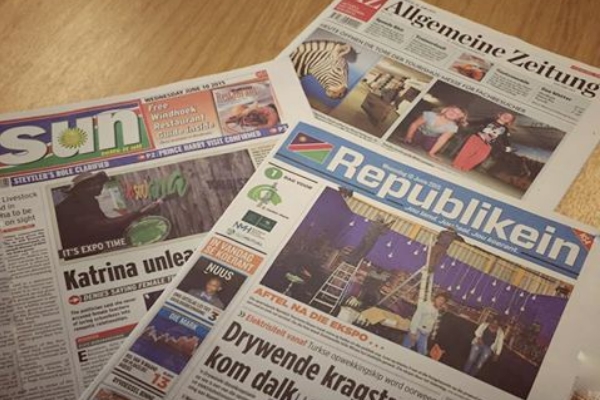
Most Namibian newspapers have weekly entertainment section scovering the local arts scene. There are 12 major newspapers in Namibia. The New Era[x] is a state-owned newspaper. All others are private newspapers. Most are based in Windhoek, namely:
The Namibian[xi] (English/Oshiwambo), Allgemeine Zeitung[xii] (German), Die Republikein[xiii] (Afrikaans), and the English papers Windhoek Observer[xiv], Namibian Economist[xv], Namibian Sun [xvi], Informanté[xvii] , Confidenté[xviii] and The Villager[xix]. Outside Windhoek there are the English papers Namib Times[xx] in Swakopmund and Buchter News[xxi] in Lüderitz.
Popular magazines include Red Carpet[xxii] , which is devoted to the Namibian arts industry, and Insight Namibia[xxiii], which occasionally covers art affairs besides their economic and socio-political focus. Both are published in English.
Online Media
The internet is growing as an avenue for people to access music, although less than 10% of the population has access to internet. Online promotion of Namibian music and arts happens mainly through social media platforms such as Facebook and Twitter. Most newspapers and radio stations, as well as musicians themselves, have their own accounts on these social media platforms.
An important website in promoting events in Namibia is What’s On Windhoek platform[xxiv] . Other blogs include Namibian Music Blog[xxv], Our Namibia[xxvi] and Have Plenty Music[xxvii]
Popular online newspapers that include music news (besides the websites of the publications outlined above) include Omutumwa News[xxviii], Oshili Nashi Popiwe[xxix], The Zambezian[xxx] and the Southern Times[xxxi].
Archives
There are two archives hosting visual- and audio material in Namibia. The National Archives[xxxii] in Windhoek hosts various media such as books, newspaper articles and posters, cassettes, CDs, video tapes and VHS. The NBC radio station in Windhoek has two libraries. The first is a print library with books, magazines, newspapers and file records concerning various subjects. It’s open to the public but borrowing is not allowed. The second is a music library that hosts a vast amount LPs, cassettes, CDs and reel-to-reel tapes. These tapes contain historical recordings of Namibian music but are unfortunately in a state of complete neglect and deterioration.
In response to this, the Stolen Moments[xxxiii] project has initiated the digitalization process of these materials in collaboration with the NBC, the National Archives and other stakeholders. Stolen Moments: Namibian Music History Untold is a national treasure hunt for the Namibian music culture that was almost forgotten, suppressed and made impossible to flourish under apartheid. In order to prevent these cultural riches from vanishing without a trace, they have started to recollect the bits and pieces of the country’s musical memory from the 1950s to the late 1980s, be it in sound recording, print-articles, film, photography and oral history. Through open calls in the newspapers, they aim to collect media material from the general public. Contributions are going to be copied and deposited at the National Archives of Namibia. This will open up the area for future investigation and form the basis for a Namibian popular music archive, as intended by the National Archives of Namibia.[xxxiv]
References
Amupala, JN. 1998. Development of Broadcasting in Namibia Press, Centenary celebration 12-13 October 1998, p.4.


Most popular

Top Naija songs of 2026
31 Mar 2026

Top Afrobeats songs of 2026
19 Mar 2026

Ghana: Mr Eazi and MOLIY’s ‘Comfort’ earns Urban Music Awards nomination
21 Oct 2026

Top amapiano songs of 2026
16 Feb 2026

Open call: CANEX Music Business Lab and Songwriting Camp
15 Oct 2026

Nigeria: CANEX WKND unveils 2026 programme
21 Oct 2026
Disclaimer: Music In Africa provides a platform for musicians and contributors to embed music and videos solely for promotional purposes. If any track or video embedded on this platform violates any copyrights please inform us immediately and we will take it down. Please read our Terms of Use for more.

Subscribe to our monthly Newsletter
Follow us on social media


Please log in to post a comment.