


























































This article provides an overview of the Basotho musical tradition known as mohobelo, explaining its historical and cultural origins and the formal characteristics of the music. It concludes by examining its rise as a popular musical form and its relevance to cultural life in present-day Lesotho.
Historical origins of mohobelo
The origins of mohobelo stretch back to the aftermath of the Lifaqane wars and the Great Trek. In the late 1800s, even though most of the unrest had subsided, Basotho men were still guarding outposts in the Maluti Mountains. They would do this for days on end, spending their time singing, and eventually they began to add energetic movements to accompany their voices. This was done while dressed in full warrior regalia – a blanket, shield, spear or knobkerrie (club) – and they began to use these armaments to emphasise the strength of their movements.
In this process a new style of dancing music, known as mohobelo, was born in the community of Ha-Molapo in the northern district of Leribe. Vocally a cross between mokorotlo (war anthems) and lelingoane or mangae (initiation school hymns), with strong praise-poetry influences, mohobelo is a stride, slide and leap dance exclusively performed by Basotho men. Although it is territorial, in that the dance movements of the north differ from those observed in the south, it is essentially a display of masculinity with an intrinsically competitive aspect to it[1].
Village chiefs soon realised that the energy of mohobelo could be harnessed productively, and community work groups (letsema) began including the dance to energise workers when ploughing fields and performing ho-pola (the act of harvesting wheat, millet or corn). Traditionally, women brewed beer and cooked food for the men working in the fields, adding ululations to the melodies and rhythms of the mohobelo dancers[2].
When a man wanted to relocate to a new village, it became customary for him to carry his koto (club) in order to attain land. This would earn him the title o oa hoba, and symbolise both his commitment to guard the village in times of need, as well as to help work the land and partake in the traditions of mohobelo.
The characteristics of mohobelo music
The music of mohobelo follows a circular call-and-response vocal pattern, with praise poetry sung in a five-tone scale (the ‘call’) and a male-charged backing chorus (the ‘response’). The rough and raw baritone vocals in mohobelo singing are another expression of the machismo of the tradition[3].
When men dance mohobelo, they stride, slide and stomp their feet while swinging their decorated sticks from side to side and over their heads. They also hum and whistle to whip up their movements. The humming sound, reminiscent of a boiling kettle, is known as ho hoba, which also functions as a verb meaning ‘to dance the mohobelo’. Although the dance is choreographed, every now and again one member will break off from the troupe and oa thala (run wild), combining this spontaneous movement with expressive sounds to excite the audience and the other dancers[4].
The dance is not only a fun display of masculinity but also a teamwork exercise. Often, the choir will sit in a horseshoe arrangement while the lead singer or poet stands. This is to create vocal synergy and a resonant whole in order to impassion the dancers. As high-energy as the dance can be, groups perform mohobelo for hours on end, with the men taking turns singing, praising and dancing.
Although praise poets are different from each other in terms of delivery (style, rhyme, nuances, lyrics and anchoring phrases), the lyrical content of mohobelo songs tends to be topical, political, nostalgic and social. Typically, the lead singer, acting as the praise poet, addresses the choir and composes lyrics on the spot, feeding off the energy created when the choir catches on to the lyrics and begins singing them back. This begins a playful conversation where the leader will sing increasingly provocative lyrics to spur on the group.
Mohobelo in modern times
In the early 20th century when Basotho migrants began working in the mines of South Africa, mohobelo was one of the cultural traditions that brought the workers together on weekends and holidays. Groups started challenging those of other mines and performing at weddings and other social events, and that led to new-look, European-style costumes being introduced[5].
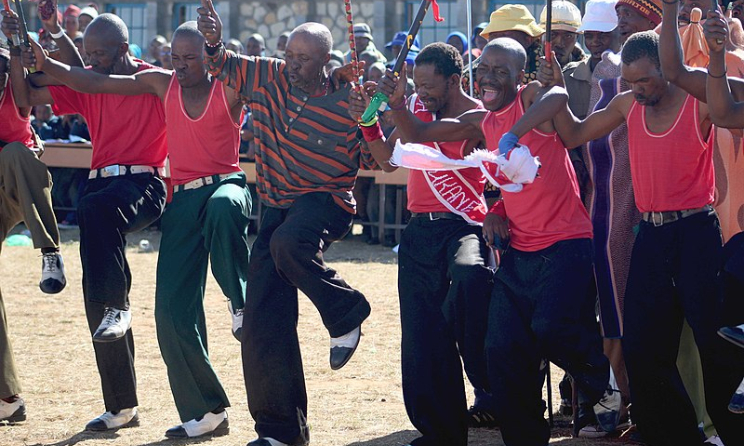
These costumes remain a common spectacle at cultural festivals in Lesotho and South Africa to this day. The uniform consists of black-and-white brogue shoes, black bell-bottom trousers, tucked-in vests and oversised, unbuttoned shirts of different colours. In lieu of a traditional club, a bright bandana or handkerchief is tied to a stick, which is usually about one metre in length. The dance group is often accompanied by a male choir, led by an accomplished praise poet whose task it is to ignite the dancers with his cheeky, playful lyrics and stirring vocal delivery. Dancers enter in a snake-like line with their sticks raised above their heads, their leader looking somewhat different from the group – usually distinguished by an ostentatious feather hat and a whistle in his mouth to lead the choreography.
The popularisation of mohobelo owes a lot to the original recordings of Basotho folk music made in the late-1960s by the South African Broadcasting Corporation for Bantu Radio (now Lesedi FM)[6]. This period marked the rise of musician Letsema Matsela, who had migrated to Johannesburg to work in the Springs mines but was born in the district of Leribe, where the tradition of mohobelo originated. With his supreme command of Sesotho and his hoarse yet melodious voice, he became the name and face of the group Letsema Matsela & Basotho Dihoba. Gallo Africa started recording the group in 1976 and by the time of his death in 1999, Matsela had released 10 albums, which still receive airplay on Sesotho radio stations across South Africa and Lesotho.
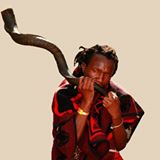
As much as mohobelo has always been a form dominated by the male voice, Matsela included a concertina, accordion and lesiba in his recordings, with ululations of women featuring prominently in the background. On one track, 'Khomo Roineke' from the album Ngaka Tsa Lesotho[7], women lead the song while men ba-hoba (dance the mohobelo) in the background[8].
Aspects of mohobelo music have been incorporated into other Basotho genres, including choral music, jazz, pop and hip hop[9]. Lesotho’s most famous music genre, famo, has borrowed a lot of its identity from mohobelo, even though its rhythmic structures and instrumentation differ.
Resources and citations:
[1] http://www.mountainvoices.org/l_th_culture_and_customs.asp.html
[2] https://www.britannica.com/place/Lesotho/Cultural-life
[3 ]https://folkways.si.edu/mokorotlo-and-mohobelo-dances-from-the-sotho-people-of-mokoroane-mohales-hoek-lesotho/world/music/album/smithsonian
[4] https://sites.google.com/site/1132700434v1/african-dance/nmane/yabara/ndlamu/adumu/kpanlogo/umteyo/mohobelo
[5] http://www.lesedifm.co.za/sabc/home/lesedifm/notices/details?id=5e9055d2-b7c8-4615-a839-c16d6cb1c77a&title=The%20Origin%20of%20the%20Basotho%20Nation
[6] https://www.sahistory.org.za/topic/development-music-south-africa-timeline-1600-2004
[7] https://www.deezer.com/en/album/15356795
[8] https://mg.co.za/article/2008-11-27-when-boss-leaves-the-workshop
[9] https://africasacountry.com/2011/07/sesotho-cipher
Disclaimer: Music In Africa's Overviews provide broad information about the music scenes in African countries. Music In Africa understands that the information in some of these texts could become outdated with time. If you would like to provide updated information or corrections to any of our Overview texts, please contact us at [email protected].
Editing by David Cornwell


Most popular

Top Naija songs of 2026
31 Mar 2026

Top Afrobeats songs of 2026
19 Mar 2026

Top amapiano songs of 2026
16 Feb 2026

Ghana: Mr Eazi and MOLIY’s ‘Comfort’ earns Urban Music Awards nomination
21 Oct 2026

Open call: CANEX Music Business Lab and Songwriting Camp
15 Oct 2026

Nigeria: CANEX WKND unveils 2026 programme
21 Oct 2026
Disclaimer: Music In Africa provides a platform for musicians and contributors to embed music and videos solely for promotional purposes. If any track or video embedded on this platform violates any copyrights please inform us immediately and we will take it down. Please read our Terms of Use for more.

Subscribe to our monthly Newsletter
Follow us on social media


Please log in to post a comment.