

























































Moral Instruction: Falz finds and falls short of Fela
17 Jan 2019 - 14:58


The Nigerian artist looking to be taken seriously only has to invoke Fela.
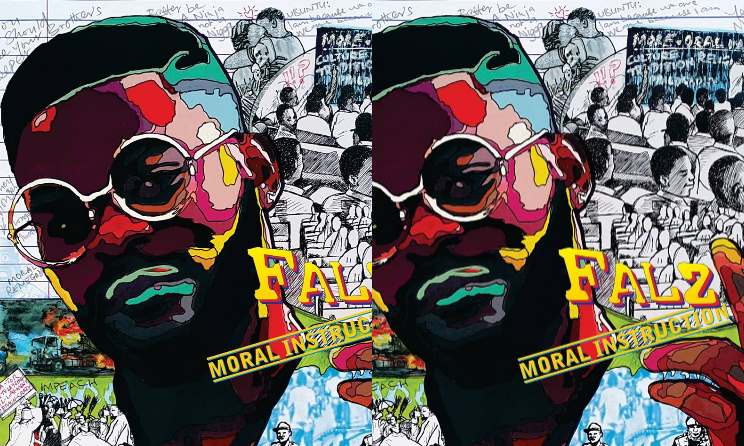
Wizkid, Tekno, Seyi Shay and Burna Boy have all taken the route. But these are not artists with any real political concerns. Wizkid and Tekno want girls; Seyi Shay wants sex; Burna Boy wants weed. Nothing wrong with these—Fela wanted all of those things too—but he had a political and artistic seriousness that none of his compatriots have managed to generate.
Nigerians might as well forget about anyone ever coming close to Fela’s artistry—only a few people care about playing instruments—but the country has been on the lookout for someone, anyone, to marry politics to music. It is why when Falz, keenly aware of the vacancy, struck the Black Power salute in his video for ‘This is Nigeria’ last year, everyone and their grandmother took to social media to say, albeit with some hesitation, that we have found the new Fela.
Upon the release of 'Talk', the first single from his new album Moral Instruction, the hesitation seems to have disappeared. Over on Twitter, Falz and Fela were both trending for several hours. Their positions kept changing and if it seemed like a relay race, it was hard to tell just who had the baton and who was set to receive it. But of course one of the runners has been dead for more than 20 years. It is not sure if the other runner would last that long.
But Moral Instruction might be his best chance to outlive his corporeal self—at least for those who believe political songs last longer than the average pop song. (They are wrong but it’s a useful delusion.) The nine-track album has Falz as preacher, teacher and Fela sampler. On the first song ‘Johnny’, he is a storyteller. The titular character has his dreams and life cut short by the Nigerian police. As far as a musical entrée to a political album goes it is quite a direct song.
Yet it is the next song, ‘Follow Follow’, that seems to bring the musical ideas on parade together. The song’s producer artfully blends Afrobeat and hip hop with extreme force. Fela’s martial commands from ‘Zombie’ are interspersed with a staccato delivery from Falz. It is a very smart production. Lyrically, the song tackles the celebrity craze, especially as it manifests online. “Gimme likes, drop comments,” he raps.
Other topics addressed include the avarice of pastors and regular people, the selfishness of politicians, the immorality of prostitution and the hypocrisy of the citizenry. Naturally, it is his lyrics about prostitution that has attracted the most attention online. "Why isn’t he talking about the men who patronise these prostitutes?" is the most common question. The most common answer is that Falz is misogynist—an answer which, if they are right, means Falz has adopted both Fela’s samples and his major flaw. There is a strange symmetry to this.
To my mind, the real trouble here is not quite the misogyny as much as it is the inconsistency. Back in 2013, on a song titled ‘High Class’, Falz seemed to be celebrating the idea of cash in exchange for sexual favours. Perhaps he has changed his mind.
Even if that is the case, there is a missed opportunity here that could have taken Falz from hectoring saint to flawed person who has realised a better way to live. The opportunity comes and is lost on ‘Hypocrite’. You might expect a song with the line, “Everybody is a motherfucking hypocrite” as part of the chorus to be introspective somewhere but it never happens. All of his fingers are pointed at pastors, politicians, prostitutes—everybody but himself.
This is part of the problem with Falz’s political commentary: he seems unaware of all the ways he is not the average Nigerian. Obviously, Fela was also from a prominent family but by creating Kalakuta, a community that welcomed average citizens, he had a perspective that Falz doesn’t.
This lack of introspection suggests a simple message: if we are all like Falz—with his material privilege, famous father, talent and sinlessness—Nigeria would be a great country. But by exempting himself from the litany of sins and misdemeanours of Nigerians on Moral Instruction, Falz can hardly defend himself against charges of punching down.
Someone might say Fela never did any self-reflection either. That might be so, but he didn’t need to. The media was replete with reports of his bad behaviour. Falz, on the other hand, is spotless in the press. And where Falz still practises hashtag-activism-with-melody, Fela sang like a witness. Falz says “still no regard for the life of a citizen”; Fela memorably sang about Nigerians in a bus: “Forty-nine sitting, ninety-nine standing.” One sounds like something you read in an op-ed; the other sounds like he was either sitting in the bus or saw the packed bus.
Perhaps smarting from the criticism he received for ‘This Is Nigeria’, Falz takes an opportunity to say something about those who are sceptical about his politics. “Person when I fight for go turn around to fight me,” he raps. “You tell your doctor you enjoy the headache. Kill the message; throway the message.” You want to tell him to not take himself so seriously.
To be fair to the man, Moral Instruction does a much better job of political commentary than ‘This Is Nigeria’. The anger in his voice on a song like ‘E No Finish’ suggests that he endorses the anger of his countrymen. He is no longer just name-dropping Nigeria’s issues. Even better, he remembers that he is human and says “I do not have the right to direct the finger of guilt or the look of contempt at my guy for even I can barely see through the speck in my eye.”
That is a fair sentiment. I just wish he had the self-awareness to say it earlier.
Artist: Falz
Album: Moral Instruction
Label, Year: BahdGuys Entertainment Limited, 2019


Most popular

Top Naija songs of 2026
31 Mar 2026

Top Afrobeats songs of 2026
19 Mar 2026

Top amapiano songs of 2026
16 Feb 2026

Open call: CANEX Music Business Lab and Songwriting Camp
15 Oct 2026

Ghana: Mr Eazi and MOLIY’s ‘Comfort’ earns Urban Music Awards nomination
21 Oct 2026

Nigeria: CANEX WKND unveils 2026 programme
21 Oct 2026
Disclaimer: Music In Africa provides a platform for musicians and contributors to embed music and videos solely for promotional purposes. If any track or video embedded on this platform violates any copyrights please inform us immediately and we will take it down. Please read our Terms of Use for more.

Subscribe to our monthly Newsletter
Follow us on social media


Please log in to post a comment.