


















































By Senai W. Andemariam
Modern musical instruments training in Eritrea began as soon as Italians seized Massawa in 1885 and started to recruit natives (Askaris) for the burgeoning colonial army. Since then there have been concerted efforts to raise the quality of music education within Eritrea but the big break is yet to come. This text is an overview of the state of music education within Eritrea.
Between 1885 and 1890 (when Eritrea was declared an Italian colony) several Askaris were trained with bugles and trumpets and constituted specially dressed units that, led by conductors, displayed musical shows to the colonial officers and fellow Askaris[i].
Role of missionaries in music education
Missionaries to Eritrea played a crucial role in the development of music education in the country. In March 1866, three Swedish evangelical missionaries set their foot on Eritrea en route to the Oromo land in Ethiopia. However, a combination of many reasons caused them to stay in Eritrea where they lay ground for the Evangelical and Lutheran Churches in Eritrea, which merged in 2006 after their separation in 1911. As part of their evangelical works, the missionaries played musical instruments and taught their native colleagues. It is said that in 1910 Nils Karlsson (1851-1929), one of the pioneers of the Lutheran Church of Eritrea (LCE), requested the dispatch of a music teacher from Sweden[ii].The education of music under the LCE continued erratically throughout the decades.
The Reverend Olle Hagner (previously Olof Andersson) (1895-1978) was one of the earliest pioneers of music education at the Evangelical Church of Eritrea (ECE). Among the early native graduates of the musical training at the ECE’s school at Beleza was Grazmatch Habteab Weldemariam who, showing an early gift of music excelled in piano, violin and guitar. It is said that Weldemariam’s father, sold an ox to buy him a violin and a guitar for his music classes.
Habteab would later become famous for organizing a concert in Asmara in the 1930s and later moved to Ethiopia to work with the Armenian music educator Nerses Nalbandian. After the missionaries were expelled in 1935 by the Italian colonial government, the early local trainees continued to teach violin, mandolin, piano, guitar, accordion and cello. Some of their early students included Shaleqa Ghrmay Hadgu who would later become one of the greatest contributors to the development of modern Ethiopian music.
The Catholic Church also played a significant role in the training of music. In 1943 Fr. Armido Gasparrini (1913-2004), a missionary in Eritrea, opened a music school in the Comboni church compound in Asmara. Initially 80 students were registered but only 40 completed the course. Early students at the school included Ato Fsehaye Aregay – indisputably the most notable native music teacher – and Ato Uqbaslassie Ghebreghiorgis.
When Prof. Didicho Trinci established the Cita Dina Band, comprising mainly students taught by Fr. Gasparinni, he involved aged Italian music teachers andnatives such as Fsehaye and Uqbaslassie in teaching the new marching band recruits. Later, the city’s municipality took over the task of running the band. Fsehaye, Uqbaslassie and the aged foreign teachers were hired and new instruments were bought for the band. With time the band disappeared but its students continued to influence music in Eritrea, Ethiopia and elsewhere.
Impact of war on music education
Between 1961 and 1991 Eritreans fought for their independence. The history of music education during these three decades may be split into what happened in the government-controlled parts of the country and the areas controlled by the liberation fronts. While there was a general decline in the performance arts in the government areas[iii], owing to the insecurity caused by the struggle, the liberation fronts – the Eritrean Liberation Front and the Eritrean Peoples’ Liberation Front (EPLF) – established, from scratch, cultural troupes which needed the education of music as part of the performances. This article has focused on efforts of the EPLF which in 1991 liberated Eritrea.
Ato Ali Ya’Asina, formerly member of Ethiopian police band, started to teach very basic music to hundreds of children (mostly of the EPLF fighters) around 1977. Later on Ato Tesfamichael Qeleta, a member of the defunct Banda Cita Dina, took over from Ya’Asina and continued the teaching of basic music. In 1987, Ato Hruy Ghebremichael, who was appointed director of the Revolutionary School for children of the fighters, proposed that music be taught as part of the regular education.
The nearly 40 students of the 1987 batch were offered one year theoretical classes and in 1988 they were provided with different classes of instruments (string, blowing, drum and keyboard) to practice with. This group continued to practice until 1991.
Post-independence years
The 1987 group performed its first marching band show on 20 June 1991 (Martyrs’ Day). Thereafter, while those who played blowing and drum instruments were taken to the Dekemhare military academy for further training in order to establish the national military marching band, the rest stayed in Asmara as the first students of the Asmara Music School. Senior teachers (such as ShaleqaGhrmay, Ato Elias Weldeghebriel, Ato Hruy Ghebremichael, Ato Tesfamichael Qeleta, Ato Umer Ali, Ato Ftsum Yohannes) taught in these two schools. The two groups were then merged to establish the national marching band and continued to perform until 2008.
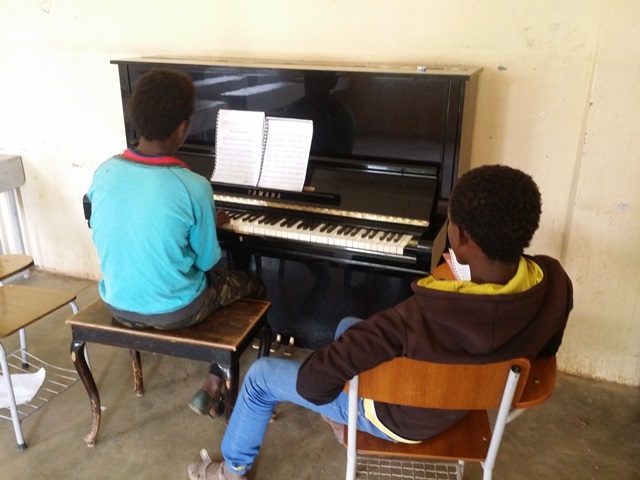
The Asmara Music School, which is run under the Cultural Affairs Bureau of the Ministry of Education, continued to revise its curriculum and produce students. Currently the school has close to 30 teachers. Asmara Music School offers a three-year certificate program and a four-year (now five-year) diploma program. Currently there is a discussion to lower the five year diploma classes to three years.
The students are offered theoretical classes during the first semester of the first year and begin playing instruments during the second semester. A mix of further theory, oral (vocal), harmony, music history, ensemble and choral work practices take them all the way through to the completion of their classes. The students are required to attend three half-day classes each week.
The ELCE Music School
Established under the auspices of the LCE, this school is church-based and has been producing 30-40 students every year. It is a continuation of the many decades of LCE practices of sporadic music courses. In 1998, the LCE, in collaboration with the Swedish Lutheran church (Bibeltrogna Vänner) invited Ato Bernabas Mebrahtu, indisputably the most famous of well-educated music experts in Eritrea now, to establish a music school.
Currently serving as the vice chairman of the Eritrean Music Association, Mebrahtu studied music directorship and pedagogy in voice for close to ten years in Finland and Sweden. After an initial training of around 20 LCE congregants over the summer of 1998, by September he pioneered a rigorous five-year certificate program with around fifty 13-14 year-old students. The program includes music theory, practice (flute, piano, vocal, guitar and drum), solfeggio (reading and writing of musical notes) and choir. Mebrahtu prides in some of his outstanding students who have gone on to take over directing the school after he left in 2007. Some of his students also teach at the Asmara Music School. The school is currently administered by the ELCE.
While he acknowledges that music teaching in Eritrea is improving, Mebrahtu is of the opinion that Eritrean music education has not reached the level where institutions can offer diplomas in music. “We do not have enough full time, licensed music instructors, musical instruments, internationally competitive music curriculum, infrastructure as well as external examination mechanisms,” Mebrahtu notes. The former music teacher says he has a plan to open his own private music school.
Private music teaching
Throughout the decades of the Italian period and through the 1960s, there were a number of private music teachers in Eritrea and the practice continues to date. Some notable private music teachers of that era include Maestro Rugero, Maestro Antonini, Brishanini, Epi Bolli, Dancuce and his famous student Umberto Barbuy who was born to Eritrean and Italian parents. Barbuy lost his sight at age seven but had a precocious talent for music that dazzled students and audiences alike from the late 1940s to the mid-1960s.
There are a few private schools in operation at the moment. They offer regular theoretical and practical courses on basic music education and offer certificates to their students, although there are reservations on the quality of the training offered by these schools. The two notable music schools are Satreb Art Institute[iv] and Makta.
Proposal for an art curriculum
An art education expert conducted a one month workshop in 2009 and a core team of trainees was selected to prepare teachers guides and student books for an art education curriculum to continue from grade one to grade eight. The draft curriculum comprised music, drama, drawing, dance and integrated art. A pilot project was launched for test on grade six students in 2016.
Since 1993 a number of proposals have been prepared to establish a national art academy which includes standard music education; the academy is yet to see light of the day.
Special thanks to Bernabas Mebratu, Muhad Suleiman and Hruy Ghebremichael for their insights on music education in Eritrea.
[i] Asres Tesemma, Teamot (Asmara: Francescana Press, 2006), pp. 43-44. [ii] Alazar Menghstu, [tr. The Background and Coming in being of the Lutheran Church in [iii] Eritrea, 1911-1932: An Eritrean-Swedish Initiative] (Uppsala: Adams Förlag, 2003), p. 16. [iv] + 2917136856
Disclaimer: Music In Africa's Overviews provide broad information about the music scenes in African countries. Music In Africa understands that the information in some of these texts could become outdated with time. If you would like to provide updated information or corrections to any of our Overview texts, please contact us at [email protected].


Most popular

Top Naija songs of 2026
31 Mar 2026

Top Afrobeats songs of 2026
19 Mar 2026

Top amapiano songs of 2026
16 Feb 2026

AFRIMA 2026: All the winners
12 Jan 2026
Visa appoints Fally Ipupa as face of Visa Pay in Democratic Republic of Congo
23 Sep 2026
NAAK and Vumaala to take SA electronic sounds to Amsterdam
02 Oct 2026
Disclaimer: Music In Africa provides a platform for musicians and contributors to embed music and videos solely for promotional purposes. If any track or video embedded on this platform violates any copyrights please inform us immediately and we will take it down. Please read our Terms of Use for more.

Subscribe to our monthly Newsletter
Follow us on social media


Please log in to post a comment.