
















































By Mayamiko Seyani
This text provides an overview of music education in Malawi. It begins with some historical background before looking in more detail at how and where music is currently taught at primary, secondary and tertiary levels, as well as at other institutions. It also considers the challenges the sector currently faces and ends by offering some tentative solutions.
History
Malawi was under British rule from 1891 until July 1964. During this time, the country was called the Nyasaland Protectorate. The early British missionaries came to Malawi in the second half of the 19th century, before British rule, with their main aim being to introduce Christianity and to stop the slave trade in the country (in response to the call of David Livingstone in 1857). The British missionary groups that settled in Malawi were the Universities Mission to Central Africa (now known as the Anglican Church) in 1861; the Free Church of Scotland in 1875; and the Church of Scotland in 1876.
The South African missionary group, the Dutch Reformed Church, joined the British missionaries in 1888 in Malawi. Other religious groups that came to Malawi include the Muslims in the 18th century; the Roman Catholic ‘White Fathers’ in 1889; the Montfort Fathers in 1901; and the Seventh Day Adventist Church in 1902. Every missionary group established its own schools, where the subjects of instruction included music (Chanunkha, 2005). However the colonial education system was racist by design as it placed Malawians in the lowest racial tier.
After 1964, the post-colonial government of Malawi retained music education in the general curriculum. However, music in independent Malawi is today still suffering from the cultural alienation that was created during colonial era. The shortfalls mandate music teachers to search for educational content and practices that integrate and value Malawian music.
Today, music education in Malawi is arguably in crisis. There has been little (if any) implementation of ideas on music education by the government and policy makers to make music an essential part of primary, secondary and teachers’ training education. As a result, there is a chronic marginalisation of music education in the course of developing or reviewing the national curriculum, and in allocating budgets or providing resource materials for subjects in education. The consequence of marginalizing music education has been lack of trained and qualified music teachers in primary, secondary and teachers’ training education. In turn, there is no teaching of music in the primary, secondary and teachers’ training education in the country.
Music education in primary schools
Music education in Malawian primary schools is faced with challenges related to curriculum-related problems and the subject’s ongoing marginalisation, inappropriate policy and implementation, and a lack of teacher training and motivation, and a shortage of qualified teachers (Mphande, 2011).
A study by Mphande in 2011 elaborates on problems facing primary music education. The integration of Music, Dance, Drama, Creative Arts, Physical Education and Needlework into the ‘Expressive Arts’ learning area leaves a lot to be desired. The length and depth of Expressive Arts teacher training (pre-service and in-service) is not enough for teachers to render their knowledge to the pupils. Another problem is that because for a long time, music and other expressive arts have been viewed as extra-curricular activities, teachers have grown increasingly apathetic towards it, giving the subject less time, effort and resources. Lastly, there is inadequate supervision and support for in-service Expressive Arts teachers.
Music education in secondary schools
Malawi’s Ministry of Education is introducing music education in secondary school in a subject called Performing Arts, which integrates music, dance and theatre. Some secondary schools, such as HHI Mission Secondary School[i] and Chichiri Secondary School in Blantyre, offer the subject to its students as an extracurricular activity.
Private high schools such as Bishop Mackenzie International School[ii] in Lilongwe, St Andrews International High School[iii] in Blantyre, Kalibu Academy[iv] in Blantyre, and Kamuzu Academy[v] in Kasungu are some of the institutions that have music as one of the subjects in their syllabi as they use the international Cambridge curriculum.
The problems facing music education at secondary schools are similar to the ones in primary schools. Chancellor College[vi], a constituent college of the University of Malawi[vii], which is the main college that trains secondary school teachers, offers music as a course in its Bachelor of Education programme. However, it restricts students from majoring in Music. The college’s argument for this restriction is that there is no teaching methodology for the subject. This of course has an effect on the teaching of education in Malawi’s secondary schools. Education in secondary schools is non-examinable, resulting in apathy from both students and teachers towards the subject. There is also not enough equipment to teach the subject, hence the subject is not taught in most secondary schools.
Music education at tertiary level
There are not enough institutions that train music teachers in Malawi. The University of Malawi’s Chancellor College in Zomba is the only one that offers music education to secondary school teachers. As already mentioned, however, the University of Malawi does not allow Education students to major in Music, which results in a shortage of qualified secondary school teachers for the subject. And because music education is not offered in most Malawian primary and secondary schools, the University of Malawi is faced with the challenge of teaching music to its students starting from the very basics.
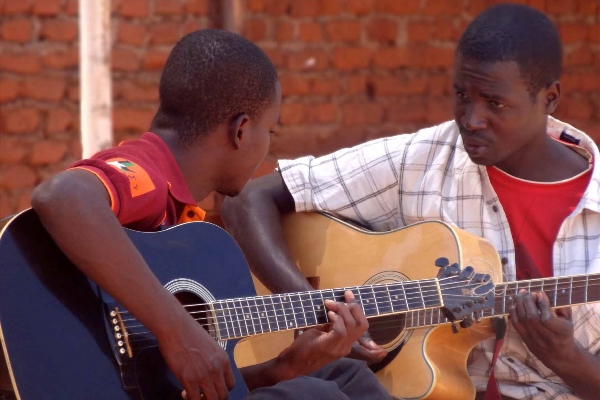
The colleges do not have enough equipment to teach the subject. For example, Blantyre Teachers’ Training College (BTTC) Demonstration Primary School had teachers who could teach the subject, but did not have the basic resources such as guitars, keyboards, drums and other instruments for teaching the subject. It was Johan Vanhoutte who came to the rescue of the school by donating guitars and volunteering to train teachers at the college.
Other institutions
The challenges and lack of resources in the formal education sector have created an opportunities for private institutions and NGOs to fill the void. For example, the Pan-African Society for Musical Arts Education (PASMAE)[viii], the Centre for Indigenous African Instrumental Music and Dance of Africa (CIIMDA)[ix] and the Malawi office of Music Crossroads[x] offer in-service teacher and student training programmes, which have had a positive impact on music education in Malawi. These projects have trained music teachers at various levels in indigenous music philosophy and practice, as well as Western music theory and research skills. They have also assisted them to create their own musical arts research teams and arrange regional festivals and similar activities for children (Mphande, 2011).
Recommendations
As has been outlined already, music education in Malawi is facing a lot of challenges, most of which emanate from the poor foundations laid during early or basic education. There is a shortage of teachers in the subject at all levels of teaching. The introduction of music education in both primary and secondary school is a good start towards the advancement of music education, but there is a further need for teacher training colleges to have music education in their courses and specifically for Chancellor College to allow its Education students to major in Music. There is also a pressing need for Malawi’s government to provide the necessary resources (instruments and equipment) to schools for the effective teaching of the subject.
References
- Mphande, Alinane Mildred. 2011. ‘Music Education in Malawi: The Need for a Philosophy’. Journal of the Musical Arts in Africa, Vol. 8.
- Chanunkha, Robert. 2005. Music education in Malawi: The crisis and the way forward. University of Pretoria.


Most popular

Top Naija songs of 2026
31 Mar 2026

Top Afrobeats songs of 2026
19 Mar 2026

Ghana: Mr Eazi and MOLIY’s ‘Comfort’ earns Urban Music Awards nomination
21 Oct 2026

Top amapiano songs of 2026
16 Feb 2026
Open call: CANEX Music Business Lab and Songwriting Camp
15 Oct 2026
Nigeria: CANEX WKND unveils 2026 programme
21 Oct 2026
Disclaimer: Music In Africa provides a platform for musicians and contributors to embed music and videos solely for promotional purposes. If any track or video embedded on this platform violates any copyrights please inform us immediately and we will take it down. Please read our Terms of Use for more.

Subscribe to our monthly Newsletter
Follow us on social media


Please log in to post a comment.