




























































By Kevin Eze
Music education is equipping individuals with musical knowledge and skills to enable them operate successfully in a musical environment. The West African country of Mali is famous for its vibrant music tradition. What sustains this tradition - and is there any form of institution behind it? The answer lies in music education.
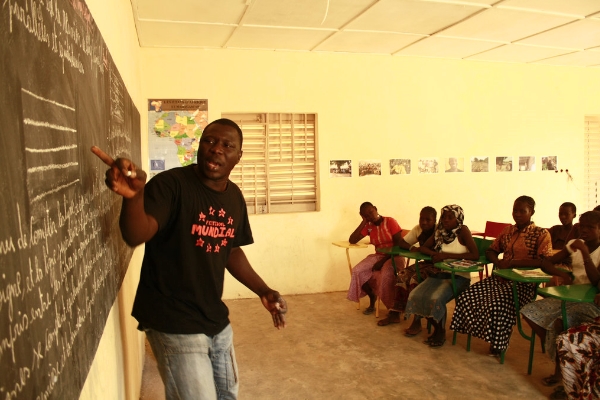
Sustained, as other art forms, by education - first, traditional and informal, then modern and formal, the music system in Mali is the product of Mali’s pastoral life. In the beginning, there was the “oral tradition”, an “institution” of its own rank, that embraced all art forms, music and literature in particular. The symbol of this link between oral tradition in music and the art of storytelling in Mali is symbolized in Amadou Hampaté Bâ’s Amkoullel the Fula Child (Actes-Sud, 1991). The centrality of traditional music education in Mali finds expression in Amadou Hampaté Bâ’s famous saying: “I graduated from the great university of the Spoken Word taught in the shade of baobab trees.”
Background
The music of Mali dates back to the ancient Mali Empire of the Mandinka (c.1230 - c.1600), covering diverse ethnic groups and regions[i]. This reveals a variety of ethnic music, though bound by the same origin. The oral tradition in Mali is the means by which messages or testimony are verbally transmitted in speech or song and may take the form, for example, of folktales, sayings, ballads, songs, or chants[ii]. Such was the advent of acapella found in Mali’s music, drawing from the literary tradition.
Then came the keepers of this traditional music institution, the griots. Griots are masters of words and music, as Tom Hale calls them in his book, Griots and Griottes[iii], who have been around for a millennium. Over time, the griots’ function changed as society advanced. Once, the male griots and female griottes were praise singers, historians, genealogists, advisers to nobility, entertainers, messengers, etc. The training of a griot begins within the family: the children learn from their griot parents, and then move on to a formal griot school, and progress to an apprenticeship with a master griot[iv]. Learning to play the kora is part of this initiation, as well as the musical tradition and ritual of learning to play the djembé (the drum).
Primary school music education
The educational and cultural policy in Mali stipulates that education is compulsory for the first nine years. Primary school music education involves musical games (call and response like Malaka, Diansa, Wassolon), pre-voice training, “warming up” (or échauffement using Malaka accompaniment, Malaka soli, Dianasa accompaniment, Dianasa soli, and Wassolon arrangements). Traditional ‘call and response’ songs like ‘Bazoumana yo’ play a role beyond the musical. They are used as moral etiquettes and in search of authenticity[v]. The initiation to the djembé (the drum) is equally an integral part of this stage, training children on the playing position, the notes (tonic, flat and bass), as well as on grace and subtlety.
High school music education
Since independence in 1960, the Malian government has devoted increased resources to secondary education - the educational and cultural policy in Mali (in agreement with UNESCO) being that music should be taught to all in the first three years of secondary education. This exposes students to the arts electives, where they can then choose between music, painting or sculpture. Learning to read and write solfa notation and initiation to instruments (especially traditional ones such as the drum, xylophone and kora) is enhanced at this stage, despite the frown in some sectors of society at Western education[vi]. Those wishing to pursue an arts degree must sit for the state exam in music (the equivalent of A-Levels in other West African countries). Music tuition is also offered at the American International School of Bamako[vii], Bamako International Academy[viii] as well as the Institut Français Bamako[ix].
University music education
To help improve the performance quality of Malian music students and musicians, the Malian government decided to open a university-level institute of training in Mali. During the academic year of 2003-2004, the Balla Faseke Kouyate Conservatory[x] saw the light of day in Bamako. While the conservatory teaches other art forms (such as dance, painting, theatre arts and video projection), the programme for music students includes music writing and theory, polyphony, dance in music, local and western instruments and music pedagogy (to prepare music teachers for the high school system), among others. Tertiary music education is also available from the University of Bamako (or University of Mali)[xi] and the world-renowned University of Sankore at Timbuktu (or University of Timbuktu)[xii].
Other music education
In Mali, as in other West African countries, music does not start in schools but on the streets. Informal education in the villages and cities are still predominant - the road walked by many popular musicians celebrated in Mali and beyond.
To complement the efforts of the state, especially in rural areas, some NGOs have included teaching music in their programmes in Mali. Playing for Change, for example, set up L’Ecole de Musique de Kirina (or the Music School of Kirina)[xiii], which offers a music programme in the small village of Kirina. Arrangements began in 2009 when Mahamadou Diabaté, musician and brother of Grammy Award-winning Kora player Toumani Diabaté, solicited the Playing For Change Foundation (PFCF) on building a music school in his native Mali. With his guidance, the PFCF established its third music school on the African continent in 2010.
One special feature about this initiative is that the school is located in the village of Kirina, about 25 miles (40km) south of Mali’s capital, Bamako. A griot village without electricity, Kirina’s inhabitants live in thatch-roofed houses made of bricks. Kirina has preserved its emblematic musical and cultural heritage for over 700 years. The school now helps to foster and disseminate this cultural heritage and musical tradition. There is a social bent to this musical programme as PFCF works to improve access to potable water for the local community, in addition to developing a workshop for musical instruments destined to help sustain the school financially and create jobs for villagers.
Since it opened its doors in October 2010, the school offers classes on the kora, djembe, balafon, dance and tama (or talking drum). Music classes are complemented by language classes in French and English, in addition to evening extra-music courses. And the PFCF has become some sort of an musical meeting place in Kirina.
Challenges
Despite the resources and facilities available to music students in Mali, the education system still faces challenges. Firstly, social tensions: the conflict in (northern) Mali is far from over, and may take some time to heal. The jihadists banned Mali music[xiv]. Second, reluctance: many parents still view Western-styled music schools as “assimilation”. Third, nonchalance: many students treat music as an area without much career prospects. Fourth, curriculum success: will graduates of the Convervatory in Bamako one day rival their internationally-acclaimed compatriots (who did not get such formal education opportunities) on the world stage?
Mali has done well in safeguarding and transmitting traditional music, but now the country needs to mobilize and further enrich the educational system to meet the challenges of the modern musical world.
Rurther reading:
Brandily, M. 2000. Introduction aux musiques africaines, Cité de la musique, Actes-Sud.
Hale, T. 2007. Griots and Griottes, Indiana University Press.
Kersale, P. and A. Coulibaly. 1998. Mali, Parole d’ancêtre Songhay - Mirage à Tombouctou, collection « Parole d’ancêtre », ANAKO editions.
Niane, D. T. 2001. Soundjata ou l’épopée Mandingue , édition « présence africaine ».
Useful websites:
[i] McConnachie, James and Duane, Orla (eds.), World Music, Vol. 1: Africa, Europe and the Middle East, New York, Penguin Books, pp. 539-562.
[ii] http://en.wikipedia.org/wiki/Oral_tradition; see also Ki-Zerbo, Joseph, 1990. ‘Methodology and African Prehistory’, UNESCO International Scientific Committee for the Drafting of a General History of Africa. Paris.
[iii] Indiana University Press, 2007
[iv] Tom Hale, 2007. Griots and Griottes, Indiana University Press.
[v] Ryan Skinner, From Ambiance to Authenticity: Popular Culture and Cultural Policy in Bamako, Mali, 1956-1966 at http://www.academia.edu/6765888/From_Ambiance_to_Authenticity_Popular_Culture_and_Cultural_Policy_in_Bamako_Mali_1956-1966
[vi] ‘Les rythmes de l’ouest africain’, Plan academique de formation, Monpollier-Nice).
[ix] www.institutfrançais.com/fr/bamako
[x] www.conservatoire-arts-mali.org
[xi] http://u-bamako.ml.refer.org/
[xii] http://en.wikipedia.org/wiki/Sankore_Madrasah
[xiii] http://playingforchange.org/programs/detail/ecole_de_musique_de_kirina
[xiv] Sujatha Fernandes, ‘The Day the Music Died in Mali’ at http://www.nytimes.com/2013/05/20/opinion/the-day-the-music-died-in-mali.html; see also Andy Morgan, Music, Culture and Conflict in Mali, New York, Freemuse publication, 2013, 220pp.
Disclaimer: Music In Africa's Overviews provide broad information about the music scenes in African countries. Music In Africa understands that the information in some of these texts could become outdated with time. If you would like to provide updated information or corrections to any of our Overview texts, please contact us at [email protected].


Most popular

Top Naija songs of 2026
31 Mar 2026

Top Afrobeats songs of 2026
19 Mar 2026

Ghana: Mr Eazi and MOLIY’s ‘Comfort’ earns Urban Music Awards nomination
21 Oct 2026

Top amapiano songs of 2026
16 Feb 2026

Open call: CANEX Music Business Lab and Songwriting Camp
15 Oct 2026
Nigeria: CANEX WKND unveils 2026 programme
21 Oct 2026
Disclaimer: Music In Africa provides a platform for musicians and contributors to embed music and videos solely for promotional purposes. If any track or video embedded on this platform violates any copyrights please inform us immediately and we will take it down. Please read our Terms of Use for more.

Subscribe to our monthly Newsletter
Follow us on social media


Please log in to post a comment.