






























































In 2013, Swaziland’s reigning monarch King Mswati III and his government announced the National Development Strategy or ‘Vision 2022’. This strategy stipulates that by 2022 Swaziland should be considered a ‘First World’ country using the Swaziland Development Index (SDI) – a set of indicators to monitor economic prosperity, environmental sustainability, education, health, and governance[i]. These development articulations have framed much of the political and policy developments in recent years, as ministries and councils strive to match their goals with this broader framework.
Until this point, however, arts education had not been a high priority for a country grappling with a chronic lack of educational resources. However, the National Development Strategy calls for the incorporation of cultural education into the national curriculum. This article provides an overview of the current state of arts education in Swaziland with a specific focus on music.
Primary and secondary education
The Government Programme of Action (2008-2013) articulates the right for all Swazi citizens to have access to free basic education. As of 2010 and despite an unsure start, free primary school education has been available across the country.
UNESCO (2013) research shows that amongst the target years of 18 to 22, the average years schooling held per Swazi citizen is eight years (under the advised 10 years). Recent data shows that 9% of this target population group have had fewer than four years of education[ii].
School leavers write either the IGCSE (International General Certificate of Secondary Education) board examinations (in private schools), or the localised Swaziland General Certificate of Secondary Education (in government schools).
The National Development Strategy and the Education Sector Policy of 2011[iii] acknowledge the importance of education in creating an appreciation for culture and the arts. The Swaziland National Council of Arts and Culture (SNCAC) Policy (2009) and the National Arts and Culture Bill (2012) both state that schools are essential spaces for the promotion of the arts, and that the national curriculum should include artistic and cultural subjects. The Ministry of Education and the National Curriculum Development Centre have included the need for creative vocational alternatives to be developed (such as visual arts, performing arts, culture, and entrepreneurship) as part of their short-term and long-term goals.
Despite all this, there are as yet no creative arts subjects taught in government schools at primary or secondary school levels. The National Curriculum Centre has started the process of developing a syllabus for the ‘expressive arts’ at primary and secondary levels, but due to financial constraints and difficulties in training teachers adequately, this process has now come to a hault.
Private schools in Swaziland, on the other hand, have offered individual and class music tuition for some years. At these institutions, there is an emphasis on students following the Associated Board of the Royal Schools of Music (ABRSM) syllabuse in their instrumental studies. Music can be taken as a subject for the GSCE, IGCSE or International Baccalaureate examinations.
Certain schools like the Setsembiso Sebunye Bahá'í High School[iv], a government-supported school, have taken the initiative recently to offer an optional fine arts course during school hours, with group music tuition (guitar and voice) as an extra-mural. Extra-curricular school choirs are also commonly found across the nation.
Tertiary education
The University of Swaziland (UNISWA)[v] is the only public university in the country. With a strong focus on agricultural studies and the sciences, UNISWA does not offer any creative arts courses or degrees. The university’s humanities faculty offers courses in African languages and linguistics, history, English and politics, but with no current options for the creative arts.
The Swaziland College of Technology[vi], another important state tertiary institution, offers technical and vocational training in the fields of education, science and engineering, ICT, and business studies. Unfortunately there are no creative arts taught at this institution either.
Limkokwing University[vii] is a private institution with campuses in Swaziland, Lesotho and Botswana. An off-shoot of a large Malaysian University, the Mbabane campus offers a selection of creative industry courses, including advertising and marketing, architecture, arts and design, sports, tourism, and what is termed ‘multimedia and animation’.
Like many other professional fields, young people in Swaziland often opt to continue their musical studies in South Africa, given the lack of tertiary opportunities in Swaziland. South African universities in Pretoria, Johannesburg and Cape Town therefore attract students from Swaziland interested in pursuing careers in the arts.
Beyond the classroom: alternative music education
With no music taught within the current national curriculum, musical skills are transmitted in alternative and often intangible ways outside of this framework. An importance space for musical learning in Swaziland is the Incwala and Umhlanga mass participatory cultural events held every year. These events involve a large body of polyphonic vocal music and accompanying dances which young girls and boys learn through participation.
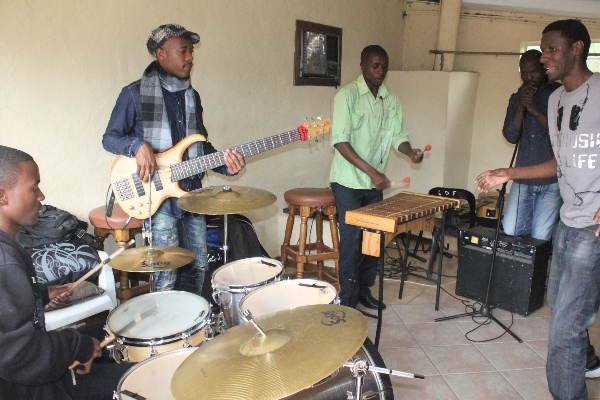
Another important space for music education is in ensembles such as choirs or dance troupes. Often schools will have after-class choirs or dance ensembles and the level of musical proficiency in these ensembles is high. There are also examples of enthusiastic young practitioners in different regions who mobilize local children into creative ensembles outside of school contexts. Local sibhaca dance and gumboot dance are popular forms of group music-making, but choirs (choral or umbholoho - a vocal genre like the South African isicathamiya) are important as well.
Choral music is a prominent mode of expression in Swaziland, within religious contexts and beyond, and so there is a vibrant culture of choir participation nationally. Swaziland is a country of churches. From the early Methodist missionaries to touring evangelical Texan pastors, Christianity takes on many forms in rural and urban areas. Many musicians in the country learn to play and sing through performing weekly in church and these players often move on to composing and performing their own material at a later stage.
Another important aspect when considering music education in Swaziland is the popularity of competitions. The Swaziland National Council of Arts and Culture (SNCAC) acts as an umbrella organ for numerous musical and other artistic associations. Examples of these are the Swaziland Arts and Music Association (SWAMA), the Swaziland Traditional Music Association, the Swaziland National Umbholoho Association, the Association of Christian Artists of Swaziland. Throughout the year, these associations host and encourage talent competitions. There are competitions held for choral music, umbholoho vocal ensembles, drum majorettes, sibhaca dance troupes and numerous other modes of expression and education.
Outside of these contexts, there are independent projects in Swaziland that aim to educate people in the creative arts. Yebo! Art and Design is a contemporary art gallery and workspace that provides education and a platform for local artists. Through their ‘Artreach’ work (a non-profit wing of the gallery), the Yebo facilitators provide visual arts skills training to different groups in Swaziland[viii].
Lucky Mlotsa, an independent artist and musician, holds his ‘Stick in Mud’ gallery at his house in Lobamba and offers free art classes from his house. Aside from his work in the visual arts, Mlotsa also runs a music and dance ensemble.
With the support of the local Alliance Française in Mbabane, the dancer and musician Pelepele (Larry Mhlanga) has formed a performing arts company called the Pelepele Arts Academy[ix]. Mhlanga develops young performers, and the ensemble runs school workshops around Swaziland and the rest of southern Africa.
The annual Bushfire music festival also hosts a week of creative workshops for local Swazi school children. Local and international artists are recruited to teach young learners about different aspects of theatre, music and dance.
To conclude, there are many signs that the government in Swaziland recognises the importance of arts education. Until the curriculum is developed and key facilitators are identified or trained, arts education happens outside of the school context. In this space, numerous players and stakeholders are developing short- and long-term projects and strategies to share creative arts education around the country. Though these are largely focused on the visual arts, a healthy and sustainable culture of music-making can be observed in Swaziland.


Most popular

Top Naija songs of 2026
31 Mar 2026

Top Afrobeats songs of 2026
19 Mar 2026

Ghana: Mr Eazi and MOLIY’s ‘Comfort’ earns Urban Music Awards nomination
21 Oct 2026

Top amapiano songs of 2026
16 Feb 2026

Open call: CANEX Music Business Lab and Songwriting Camp
15 Oct 2026

Nigeria: CANEX WKND unveils 2026 programme
21 Oct 2026
Disclaimer: Music In Africa provides a platform for musicians and contributors to embed music and videos solely for promotional purposes. If any track or video embedded on this platform violates any copyrights please inform us immediately and we will take it down. Please read our Terms of Use for more.

Subscribe to our monthly Newsletter
Follow us on social media


Please log in to post a comment.