























































By Benon Kigozi
Music education forms a vital part of any education system that seeks to bring forth well-rounded graduates equipped with the relevant skills to enable them take on the challenges of the modern workplace. This text emphases its importance, and the need for policy-makers to inculcate it more in modern Ugandan education.
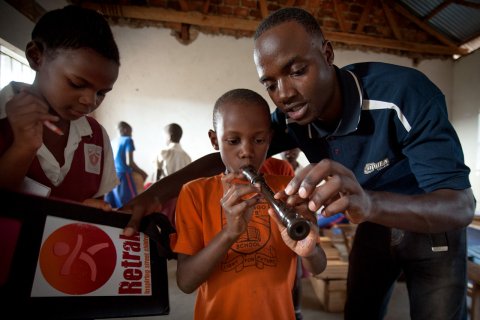
When the Republic of Uganda was established on 9 October 1962, the Ministry of Education published a national curriculum to articulate the mode and content of training of Ugandans in various academic fields in order to protect the nation’s position on civilisation and culture. A few educationists acquired music practices from abroad in order to contribute towards music education. Notable among these were Michael Kalule, George Kakoma, Zadok Adolu Otojoka, Moses Serwadda, Mbabi Katana and Sennoga Zaake. Alongside other educators who realised the importance of music education, they emphasised that music be taught as a subject at all levels of public education.
The Makerere University Department of Music, Dance and Drama was founded in 1971 and subsequently music became a subject taught in various other institutions. The rationale for the music syllabus focuses on Western approaches rather than a true African context that reflects appropriate philosophical models that fit in an African context. And even though it is taught in schools, music revolves around unevenly distributed practices and resources, including teachers and facilities.
The Uganda Society for Musical Arts Education (USMAE) - the recently formed national affiliate of the International Society for Music Education (ISME) - has mounted an advocacy campaign to ensure that African perspectives and approaches to music education prevail in schools. USMAE calls for philosophical models based on African concepts and aesthetics alongside the Western paradigm, in order to address the holistic, integrated and cultural approaches to musical arts education. Currently, music is taught in schools as a stand-alone subject. In some schools it is integrated with drama and dance, in a program popularly known as Music, Dance and Drama (MDD).
Government primary and secondary schools
In 2010, the Ministry of Education and Sports (MoES) published a new primary school syllabus for Performing Arts and Physical Education (PAPE) incorporating music, dance, drama, visual arts, technology and physical education (Uganda, 2010). The PAPE syllabus is presented in two parts: Part I deals with the performing arts aspect, highlighting music, dance, visual arts and drama, and Part II deals with physical education and technology. Some primary schools offer music as a classroom subject. However, since music is not audited and not examined, school administrators tend to ignore its importance in the development of cognitive skills. Students are mostly taught to play indigenous instruments, perform traditional dances, and sing traditional songs. The government organizes music, dance and drama festivals on an annual basis as part of the school music curriculum at district and national levels. It is during this period of time that pupils are seriously engaged in instrumental and vocal music practice over a period of about three months during the second of the three terms, in preparation for the festival competitions.
At secondary school level, Gayaza High School[i] and Bwerenyangi Girls Secondary School[ii], among others, still offer music education. Students are offered music as one of 11 subject choices at Ordinary Level (O-Level) in a four-year education programme, culminating in the final examinations of the Uganda National Examinations Board (UNEB)[iii]. Students may also choose music as one of the three subject choices at Advanced Level (A-Level) with a further two years of study leading to examinations by UNEB for the award of the Uganda Advanced Certificate of Education (UACE).
Private schools
Whereas music education is based on Uganda’s national curriculum, at private schools and especially international schools, students are exposed to foreign music education curricula. For example, Kampala International School, Uganda (KISU)[iv] and Rainbow International School, Uganda (RISU)[v] follow the National Curriculum of Britain and Wales. The music program at KISU is an adaptation of the National Curriculum, integrating it with indigenous African music studies. The International School of Uganda (ISU)[vi] follows an American system of music education. In most cases international schools adapt the curriculum to integrate cultural studies of Uganda as the host country.
Local private schools promote music education more in form of extracurricular activities. They organize activities based on the holistic nature of the arts, with music at the core, as well as dance and drama. These culminate in inter-school music and arts competitions, where external specialists are hired to adjudicate the competitions. Generally in private schools, music is accorded better attention as a result of bigger budgets for arts education. They are better resourced in terms of music departments and subsequently the quality of music education is better than at government schools.
University music education
While music education takes place at the Uganda Christian University (UCU)[vii] and Kyambogo University (KYU)[viii], the Department of Performing Arts Film (PAF) at Makerere University[ix] has established itself as the leading music school in the country. Founded in 1971, PAF offers a rich and varied music programme of both African and Western music at Diploma, Bachelor’s and Master’s level. Like UCU and KYU, PAF admits students directly from A-Level, as well as providing mature entrants with an opportunity to further and improve their qualifications and abilities in the various music specializations. At UCU and KYU the highest music qualification is the Bachelor of Music Education, whereas at Makerere University the undergraduate programme leads to either a two-year Diploma in Music, Dance or Drama or a three-year Bachelor of Arts in Music. Through a variety of foundation courses, the graduate programme in music at Makerere University combines research and practice, giving students the opportunity to reflect as well as apply knowledge and experience from coursework to practice. The graduate program leads to a Masters of Performing Arts (music, dance or drama).
Other avenues for music education
Other private music education avenues in Uganda include MusiConnexions, a heterogeneous institution that offers instrumental music education on various instruments including wind, string and keyboard instruments, both indigenous and Western. MusiConnexions teaches the Associated Board of the Royal Schools of Music (ABRSM) syllabus across the various levels and organizes pubic concerts for its students throughout the year[x].
Another institution, Kampala Music School[xi], having emerged out of the Pianos for Uganda project by Fiona Carr, has become one of the top music institutions in the country. Like MusiConnexions, Kampala Music School provides opportunities to students of taking international examinations of the Associated Board of the Royal Schools of Music.
Recently there have been other music institutions opening in Uganda based on the model of the conservatory. All these institutions are inclined towards Western music education, encompassing both classical and contemporary music styles. ESOM School of Music[xii] offers instrumental music lessons on violin, guitar, bass guitar, drums, singing, songwriting, music theory, video editing and dance. The Kiwatule Music School[xiii] offers mainly guitar and keyboard instrument lessons. The Reformed Theological College, established by Korean missionaries, offers music lessons in guitar, piano and music theory. In addition, there are a few freelance musicians that give private music lessons, mainly at home.
Conclusion
Assessing the quality of Uganda’s current education system and structures, Kwesiga (2002), Tamale (2002), Reinikka (2001) and Kajubi (1991), emphasize the inadequacy of music education to address the needs of the learners. Music is housed under physical education and not entirely recognised as an integral part of indoor classroom education. It subsequently receives a low priority and is not regarded as a discipline worthy of study, despite its value in one’s social, emotional, physical and intellectual growth. Because of the low priority accorded to music, there is a problem of timetabling, inflexible scheduling and re-scheduling of music lessons almost everywhere in government schools.
There is a gap between government policies’ priorities and the need for an improvement in personal management practices with regard to music education. Music education development is not taking place through transparent processes and some schools are far better equipped than others. Teacher training models are short of equipping teachers with the necessary skills to cater for the needs of pupils. There has not been much progress in counteracting inadequate training of prospective and post-primary music teachers who have been appointed and confirmed by the Education Service Commission (ESC). Students join teacher education programmes with a limited musical background and experience, and consequently, low levels of confidence in their ability to teach music. Many qualified teachers still lack confidence in their ability to teach music in primary schools. This can become problematic when non-specialist music teachers are required to implement music in the creative arts syllabus (Makubuya 1999:4). The school census of March 2000, part of the Education Management Information Systems (EMIS) and the Education Statistical Abstract (ESA), reported that resources are inadequate as a result of learners’ enrolment (Uganda, 1999; Uganda 2000b).
With the recent formation of USMAE, the prospects of music education surviving and subsequently developing are brighter. While the structure and nature of music education is largely determined by the general education system administered by the MoES, music educators under USMAE can play a significant role in manipulating the face of music education through involvement in policy making, budget allocation and administration, and the general management of music education at all levels. Lastly, Uganda’s government, through the MoES, should partner with the Pan African Society for Musical Arts Education (PASMAE)[xiv] to improve the quality of music education as part of arts education by extending logistical support and financial support to all schools.
Bibliography
- KAJUBI, S. 1991. “Educational reform during socio-economic crisis”. In Hansen, H.B. and Twaddle, M. (eds.), Changing Uganda. James Currey, London.
- KWESIGA, J.C. 2002. “Women’s empowerment: The link between theory and practice”. In ACFODE Arise Magazin No. 2, 3 January / April, 1998, pp. 7-9.
- MAKUBUYA, J. K. 1999. “The ndongo bow lyre of Uganda: an examination of its acoustical properties”. Journal of the international library of African music. Vol. 7, No 4. pp 24-27.
- MAKUBUYA, J. K. 1999. Primary school teachers as classroom managers with specialized abilities. Mombasa: SAMES, 121 – 125.
- REINIKKA R. & COLLIER P. 2001. Uganda’s Recovery: The role of firms, farms and government. Fountain Publishers.
- RUHWEZA, A.K, BAGUMA, G & ETTA F. 2000. SchoolNet Uganda: Curriculumnet. Information and Communications Technologies for Development in Africa: Volume 3. IDRC Books.
- TAMALE, S. 2002. When Hens Begin to Crow: Gender and Parliamentary Politics in Uganda. West view Press.
- UGANDA, 2001. The Uganda Primary Schools Curriculum. National Curriculum Development Centre.
- UGANDA, 1999. Education Strategic Investment Plan. Ministry of Education and Sports.
- UGANDA, 2000. Education Management Information Systems. Ministry of Education and Sports, Kampala.
- UGANDA (Ministry of Education and Sports (MoES), 2010. Regulations and syllabuses: Uganda Certificate of Education.
[i] www.gayazahs.sc.ug/ [ii] www.bweras.com/ [iii] www.uneb.ac.ug/ [iv] www.kisu.com/ [v] http://rainbowinternationalschool.com/ [vi] www.isu.ac.ug/ [vii] www.ucu.ac.ug/ucunew/ [viii] www.kyu.ac.ug [ix] http://paf.mak.ac.ug/ [x] For more about MusiConnexions Uganda, contact Benon Kigozi at [email protected] [xi] http://kampalamusicschool.com/ [xii] http://esom-music.com/ [xiii] www.facebook.com/pages/Kiwatule-Music-School/374554712598435 [xiv] www.facebook.com/PASMAE
Disclaimer: Music In Africa's Overviews provide broad information about the music scenes in African countries. Music In Africa understands that the information in some of these texts could become outdated with time. If you would like to provide updated information or corrections to any of our Overview texts, please contact us at [email protected].


Most popular

Top Naija songs of 2026
31 Mar 2026

Top Afrobeats songs of 2026
19 Mar 2026

Ghana: Mr Eazi and MOLIY’s ‘Comfort’ earns Urban Music Awards nomination
21 Oct 2026

Top amapiano songs of 2026
16 Feb 2026
Open call: CANEX Music Business Lab and Songwriting Camp
15 Oct 2026
Nigeria: CANEX WKND unveils 2026 programme
21 Oct 2026
Disclaimer: Music In Africa provides a platform for musicians and contributors to embed music and videos solely for promotional purposes. If any track or video embedded on this platform violates any copyrights please inform us immediately and we will take it down. Please read our Terms of Use for more.

Subscribe to our monthly Newsletter
Follow us on social media


Please log in to post a comment.