


























































By Tedros Abraham
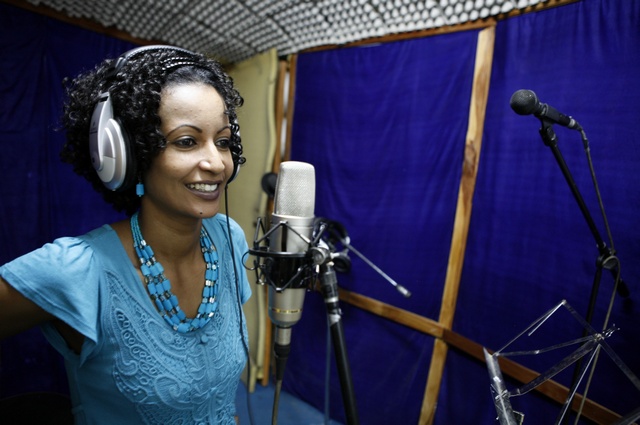
A lack of reliable and consistent economic data affects the extent to which the music industry is appraised within and across most African countries, Eritrea is no exception. Information about the Eritrean recording industry is minimal. For a nation that has had to endure years of war, music production in Eritrea, starting from 1950s, has always been faced with many challenges. A restricting political space, lack of music education as well as recording facilities are just a few of the challenges. This text explores the recording industry in Eritrea.
Introduction
Before the 1980s, there was hardly any existing full-fledged recording studios in Eritrea. Tewelde Redda, a famous Eritrean guitarist of the 1960s to mid-70s, recorded many of Asmara Theatre Association’s (Ma.Te.A.) music during live performances. Music arrangers like Osman Abdelrahim and Alamin Abdeletif whose modern music arrangements borrowed from western influences also played a role in shaping the music of the time.
In the 1980s when Ethiopian music, mainly Amharic was dominant, the few active Tigrigna singers (Yohannes Estifanos, Tareke Tesfahiwet, Mulugeta Beyene and Berhane Haile) in Asmara recorded their music at the Police Orchestra facilities. In these recordings, Isaac Banjaw, a music composer and arranger, played a significant role in producing Tigrigna music of the 1980s. However, Tsegay Beraki, one of the famous musicians of the time, recorded his 1990 album Afom Mear’yu in Addis Ababa, Ethiopia.
Also during this time, musicians in the armed struggle recorded their music in the underground studio of the Radio of the Broad Masses of the EPLF. The station was also used to play revolutionary music aired to the Eritrean audience who were under Ethiopian controlled areas of Eritrea. Music remained part of the struggle campaign and raised popular support encouraging the youth to be part of the struggle.
Tekle Kiflemariam’s (popularly known as Wedi Tukul) Yikealo, which came after the 1988 military victory that liberated Afabet town from Ethiopian army, and Ahmed Mohammed’s (aka Wedi Shiek) Hayet Enta are just two of the albums produced at the underground studio.
Exiled Eritrean musicians produced their works in Sudan and Saudi Arabia. For instance, Yemane Ghebremichael’s (Barya) Zemen album was produced in Saudi Arabia by the famous Eritrean music composer Abdallah Abubaker who had played with Ma.Te.A. (Asmara Theatre Association) and Rocket Band in the 1970s. Sami Berhane also recorded his album Nabra Aykonen in Saudi. Idris Mohammed Ali and Bereket Mengsteab on the other hand recorded their music in the Sudan.
During this period most music composers were self-taught and had revolutionized traditional beats blending them with contemporary popular genres. Tewelde Redda’s unique guitar skills invoked bluesy influences in his music. A big portion of what was produced during those years relegated the traditional Eritrean guayla beat to the backseat. Yemane Barya’s Zemen album, for instance, consistently employed rhythmic grooves of bass line and drum foreground in most of the tracks. This it appears, was the result of intensive improvisations and training which musicians like Abdallah Abubakar perfected with full knowledge of funk music.
The content of most of the music produced at the time, as much as they touched upon romantic issues, they raised Eritrean national consciousness. While some symbolised Eritrea as a female lover they had lost, others represented Eritrea as a home they missed in order to escape censorship of the time.
Computerized recordings
In the early 1990s, the Eritrean band Adulis used a four-channel mobile analogue mixer to record its music such as Adey Adeya. For artists who could not work with the analogue equipment, the only option was to travel outside the country to neighbouring countries like Ethiopia. In Ethiopia, a studio owned by Tekle Tesfazghi’s Studio played an important role in recording albums by Eritrean musicians. Fitsum Zemichael’s Lidya album produced in 1994 is one work produced at Tesfazghi’s studio.
Recording studios with 16-channel mixers mushroomed in the late 1990s when Admas Studio was established by Nahom, Natnael, Yoel and Lilly who were Eritrean returnees from Germany. Admas thus recorded albums by Yemane Ghebremichael (Mesob Ade, 1994), Aron Abraham (Deki Hade Ruba, 1995) and Dashim Misgna (Liwam, 1995).
Yemane Kidane’s and Mega Mix studios[i] came to be at the forefront from 2000 onwards. While Mega Mix studio continues to operate, Admas studio is out of the picture as it has turned into a bar. Mega Mix Studio, established by Isaac Abraham in the mid-1990s (now operated by Paulos T.Berhan), began producing works such as Dawit Teklesenbet’s 1996 album dubbed Shilan. The studio is also credited for producing popular Eritrean music since early 2000s.
These music studios, employing digital systems, introduced a trend of recording which stresses individual skill instead of working as a band. Individual musicians recorded their parts separately without any prior training together as a band. This has given significant room for creative arrangement of the separately recorded instruments and voices for songs. However, it minimized collaborative band works which would certainly have honed the skills and styles of musicians.
Yemane Kidane’s studio produced a couple of Helen Meles albums such as Resani (2003) and Halewat (2006) that were arranged by Muktar Saleh. Muktar’s unique composition of guayla beats emphasised saxophone as a bridge, as is the case in Helen’s ‘Fikri Hamime’.
In the past it was common for artists to use krar as a bridge. Even after Muktar left the country more than five years ago, this trend continued to be employed and with time it ended up being overused and thwarting the creativity of those who followed his footsteps. The trend however enabled Aron Berhe (aka Satir), Eritrea’s best known saxophonist of the 1980s to leave his footprint on every song that was released. It also appears that music with modern beats, which Eritrean musicians were famous for four decades ago, has been abandoned opting for repetitive guayla songs which are hard to differentiate from one to another.
In recent years, studios established by aspiring individual musicians include Tesfit Studio, Thomas Medhanie, GG (Ghideon), and Huruy Studio which are making strides in music production of the country. These individuals were previously musicians themselves; and the fact that some of them played more than one musical instruments helped them produce better arranged music.
A typical example is Temesgen Gebreslassie’s (alias Taniqo) first album Wela Aykeseb (2004) which was arranged by Thomas Medhanie. The tracks in the album are mainly love songs and most of them arranged with modern beats. The album was a change from what had been common and was able to get the Raimoc Awards[ii] of 2004.
Other notable productions in the last decade are Yohannes Tekabo’s Fewsi Libi[iii] (2008) and Eritrea’s Got Soul[iv]. Eritrea’s Got Soul was produced by French musician Bruno Blum in collaboration with a dozen of Eritrean musicians. From the diaspora, Fitsum Zemichael has stood out penetrating the international market with his compositions of various music genres that blend traditional beats from Eritrea and Ethiopia as demonstrated by his 2014 album Shabu (Love is universal).
Apart from the productions inside Eritrea, in 1991 Abraham Afewerki released his first album Kozli Gaba which is believed to be the first Eritrean music album to be distributed on digital format and recorded by a major record label in Europe – Virgin Records.[v] Abraham replicated his unique productions which blended traditional beats and the western influences of his first album on all his five albums. His last album Semai was released in 2006 before he passed away while working on a video of a song.
Distribution
Asmara-based studios are active only in recording music but have neither online presences nor distribution mechanisms. Many musicians, however, are partnering with online platforms such as LYE.tv, Halenga Records, Ella Records, ATA and Amen Entertainment to reach their audiences outside Eritrea.
Conclusion
Music production in Eritrea has shown significant strides in terms of appropriating modern instruments. Recording separately as introduced by the various recording studios has affected the quality negatively as cooperative band work was discouraged. The creativity that could have come about from cooperative work and improvisation is no longer possible.
Additionally the current crop of artists solely employ traditional beats played by synthesizers and electric instruments leaving little to no room for innovation.


Most popular

Top Naija songs of 2026
31 Mar 2026

Top Afrobeats songs of 2026
19 Mar 2026

Ghana: Mr Eazi and MOLIY’s ‘Comfort’ earns Urban Music Awards nomination
21 Oct 2026

Top amapiano songs of 2026
16 Feb 2026

Open call: CANEX Music Business Lab and Songwriting Camp
15 Oct 2026
Nigeria: CANEX WKND unveils 2026 programme
21 Oct 2026
Disclaimer: Music In Africa provides a platform for musicians and contributors to embed music and videos solely for promotional purposes. If any track or video embedded on this platform violates any copyrights please inform us immediately and we will take it down. Please read our Terms of Use for more.

Subscribe to our monthly Newsletter
Follow us on social media


Please log in to post a comment.