



















































By Dietrich Woehrlin
Rhythm is the common denominator in the music of all cultures. Every type of musical ensemble requires certain basic rhythmic abilities. Since rhythm is something that can be best absorbed, sensed and recreated with the whole body, the 'first steps' toward these basic rhythmic abilities are best taken literally.
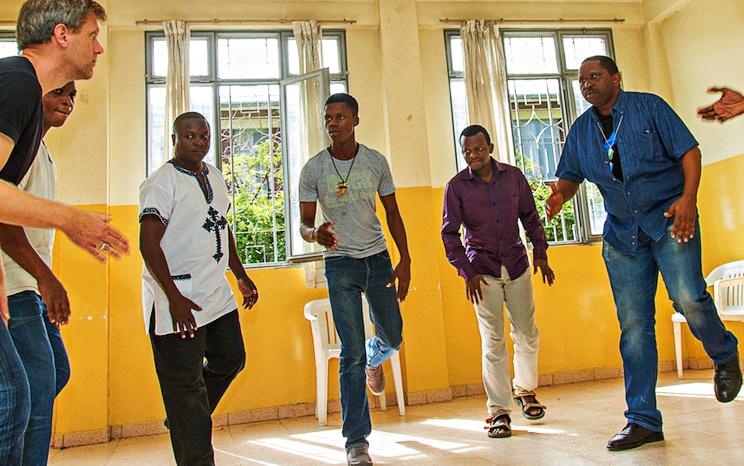
Clapping, dancing and speaking should also be used as a way of sensing rhythm. Body percussion is a practical way to learn and maintain rhythmic security. It allows the exploration of different rhythms without the need for instruments or written music. The body is the instrument and therefore body percussion entails stamping, rhythmic speech, finger snaps, and, quite literally, drumming on the body. Thus, rhythm becomes an all-encompassing experience, for body, senses, soul and intellect.
This is why body percussion is perfect for:
- Basic and advanced rhythmic training.
- Experiencing and understanding polyrhythms, as an individual or in groups, thus expanding one’s 'rhythmic horizons'.
- As a tool for learning and perfecting rhythmic ensemble playing for groups.
Over the many years I have taught rhythmic and body percussion, I have noticed that beginners are able to work with 3/4 bars much more easily than with 4/4 bars. I had assumed 4/4 bars would be easier for them (working on a basis of three beats instead of two or four). Today, this seems very logical to me. It’s much easier to learn 2 against 3 (binary system) than 3 against 2 (ternary system).
It is possible to reduce any rhythm to a combination of twos and threes. In my opinion it is important to study both of these numbers/rhythms and the combinations contained therein first, as an essential part of the learning process. It is only when you have a solid grounding in 2 against 3 and 3 against 2 that you can work freely with all the other rhythms.
Rhythmical group exercises are important and hugely beneficial, because each player is forced to be very precise, and to learn his/her own part against the rest of the group.
This type of exercise can be put into group practice:
- In a circle (i.e. one after the other).
- In groups, A + B (C, D...).
- As a canon.
It is very important to not just perform the rhythmic exercises with the body, but to also be able to individually recite or count them aloud. Only when your mind can move freely between the different levels of polyrhythms, are you able to play them, listen to them and improvise on them with freedom. It is only possible to achieve this through special training, learning to separate your head (counting and reciting aloud) and the physical movements from one another, thus 'automating' the exercises.
This means: in order to think and play using constantly changing rhythmic levels, you have to count aloud, or recite similar words and syllables.
In order to work better with groups of 2 and 3 notes, it can be helpful to use certain syllables or even words, instead of numbers.
So instead of counting groups of two like this:
1 2, 1 2, 1 2, 1 2, 1 2…,
it is easier to recite:
Ta Ke, Ta Ke, Ta Ke…
1 2 = Ta Ke
1 2 3 = Ta Ke Di
If you want to try out 2 against 3 in body percussion you can clap the 2 with the hands and do the 3 with steps. So you will have hands (2 claps) against feet (3 steps). In order to do this precisely, start with the steps, stomping continuously on the Ta while reciting TaKe. You’ll get three Tas or, in other words, three groups of two (TaKeTaKeTaKe).
To get 2 in the hands against this 3 in the steps you start reciting TakeDi in the same reciting speed that you had before. Now clap on the Tas of TaKeDi. You’ll get two Tas or, in other words, two groups of three (TaKeDiTaKeDi). Now you have 2 claps against 3 steps.
Instead of just clapping, you could also use other sounds or even a sound sequence:
Example: thigh - chest - clap (= three sounds)
thigh - chest - clap - snap (= four sounds)
Body percussion tutorial 1: Introduction
Body percussion tutorial 2: The 2 against 3 circle
2 groups of 3 in the hands or recited (emphasising either Ta or KeDi of TaKeDi) against 3 groups of 2 in the steps (emphasising only the Ta of the TaKe). This is a group exercise whereby the rhythm is passed from person to person in the circle.
Body percussion tutorial 3: The 2 against 3 canon
2 groups of 3 in the hands or recited (emphasising either Ta or KeDi of TaKeDi) against 3 groups of 2 in the steps (emphasising only the Ta of the TaKe). The canon is created by three groups of people starting at different times.
Body percussion tutorial 4: 4 against 3
4 groups of 3 in the hands or recited (emphasising either Ta or KeDi of TaKeDi) against 3 groups of 4 in the steps (emphasising only the Ta of the TaKeDiMi).
Body Percussion Tutorial 5: The 4 against 3 canon
4 groups of 3 in the hands or recited (emphasising either the Ta, Ke or Di of TaKeDi) against 3 groups of 4 in the steps (emphasising only the Ta of the TaKeDiMi). The canon is created by three groups of people starting at different times.
Body Percussion Tutorial 6: The 3 against 2 circle
3 groups of 2 in the hands or recited (emphasising either Ta or Ke of TaKe) against 2 groups of 3 in the steps (emphasising only the Ta of the TaKeDi). This is a group exercise whereby the rhythm is passed from person to person in the circle.
Body percussion tutorial 7: 3 against 4
3 groups of 4 in the hands or recited (emphasising the Ta or the KeDiMi of TaKeDiMi) against 4 groups of 3 in the steps (emphasising only the Ta of the TaKeDi).
Body Percussion Tutorial 8: Modulating between 3 against 4 and 4 against 3
Switching between 4 (hands/recited) against 3 (steps) and 3 (hands/recited) against 4 (steps).
The tutorials shown here were designed for the Professional Training Programme developed by the Global Music Academy in Berlin, Germany, for use in Music Academies in Africa. The videos were made possible through a grant from the Erasmus + Programme of the European Union and Goethe-Institut, who funded the East African Global Music Campus (EAGMC) – which took place in 2017-18 in Addis Ababa, Ethiopia – and participants from Music Schools and Academies in Ethiopia, Sierra Leone, South Sudan, Tanzania and Uganda. These tutorials form part of the Rhythm and Body Percussion module for the programme.


Most popular

Top Naija songs of 2026
31 Mar 2026

Top Afrobeats songs of 2026
19 Mar 2026

Top amapiano songs of 2026
16 Feb 2026

Ghana: Mr Eazi and MOLIY’s ‘Comfort’ earns Urban Music Awards nomination
21 Oct 2026
Open call: CANEX Music Business Lab and Songwriting Camp
15 Oct 2026

Nigeria: CANEX WKND unveils 2026 programme
21 Oct 2026
Disclaimer: Music In Africa provides a platform for musicians and contributors to embed music and videos solely for promotional purposes. If any track or video embedded on this platform violates any copyrights please inform us immediately and we will take it down. Please read our Terms of Use for more.

Subscribe to our monthly Newsletter
Follow us on social media


Please log in to post a comment.