



























































Saturday, 28 November 2020. The Spier Amphitheatre was the perfect place for my coming out of performing-arts lockdown. After eight months of vinyl and CDs, early summer was a good time for the vibrancy of live music. And good it was, despite the hint of COVID-19 hovering between the phrases and behind the many colourful masks.
If perfect harmony is real, or possible, it was in the air on Saturday. Harmonious rapport between the fans, an edgy camaraderie and subdued awe at still being safe, and wide-eyed anticipation of an aural feast. It was not only the audience commenting on how long it had been since they attended a live show – some of the performers spoke of their feelings of first time back onstage in eight months. But none of them held back in delivery.
From jazzed-up and jazzified, to reinterpreted Verdian madrigals, from Xhosa uhadis and Venda panpipes to the interwoven polytonal vocals of Ancient Voices, seeing five concerts in eight hours was unmitigated sensory overload.
The festival opened with vocalist and pianist Nomfundo Xaluva – a late replacement for Spha Mdlalose, who was unable to make it because of illness. With Blake Hellaby (piano), Steven de Sousa (bass), Lumanyano ‘Unity’ Mzi (drums) and Thandeka Dladla (backing vocals) as the backing band, I expected something more. Xaluva has a fine voice, and is a recognised composer, but her choice of music as the opening act was uninspired. It may be that the short notice left her unsettled, but she talked and sang her way through a set of what felt like hymns and dirges.
Next up was Ancient Voices, an unusual blend of classical and indigenous instruments played by surprisingly young(ish) musicians. I say surprisingly youngish because their music and instrumentation are not usually associated with the urban youth. This concert was one of my highlights. In contrast to the opening act, it was refreshingly playful and joyous. Ancient Voices is three young women – Nomapostile Nyiki, Lungiswa Plaatjies, and Nomakrestu Xakathugaga – playing traditional instruments such as the uhadi and djembe, with two more women, Sarah Evans and Larissa Johnson, playing violins. Together, they create complex rhythms to accompany the layered chants, calls and whistles. An enchanting and delightful ensemble.
I chatted to both Nyiki and Evans offstage (two separate chance encounters) and both of them commented on how important it was for the urban youth to have some tangible connection with their traditional roots – how it helps build and maintain self-image and keep them connected and grounded.
Navi Yuga, the next show, is a Siya Makuzeni and Darren English collaboration. Makuzeni, the 2016 Standard Bank Young Jazz Artist of the Year, is a trombone-playing jazz singer. I’ve been aware of her as a vibrantly dynamic musical force since hearing her sing and play on Vivid – Vivid Africa’s extraordinary 2005 album by McCoy Mrubata and Greg Georgiades.
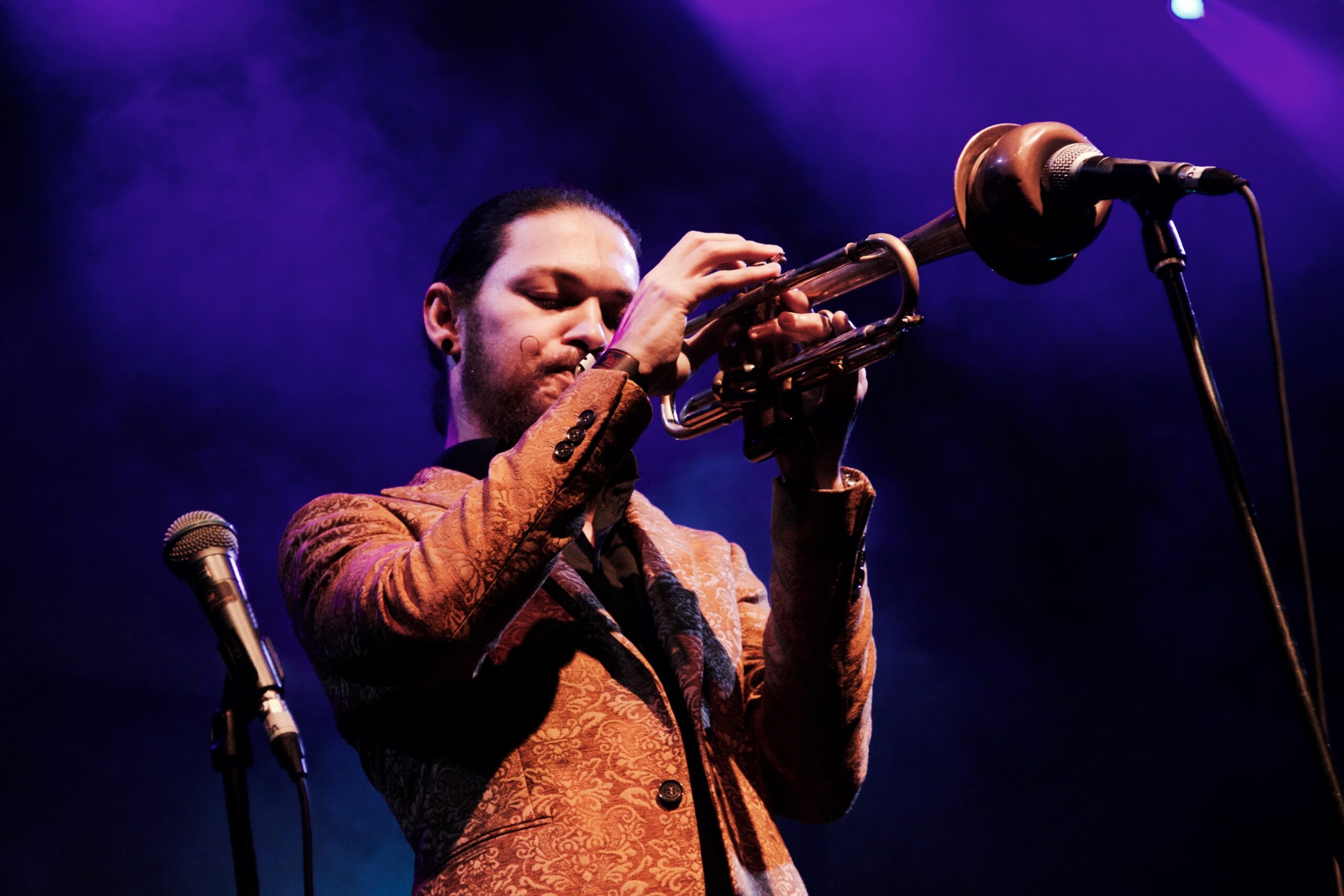
Darren English, though, was an unknown quantity to me. And if he’s a new musical voice to you as well, you’re in for a treat. He plays trumpet with a crisp assuredness, a purity of tone and imaginative phrasing that promise a great future.
After an uncertain and hesitant start, what a treat this collaboration turned into. I had no idea who composed what, but Makuzeni and English wove dreams and stories to fire the imagination and arouse the heart. On the second track, Makuzeni put down her trombone to sing with passionate energy, her voice punctuated by English’s sharp and crystal-clear trumpet. By the time Makuzeni kicked off her shoes, her brilliant scatting had me breathless. Solidly backed by Mpumi Dhlamini on piano, Lumanyano ‘Unity’ Mzi on drums, and Sean Sanby on bass, Makuzeni and English explored freely. At some point, English took over on piano, playing with the same assured confidence that he did on his first instrument, and Makuzeni went back to her trombone. It was madly inspiring music, the stuff from which legends are made.
The next act, another new collaboration, was the long-awaited encounter between legendary pianist Paul Hanmer and composer, guitarist and singer extraordinaire Neo Muyanga. Hanmer and Muyanga in Conversation – presenting brand new material written especially for this festival – was a treat for the heart, the mind, the ear and the spirit. This fresh work – painting a broad musical landscape of Western art music, contemporary African jazz and chance music sprinkled with folk idioms and oddities – also reflects a deep history reaching from urban maskandi back to Verdi and the madrigals of 16th century Italy.
If you think that’s a mouthful, you should have been there to get the whole earful. This was the sensitivity and gentleness and the artistic intelligence and sublime sounds of two minds combining as one voice. So beautiful it brought tears to my eyes while putting smiles in my heart. A very special experience that will carry me well into the New Year.
This festival did not wind down gently, did not go gentle into that good night. Oh no, not with the amazing talent of Sisonke Xonti to see it out. Saxophonist Xonti, the 2020 Standard Bank Young Artist for Jazz, provided a rousing set to say goodnight. He was presenting portions of uGaba, The Migration, his second album, which was released in November. Backed by the superb talents of Steven de Sousa on bass, the superlative Yonela Monana on piano (Kyle Shepherd was originally scheduled to play this gig), Tefo Mahola on drums and Sabu Jiyane on percussion, Xonti lifted the roof – or would have lifted the roof if the amphitheatre had one.
Xonti's four-part ‘Migration Suite’ is a bold work, exploring rural and urban identity and the perilous spiritual journey from homeland to the global village.
One lasting impression, a small COVID-19 reminder that summed up things heard from the audience and some of the musicians, was Paul Hanmer coming onstage wearing his mask. But by the third song, his mask rested on a corner of the grand piano. I like to think wearing a mask represented the caution we all need to show towards each other, and removing the mask represents the trust we place in the people around us. The symbolism of that gesture by Hanmer was echoed in the many small encounters with artists and audience on Saturday night at the Spier Amphitheatre. Rather be safe than sorry.


Most popular

Top Naija songs of 2026
31 Mar 2026

Top Afrobeats songs of 2026
19 Mar 2026

Ghana: Mr Eazi and MOLIY’s ‘Comfort’ earns Urban Music Awards nomination
21 Oct 2026

Top amapiano songs of 2026
16 Feb 2026
Open call: CANEX Music Business Lab and Songwriting Camp
15 Oct 2026
Nigeria: CANEX WKND unveils 2026 programme
21 Oct 2026
Disclaimer: Music In Africa provides a platform for musicians and contributors to embed music and videos solely for promotional purposes. If any track or video embedded on this platform violates any copyrights please inform us immediately and we will take it down. Please read our Terms of Use for more.

Subscribe to our monthly Newsletter
Follow us on social media


Please log in to post a comment.