



















































By Tedros Abraham
This text provides an overview of Eritrea’s traditional music across most of the country's ethnic groups, including its traditional dances and instruments.
Dances
Dance plays a very important social role in Eritrea. With nine different ethnic groups, the dances of the Kunama and Hidareb people of Eritrea are particularly exuberant.
Bilen, Tigre and Tigrinya have a dance commonly performed by a group of both sexes in a circle. While the Bilen and Tigre ethnic groups call it golia (or sisiit), the Tigrinyas call it guayla or kuda[i] The dance movements have variations: the Bilen and Tigre shake their shoulders while standing only to rotate in the circle towards the end of the dance, whereas the Tigrinya first dance rotating anti-clockwise but later alter it to fast-paced shoulder movements while facing a partner breaking the circular rotation.
Asomia is a praise song-dance commonly performed in Bilen, Hidareb and Tigre ethnic groups[ii]. In this performance, two groups of opposite sexes face one another. The females beat the drum while the males dance holding their canes exchanging praises. A type of song-dance usually performed by females - namely alieleho in Bilen but with no specific name in Tigrinya - is similar to the praise song-dance stated above for its content, which praises and at the same time passes on a veiled criticism during wedding ceremonies. A romantic type of dance, hembob, is performed by partners of the two sexes and is distinct to the Hidareb and Tigre[iii].
Bilen and Tigre women dance shellil, in which its distinctive feature is their neck movements that let their braided hairs spread like water-fountains to both sides of their shoulders [iv]. The neck movement along with soft steps of their feet and overall body movement is a stunning sight. This dance can also be performed in a kneeling position with a vigorous neck movement that makes the dancers appear possessed by frenzied spirits.
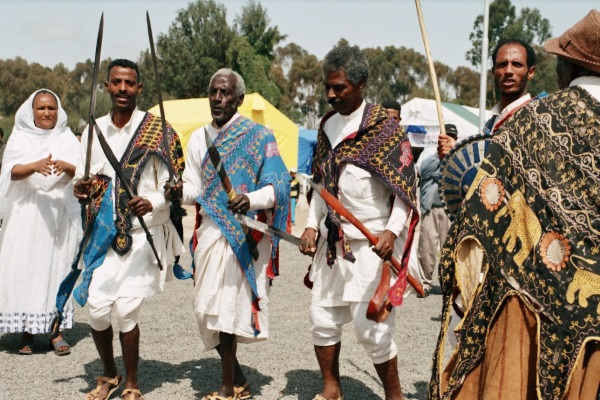
The Hidareb’s serret dance combines both an intermittent warrior’s agile jumps, during which the male dancer brandishes his sword, and a waist-up serpentine movement in which both sexes keep their bodies in the shape of an arch[v]. Kuas is also another type of dance the Hidareb perform imitating bird-wing movements with their hands.
Afar and Saho are two ethnic groups that have very close affinity in their languages and dance movements. The common dance is keke, in which both sexes dance facing one another and exchange places with their partners, moving towards one another while dancing. The male hops rhythmically and swerves to arrive at the spot where his partner had been. The female brandishes a jile (wide-bladed curved knife), which Afar men often carry along with them[vi].
The Kunama cultural and religious rituals - tuka (rites of passage), indoda (prayers for rain), sangga-nena (peaceful mediation) and shatta (showcases of endurance and courage) - are celebrated with dances that are widely loved across the country. The fast-paced movements require the females to shake every part of their bodies as the male hop and beat the ground with their feet, complementing the drumbeats.
Dances in the Nara ethnic group meanwhile feature warriors wielding kedo (a shield made of animal skin) and spears or swords. Such dances display movements of attack and defence using those weapons.
Instruments
The traditional musical instruments of Eritrea have similarities with those of countries in the rest of the Horn of Africa. They include the stringed instruments, drums (Krar, Abangala, Rebaba and Chira-Watta) and wind instruments (Shambiko Embilta, Melekhet and Horn).
The instrument common to all of the nine ethnic groups is the drum, referred to as kabro (Afar), kalambura (Bilen), kabbur (Nara)[vii] or kebero (Saho and Tigrinya). The drum sets the beat for their musical tunes and rhythms. On some occasions it is the only instrument used for a song accompanied by dance, as is the case in the Afar and Saho’s keke dance.
The drum shapes differ across the ethnic groups. With the Afar, Saho and Tigre, for instance, we find semi-spherical shaped drums. In Tigrinya, a cylindrical shaped drum is very common. There is also an oval one with flat surface on both ends in the Orthodox Christian churches. The church also has a tsenatsil, which has a jingling sound like that of a tambourine[viii].
The Kunama’s wear sandals fashioned with layers of leather that make clapping sounds with every move. This is accompanied by masses of beads or bottle caps on the lower body, whose rattling sound is like a shekere.
Stick percussion is also common in some of the ethnic groups; especially in Bilen, where it never parts from the hands of the dancing men.
A very widely used string instrument is a lyre-like instrument with slight variations across the ethnic groups. The Tigrinya krar (masenqo) is readily available in various shapes and variations. Traditionally, the krar had five or six strings.
The abangala is a single-string instrument, plucked like a guitar with fingers pressing on the string along the fret-board (fingerboard), made out of gourd. It is commonly used among the Kunama ethnic group. Another single-string instrument - played with a bow like violin - is the chira-watta, which very much rooted in the traditional Tigrinya music.
Wind instruments used in traditional Eritrean music, except for the flute, appear to be specific to each of the ethnic groups. For example, the harbinger is a Kunama horn instrument used for dance that sounds like a train whistling to declare its arrival. Though similar in its name to the modern brass horn, it is made from a real animal horn.
Among the Tigrinya, there are two distinct wind instruments: embilta and meleket. This two instruments feature in many traditional songs and has had an impact on the mood of various traditional dances. The embilta is a metre-long tube played by blowing air into it. However, in present-day Eritrea it is hard to see these kinds of instruments and it is difficult to find skilled players. Towards the end of the 1990s for instance, there was just one father and son who could play the meleket.
Key artists
The earliest known songwriter in Tigre is Idris Wed Amir, whose songs have been reproduced by many. As he travelled singing from Semhar region (in eastern Eritrea) to eastern Sudan, his songs were widely played across many parts of Eritrea and eastern Sudan. Renditions of a song such as ‘Abayki Gesa Yi Mdru’, for example, has been sung by Idris Mohammed Ali and Mohammed Lobinet.
In Tigrinya, Ateweberhan Segid was well-known for his krar skills and is considered the first to have employed electric krar in his productions. Bereket Mengisteaboften referred to as the king of the krar produced songs rooted in traditional tunes [ix] . Tsehaytu Beraki is equally talented in krar, like her male counterparts, and started playing in Siwa houses (local beer halls). All three of them played important roles in raising their audiences’ political and social awareness in the years from 1950s to 1970s, when Eritrea intensified its struggle for independence.
Among Eritrea's traditional vocalists, Mohammed Druf is a prominent singer who was awarded a number of prizes, including Raimok Award, for his productions. Ali Mohammed (Ya’asina) is known to have been influential in Saho music, as well as the early productions during Eritrea's struggle for independence. Mahmoud Kahano and Abrar Osman (who won the Raimok Award of 2000, dominating all categories), are also notable songwriters in the Saho. Famous singers in Nara ethnic group include Adem Faid Amer and Mohammed Agar. According to award-winning artist Faid Amer, the first known songwriter in this ethnic group was Adem Ibrahim [x].
Conclusion
Nowadays, the traditional dances and music of Eritrea's various ethno-linguistic groups can no longer be found in their purest sense. What remains exists in remote villages, as modern productions typically blend traditional tunes and beats with modern influences. Traditional instruments are often played in an acoustic setting, or along with synthesizers.
The only active cultural troupe, Sibrit[xi], aims to revive traditional Eritrean music. Although it still performs various traditional dances, these are often improvised and contain new elements.
References


Most popular
Call For Applications : ACCES seeks a UK-based performer
10 Sep 2026

Top amapiano songs of 2026
16 Feb 2026

Top Afrobeats songs of 2026
19 Mar 2026
Open call: Ernst von Siemens Music Foundation 2026 funding programmes
04 Sep 2026
Open call: FAME Week Africa, Pressure Cooker Studios songwriting camp
09 Sep 2026
Open call: Goethe-Institut grants for Southern African creatives
08 Sep 2026
Open call: SAMRO Music Creation Support Fund
02 Sep 2026
Disclaimer: Music In Africa provides a platform for musicians and contributors to embed music and videos solely for promotional purposes. If any track or video embedded on this platform violates any copyrights please inform us immediately and we will take it down. Please read our Terms of Use for more.

Subscribe to our monthly Newsletter
Follow us on social media


Please log in to post a comment.