













































By Maminirina Rado Andrianaivomanana
This text provides an overview of the traditional music of the ‘Big Island’, its influences, its roots and its impact on Madagascan society.
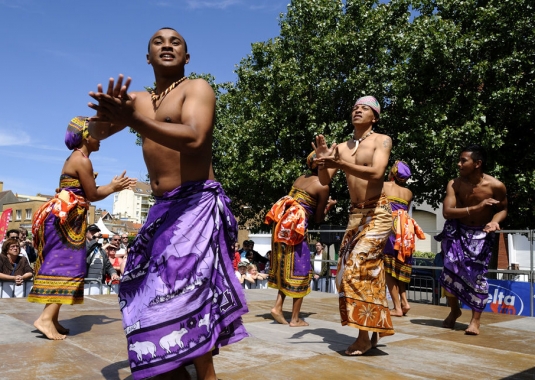
Traditional music in Madagascar formed its identity with influences from various horizons: the Austronesian peoples on the one hand, and African, Arab and European migratory populations on the other. Such variety made it impossible to specify, in time and space, the true origin of traditional music in Madagascar. What is certain is that traditional music was probably heard for the first time in Madagascar a millennium ago.
Today, with the arrival of the internet, the traditional music of Madagascar remains alive and refreshed by new contributions. Like most traditional music, that of Madagascar has both a sacred and a secular side. It can sometimes become the backbone of a ritual, as much as it can be used to animate the games of teenagers in the village. This had already been so in the era of kingdoms and even beyond. The only difference is that now, modern appliances and pop culture come to replace traditional musicians and their melodies. This phenomenon has taken over the big cities, but much less the distant villages. When talking about traditional Madagascan music, ternary rhythm comes immediately to mind. If the country speaks one language, this language presents variants seen from the various groups that make up its population.
The same is true of the ternary rhythm, which comes in hundreds of versions, from north to south, from east to west and central Madagascar. In short, the ternary form, the basic tempo of traditional music here, is the common reference of the wealth of traditional music from Madagascar. Although MP3 players are flooding the markets, the remote villages of the country still retain a significant part of the musical tradition with local artists. In their various ways of playing, the rustic traditional sounds are still heard. Here the artist sings more to ensure a vital link to the community’s history than with the aim of becoming a big star. In major cities, popular culture has appropriated in its own way the variety of traditional genres, by interposing rhythms, incorporating new electronic sounds, and creating space for spectacular innovations.
The main ethnic groups of Madagascar and their influence on traditional music
According to an ethnographic sampling inherited from colonization, Madagascar is home to 18 ethnicities. Recent studies have also demonstrated that the 22 million Madagascans represent a complex mosaic, with a culture and a common language understood and spoken throughout the territory. The concept of ethnicity has therefore been abandoned to make way for a common ‘human group’. However, the facial features of the population do vary between Asian, Arabic and African, or various combinations of the three.
History made it that some human groups were more influential than others in the musical development of Madagascar. The Sakalava group dominated the west, and its music has influenced that part of the island. In the centre, the Merina are located on the highlands of Madagascar. To the east, the Betsimisaraka marked their presence with vivid rhythmic variations. According to legend, ‘Afindrafindrao’, an ancestral musical tune danced in quadrille, was adopted by the Merina kings in the 19th century and later influenced the whole country.
In the south, the Antandroy are probably one of the strongest of groups in preserving its musical tradition. For them, the first musical instrument is the body – they understood it a little more than others, probably because they live in a hostile region where water is very scarce and famine dreaded. Traditional music has until now represented a genuine force unrivaled elsewhere in the country. The contemporary singers or musicians from this group are the most recognized worldwide.
In the north, the Antakarana group also made a special contribution to traditional music in Madagascar. Favoured by the climate and vegetation, this part of Madagascar is one of the most festive of the country. Other groups have also left their musical fingerprints, even if they were less highlighted, include the Bestileo, Tanala, Bezanozano, Tsimihety, Bara, Antesaka, Antemoro, Sihanaka, Vezo, Masikoro, and a dozen others.
Traditional instruments
The ‘Valiha’ (zither pipe) and ‘marovany’ (a box zither) are the undisputed kings of traditional music instruments of Madagascar. The first is a cousin of the second, and both are played in most of the country as a legacy to the island’s Malayo-Polynesian heritage. Then comes the rattle stuffed with rice seeds, called korintsana, koritsa or kantsa, depending on the region.
Apart from that, one finds four categories of instruments in the traditional music of Madagascar: string, membrane, idiophones and aerophones. The Austronesian, African, Arabic and European contribution formed a common basis for musicians and traditional singers of Madagascar. More than 100 musical instruments have since been listed as having secular origins. Some are more specific to a certain region, such as lutes (of Arab origin), mandolins (adopted in the south and southeast of the Big Island), kabosy (box guitar) and the sodina, a flute that is also an Arab contribution.
Traditional ceremonies
Traditional music is placed at various occasions in Madagascar and accompanies Madagascan life throughout the ages. For example, when the young Antandroy from the south keep their cattle across the field, they pass time by singing the beko. This is also sung at wakes. Traditional music takes another dimension during ceremonies in memory of ancestors, such as Tromba, or possession rites practiced throughout Madagascar. Since time immemorial, funerals, circumcisions, marriages, the return of the dead, initiation rites, past clan wars, victories and popular pleasures gave pride of place to traditional music. For each human group, these mass gatherings are distinguished by their names, their dates of celebration and some details in the performance of certain rituals, but they are all fundamentally similar.
Contemporary artists of traditional music
In Madagascar, traditional musicians are often self-taught. There are neither schools nor music teachers; everything is learned in the family setting, orally and by listening. In this way, a artist like D’gary, from the south of Madagascar, has been able to revolutionize the way of playing the guitar. He simply picked up the playing style of marovany, guitar on crate, which is of Bara origin. His virtuosity led him to fill halls around the world and to play with top international musicians.
Régis Gizavo, another musician from the south of the island, is an outstanding accordionist. He has already accompanied some of the great singers of French music. This Madagascan artist has appropriated the music of the ethnic group called Antandroy, adding modern instruments such as congas, drums and bass. Also in the south, Fanovona Jean Gabin (who died in 2010) will always remain a Madagascan reference in Antandroy traditional music. The champion of beko, he traveled across five continents, becoming an ambassador of sorts.
Based in Fianarantsoa, the ‘capital’ of the Betsileo ethnic group, Raprôsy the lokanga or fiddle player, continues to enliven the ancestral music of this region, horija. This farmer-looking musician is an institution in Madagascar, like the virtuoso Rakoto Frah (who died in 2001), whose face is engraved on the national currency, an outstanding sodina player. He comes from the central part of Madagascar, where Merina people live.
Also, Mama Sana (1900-1997) excelled as a singer and player of marovany. She would have practiced music therapy without knowing it, as her genius made her sing and play illuminated texts and unimaginable melodies. Currently, artists and groups of the new generation, such as as Baba Madagascar, Mika and Davis, Zandry Gasy, Oladad, Teta and others are trying to give new impetus to the traditional music of Madagascar.
-
Mythes, rites et transes à Madagascar - Robert Jaovelo-Dzao, aux éditions Karthala, 1996.
-
Tantaran’ny Andriana - François Callet, Tome .2, 1883.
-
‘Les danses Malgaches’ - Gustave Mondain, Bulletin de l’Académie Malagasy, Vol VII 1909


Most popular

Top amapiano songs of 2026
16 Feb 2026

Top Afrobeats songs of 2026
19 Mar 2026

AFRIMA 2026: All the winners
12 Jan 2026
Open call: Goethe-Institut grants for Southern African creatives
08 Sep 2026

Top Naija songs of 2026
31 Mar 2026
Sun-El Musician confirmed for ACCES 2026 in Joburg
15 Sep 2026
Open Call: Voices For Roxette invites artists worldwide to submit cover versions
15 Sep 2026
Disclaimer: Music In Africa provides a platform for musicians and contributors to embed music and videos solely for promotional purposes. If any track or video embedded on this platform violates any copyrights please inform us immediately and we will take it down. Please read our Terms of Use for more.

Subscribe to our monthly Newsletter
Follow us on social media


Please log in to post a comment.