




























































Traditional musical instruments in Namibia
17 Jul 2015 - 07:12


By Minette Mans
Musical instruments in Namibia are traditionally used in specific circumstances. These ways are culture-specific and the relationships between people, instruments, and dance, and their values and beliefs are constructed in unique ways. Let us look at some musical instruments in terms of the manner in which sound is produced.
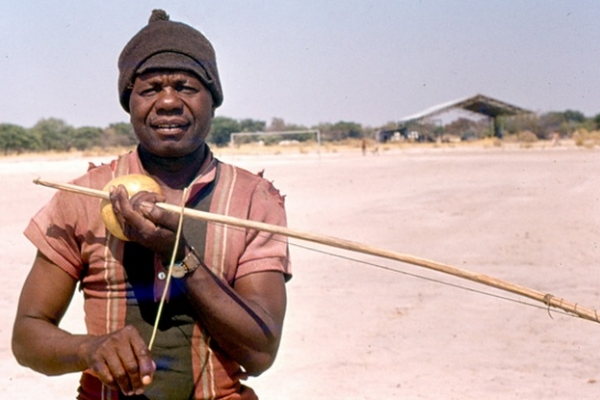
Chordophones are instruments using strings at tension. The strings can be plucked, struck, scraped or bowed to bring forth sound. Although the drum is usually considered Africa’s heartbeat, bows are more common in Namibia - symbol of the philosopher and sages of the past. In Namibia, pastoralists move their goat, sheep and cattle herds from one watering and grazing spot to another. This herding lifestyle contributed to an abundance of bows and other string instruments.
Musical bows may be performed without or without song, praise and other sounds. Songs trace histories and individual stories. One song by a master ombulumbumba player, Petrus Tjisuta, tells of walking on the long road between Johannesburg and Opuwo in Namibia. On the road he found a lion sleeping. He poked at it with his finger. The lion got such a fright, it jumped up and ran away. Bows are quite often played by women as well as men, often for ‘loneliness’ reasons. Some bows are played by inserting one end into the mouth (cheek) and beating the string with a small stick while creating different overtones by changing the shape of the mouth inside. Braced bows are tied with a small piece of sinew or wire to create two (or more) different lengths of string, giving different tones. When an external resonator is attached a more resonant sound can be created.
Hunting bows used as musical instruments are common and may be braced or un-braced. They are mouth resonated. Sometimes they are large and may be played by two persons. This is called n!aoh in Kxoe language. Strings may be made of sinew or of steel, and are usually single, although there an unusual form of !gomakhās in north-western Namibia has two metal strings. The second (higher pitched) string is metaphorically referred to as the female voice, and it provides sympathetic vibration for the longer (male voice) string.
The musical use of hunting bows is ancient and filled with potential power. It may be played before a hunt, when the hunter prays to the spirits of deceased relatives to obtain help in the hunt (Kxoe). But the bow is also played after a successful hunt (Kxoe, !Kung, Hai//om) and to give thanks after killing one’s first eland (Kxoe). It is played for one’s own pleasure and to calm the animals when herding cattle (Ovazimba, Ovahimba, Ndonga) and for social entertainment (Hai//om, Ovazimba, Ovahimba, Ndonga). Amongst some of the people the bow is far more than mere musical or hunting instrument, and good playing is powerful enough to ensure a successful hunt. According to Olivier (2005), two or more Ju/’hoansi are not allowed to play their hunting bows at the same time as it could be dangerous. The men could inadvertently kill each other because they would be musicians, hunters and animals at the same time.
The braced, gourd-resonated bow exists among several cultures in Namibia, each language having its own vernacular name for the instrument. In northwestern regions the calabash (otjikola) or plastic resonator is placed on the chest, and it is opened and closed rhythmically to create different sound effects. In the north-east the resonator is made of a dried melon, a tortoise shell, a metal tin, or plastic or wooden bowl. The placement of the brace that ties off the string at different lengths differs from player to player, and culture to culture. It may appear anywhere from about one fifth of the string to the middle. Like the larger hunting bows, these bows are also held either vertically to the front of the player or horizontally at chest level. The string is struck with a small stick usually held in the right hand, while the left hand holds the bow and creates partials by touching the string with the nail of the thumb or index finger. In Ovazimba music there are many vocal sounds like aspirations, clicks, shouts and drone, that enhance the quiet songs and bow-playing.
The scraped musical bow has a completely different sound. Its ‘string’ is a strip of palm leaf, and it is played by scraping a small stick across the notches on the bow in a rhythmic pattern, while at the same time placing one’s open mouth over the strip of leaf for resonation. Traditionally played by women, it is not surprising that one form of this bow has associations with the “traditional wedding” (ohango) of Ngandjera people. In times past when the large gathering of young ‘brides’ travelled north to Ombalantu for this initiation, some of them played the okayagayaga bow while walking to their destination.
The north-western pluriarcs are instruments with several bows and strings attached to a boat-like resonator. From the large 5 string otjihumba (Ovazimba) to the smaller 4 string Ju/’hoan instrument, the tuning of the strings differs to fit with the tonal organization of the music of that area. The Ju/’hoan pluriarc, played by women, has metal strings and a metal resonator. It is accompanied by singing and sometimes by dance and is played for entertainment, although when dancing and playing healing songs with this pluriarc, shamans can go into trance. The five-string pluriarc is played only by men. Amongst Ovahimba and Ovazimba, the otjihumba accompanies praise songs (omutandu) – a form of orature that is fundamental to lifestyle and ancestor remembrance of this northwestern part. It forms a rhythmic ostinato accompaniment interspersed with instrumental solos that expand and vary the basic musical material. In Ju/hoan and Hai//om playing, the voice part performs the same melody in imitation of the pluriarc. Ju/’hoansi relate that their five-string pluriarc originated in the Nyae Nyae area. Its history is sacralized in a myth about Kxao N//ae, who used the instrument to create his own inner peace after having tragically killed his wife. The music he played also served to calm others who might have punished him in revenge.
Traditionally, young men of that north-western area played a lute or ramkie. The lute played amongst Ovazimba, Ovacuvale, and Ovangambwe is called otjindjalindja. It has three metal or animal sinew strings, a resonator box, a neck and fingerboard and the head is fitted with three tuning pins. The fingerboard has two raised nuts, therefore allowing only a single change of pitch for each string. The strings are generally plucked or strummed with the right hand while the left stops and releases the strings.
Another interesting string instrument is a board or trough zither occasionally found in Ju/’hoan, Hambukushu, Batswana, Sambyu and Khoekhoe communities. The single string is bowed with a small bow held in the right hand, while the left touches the string to create partials. The trough or board to which the string is attached, is topped by a loose tin resonator (in the past a tortoise shell). Amongst Ju/’hoansi the zither is imbued with special meaning, played the evening before a hunt, or to announce a successful hunt or even after an unsuccessful hunt in order to ensure that the next one will be successful! The musician is said to pray and the music of the bow goes up to the god who can help the hunter.
It is likely that in future the use of bows, lutes and zithers will go into decline and be replaced with more ‘modern’ instruments such as guitars and violins.
Idiophones are instruments of inherently resonant material, and include a variety of ankle and hand-held rattles, sticks, bells, gongs, iron and wood plaques (one of which, otjipirangi, is attached to the foot and stamped on the ground), lamellophones, xylophones and a scraped calabash idiophone . Different shapes and forms depend on materials available in a certain area.
Membranophones include the many different forms of drums and mirlitons, include tubular conical drums (usually used in sets of two or three mulupa), large ceremonial drums (eengoma) supported on a cleft upright stick, a clay pot drum, wooden pot drum with wet handheld membrane, friction drums, mirlitons. The Kwanyama eengoma are associated with the women’s traditional wedding ceremony efundula and used to be played in large ensembles of maybe twenty to forty drummers.
Aerophones include end-blown and side-blown animal horns, one with a wax bulb extension - the Ovahimba ondjembo erose which is used to inform people that cattle are being moved. There are also stopped and unstopped flutes from reed, animal horn, or papaya stems (≠āb), with and without finger holes, bullroarers and whistles from bark or metal.
Whether used singly or in combination with other instruments, voice or dance, musical instruments all have their own repertoires and form part of a greater system or constructed musical world.
For more on traditional music in Namibia, click here.


Most popular

Top Naija songs of 2026
31 Mar 2026

Top Afrobeats songs of 2026
19 Mar 2026

Ghana: Mr Eazi and MOLIY’s ‘Comfort’ earns Urban Music Awards nomination
21 Oct 2026

Top amapiano songs of 2026
16 Feb 2026

Open call: CANEX Music Business Lab and Songwriting Camp
15 Oct 2026

Nigeria: CANEX WKND unveils 2026 programme
21 Oct 2026
Disclaimer: Music In Africa provides a platform for musicians and contributors to embed music and videos solely for promotional purposes. If any track or video embedded on this platform violates any copyrights please inform us immediately and we will take it down. Please read our Terms of Use for more.

Subscribe to our monthly Newsletter
Follow us on social media


Please log in to post a comment.