




























































Women’s Day playlist: Paying tribute to Africa’s musician-activists
08 Mar 2021 - 08:10

The cultural contributions of female African musicians cannot be overstressed. Although underrepresented and often marginalised, they are behind some of the most glorious artistic moments across the continent and on the world stage – from crafting enduring records resulting in continual Grammy success, among other high-profile global honours, to serving as beacons of leadership and advocates of pertinent causes.
The United Nations (UN) notes that their daily challenges notwithstanding, women, particularly the younger generation, are leading diverse and inclusive movements for social change, including taking a stand against climate change, fighting for a green economy and pushing for women’s rights.
For more than a century, International Women’s Day on 8 March has functioned as a rallying point for acknowledging and celebrating the achievements of women. Additionally, the day seeks to draw attention to women’s equality, lobby for increased gender parity and raise funds for female-focused charities. The 2021 UN theme for International Women’s Day is, Women in Leadership: Achieving an Equal Future in a COVID-19 World.
“As countries and communities start to slowly recover from a devastating pandemic, we have the chance to finally end the exclusion and marginalisation of women and girls,” United Nations Development Programme (UNDP) administrator Achim Steiner said. Steiner called for the collapse of “deep-seated historic, cultural and socio-economic barriers that prevent women from taking their seat at the decision-making table to make sure that resources and power are more equitably distributed.” He added: “More inclusive leadership and representation leads to stronger democracies, better governance and more peaceful societies.”
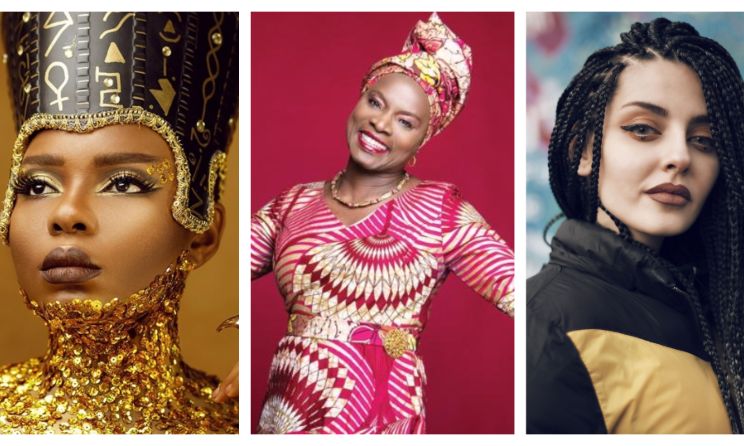
In commemoration of this special day, Music In Africa brings you a playlist highlighting some female artists known for their activism efforts in Africa.
Angélique Kidjo
Bearer of a powerful voice both within music and away from it, the four-time Grammy-winning Beninese singer is a lifelong activist behind an inexhaustible list of advocacy efforts. They include recording songs for several campaigns such as UNICEF and Pampers’ Give the Gift of Life in 2009 toward the eradication of tetanus, and contributing the song ‘Leila’ in 2010 to the Enough Project and Downtown Records’ Raise Hope for Congo compilation, which shone a light on the protection and empowerment of Congolese women, among others. Kidjo has also served as a UNICEF goodwill ambassador since 2002 and is a champion for the International Federation of Human Rights’ Africa for Women’s Rights campaign. Additionally, she is the co-founder of the Batonga Foundation, which has operated with the vision of empowering and educating adolescent girls in sub-Saharan Africa since 2007.
Barbara Kanam
In her home country, the DRC, as well as neighbouring Mali, Burkina Faso and beyond, Barbara Kanam is a symbol of solidarity and a voice for social change. Mainly through her Kanam Foundation, the singer-songwriter, producer, actress and politician has led fundraising and awareness efforts around Ebola, cancer among children or supporting rape and young victims of conflict. “Music, for me, is a way to be the voice of people. It’s an engagement, to be next to people, the chance to talk to the world,” Kanam told CNN in 2018, adding that her life and career should serve as inspiration to young women on the continent to rediscover “hope and dignity because it’s difficult for many women to stand up and look further.”
Oumou Sangaré
Grammy-winning Malian musician Oumou Sangaré’s defence of women’s rights goes back to the 1980s. Her music career, which spans more than 30 years, is replete with the themes of love and marriage, particularly for a woman’s freedom to choose. She also advocates strongly against child marriage and polygamy. The ‘Songbird of Wassoulou’, as she is known, is a member of the all-female supergroup Les Amazones d’Afrique and continues to be at the forefront of fundraising efforts for the most disadvantaged, including orphans. In a 2018 interview with The Financial Times, Sangaré said: “I’m very much socially involved in the problems of my country. Politicians should listen to what we, the artists, have to say, because we are the people’s voice. If there is anything I can do for my people, for Africa, for humanity, I will do it through my music.” Asked what drives her, she said: “The feeling of still many things to do. There is so much to help within my country’s development and to create awareness of situations that need to change – that must change.”
Yemi Alade
For Nigerian Afropop singer Yemi Alade, female empowerment begins with the themes in her music. Away from that, Alade has frequently partnered with various charity organisations, including the UNDP. In September 2020, she joined the programme as a goodwill ambassador. The ‘Johnny’ hitmaker was also part of the launch of the UNDP’s Mission 1.5 climate action initiative. Additionally, she joined an international contingent of influencers to the organisation’s COVID-19 response efforts.
Wiyaala
Nicknamed the ‘Lioness of Africa’, Wiyaala, a native of Funsi in Ghana’s Upper West Region, has constantly lent her voice to various campaigns by UNICEF Ghana and Ghana’s Ministry of Gender, Children and Social Protection, including the promotion of health and sanitation, and crusades against child marriage, child poverty and family violence. In August 2020, Wiyaala was named as a jury member of the Song Contest Against Child Labour, an initiative led by the European Union and the Ghana Employment and Social Protection programme. In her music, examples abound of her commitment to female empowerment. Her 2014 song ‘Tinambayai’, rendered in her native Sisaala language, is a protest against the exploitation of women in Africa.
Raja Meziane
Raja Meziane’s career is a bold example of the immense power of a young female artist who can inspire change. From Prague, Czech Republic, where she is in exile, the Algerian rapper, lawyer and activist will not be silenced. Widely considered a muse for anti-government protests and the “face of the revolution”, Meziane’s music addresses inequality, social injustice and corruption. In 2019, her activism secured her a place on the BBC’s list of the 100 most influential women.
Yvonne Chaka Chaka
For many years, beloved South African singer Yvonne Chaka Chaka has been a prominent voice in the fight against HIV/AIDS, tuberculosis and malaria. Additionally, she has served as a global advocate for women and children’s rights. In 2012, while receiving an honorary doctorate degree from the University of KwaZulu-Natal, she said: “We need to continue with the dialogue of creating cultural change of turning taboo subjects such as women empowerment into acceptable topics of discussion ... We also need to begin to take a look at how gender attitudes are affecting our socioeconomic and political environments, because it is just not enough to hear gender problems in the abstract. Rather, we need to see them face-to-face and stop making assumptions about women.” Last year, the ‘Princess of Africa’ unveiled WOMan Radio, a female-led online channel to further advance her vision of empowering women in the media space. The platform promotes progressive measures driving gender balance while offering an avenue for rethinking society’s approach to the gender question.
Lira
Her vocal majesty aside, award-winning South African singer Lira is among the influential artists on the continent who harness their celebrity for social causes. Thematically, over several albums, Lira, whose most prized musical achievements include performing for Nelson Mandela and Barack Obama, sings about positivity to inspire change around the world, especially for women and girls. In 2019, she became the first African woman to have a Barbie doll made in her likeness, as part of Mattel’s global campaign to give girls diverse role models while celebrating inspirational women. “I’ve been so emancipated in my journey,” Lira told Deutsche Welle. “I’m really empowered in music as well that I really want that for other women. So, it’s really about sharing what I’ve learnt in my journey.”
Edith WeUtonga
Zimbabwean Afro-jazz and traditional musician Edith WeUtonga is among a handful of female bass in her country. Across four languages, the accomplished artist and bandleader has distinguished herself as an essential voice on the continent, touching on pertinent themes affecting society. Over her career, she has spearheaded various campaigns including the fight against malaria in Africa as well as advocating for the education of young female artists so they can have a competitive edge in the industry. “For the up-and-coming female musicians, it’s important to have knowledge because if you have knowledge, you’ll be more attractive and have the power to negotiate whatever you want as a musician. Education is the only way to go,” she said in 2019.
Selmor Mtukudzi
Zimbabwean Afropop musician and actress Selmor Mtukudzi believes that women empowerment is directly linked to the welfare of a nation. Over her career, she has been associated with multiple causes including the Strong Girl and Poverty Is Sexist campaigns. In 2015, Mtukudzi, who is the daughter of the late Oliver Mtukudzi, joined eight musicians across Africa on the song ‘Strong Girl’, which called for women and girls to be central in the fight against poverty. In 2017, she addressed Canada’s Parliament about the importance of girls’ education. Mtukudzi is also the founder of Vabvana Trust, an organisation geared towards uplifting and amplifying the voices of girls and women.
Muthoni Drummer Queen
The Kenyan rapper, drummer and cultural entrepreneur is not only renowned for her progressive take on alternative hip hop and electronic music, but also for prioritising feminism in her art. Her acclaimed third album SHE, for instance, is an unapologetic celebration of the African woman’s dynamism, strength, beauty and resilience. “I believe that women are layered and nuanced beings, with the agency to make decisions over their own lives,” she said. “My imagery is that of a boss lady and queen because I want to make another image of women in a male-dominated hip hop scene of an urban, African queen.”


Most popular

Top Naija songs of 2026
31 Mar 2026

Top Afrobeats songs of 2026
19 Mar 2026
Ghana: Mr Eazi and MOLIY’s ‘Comfort’ earns Urban Music Awards nomination
21 Oct 2026

Top amapiano songs of 2026
16 Feb 2026
Open call: CANEX Music Business Lab and Songwriting Camp
15 Oct 2026
Nigeria: CANEX WKND unveils 2026 programme
21 Oct 2026
Disclaimer: Music In Africa provides a platform for musicians and contributors to embed music and videos solely for promotional purposes. If any track or video embedded on this platform violates any copyrights please inform us immediately and we will take it down. Please read our Terms of Use for more.

Subscribe to our monthly Newsletter
Follow us on social media


Please log in to post a comment.