
































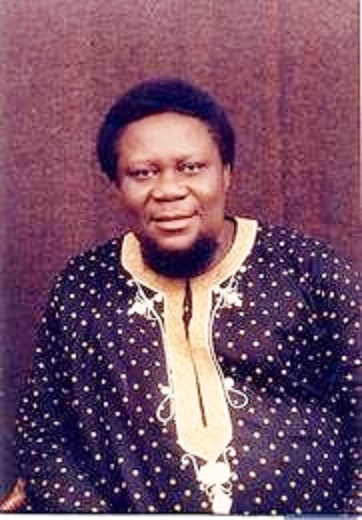
A look at the life of the lateTony Ibegbuna, veteran Nigerian Radio Jockey.
Growing up in Lagos in the 1970's, like many of my peers, my appreciation of music was shaped by probably the most potent and forward looking media vehicle in Nigeria at the time, the incomparable Radio Nigeria 2 (or RN2). RN2 was conceived as a lighter version of the flagship Radio Nigeria 1 and had a focus on music and light entertainment, with a mere cursory nod to news, by way of brief news tit-bits and aptly referred to as "Newsbeat".
The station spawned a generation of highly talented radio dj's, spanning from the venerable presence of the Jazzmeister, Benson Idonije to the Highlife "warrior" Jones Usen, to the totally professional and talented young Turks, Fred "Freaky Fred"Oshodi, Ron "Ronnie Boy the Cat" Ekundayo, Femi Sowoolu "the Pinfather" and the inimitable Jacob Akinyemi Johnson "JAJ", amongst many others. However I omitted a certain gentleman, who could be described most appropriately by the description, the doyen of modern Nigerian Radio Journalism, Tony Ibegbuna "Tony I".
Tony Ibegbuna was alongside the afore-mentioned and legendary Benson Idonije, one of Nigeria's Pioneer Music Journalists and Radio DJ's. An imposing presence of a man, with a deep baritone voice and an almost flawless diction, Tony I ruled the airwaves from the mid 60's with NBC, on to Radio Nigeria and was indeed acknowledged as the first voice on the Radio Nigeria 2. A consummate professional and perfectionist, he was an extremely hard-working and dedicated journalist, a rare gem alongside the afore-mentioned Benson Idonije.
Tony I died in May 2009, largely unheralded and in a sad testimony to the world's treatment of the truly great and good, was largely forgotten, having been wheel-chair ridden, due to ill-health for several years. This piece is a modest tribute to a pioneer and a truly great Radio Jockey, however I think the best tribute to Tony I, was that written by his erstwhile colleague and Music in Africa contributor, Benson Idonije, published in the Nigerian Guardian of June 19 2009.
"Tony Ibegbuna... farewell to a veteran broadcaster By Benson Idonije"
The body of veteran broadcaster, Tony Ibegbuna will be laid to rest today in his home town of Onitsha, in Anambra State of Nigeria. He died on Saturday, May 2, 2009, at his Festac Town residence in Lagos.
As producer, presenter and administrator, he was an accomplished broadcaster. And the fact that he even went further to offer something extra in keeping with the demand of the profession which requires that a producer must demonstrate a specialist knowledge gave him a big boost. He was a talented actor who took part in almost all the radio drama productions that were broadcast on Radio Nigeria from the 60s to the 80's with the likes of Tunde Aiyegbusi, Ihria Enakimio, Gbenga Ariba and Agbo Sikuade as producers who would individually have glowing comments to make about his involvement and general sense of commitment. He acted in Gandu Street, Long Throat Junction among others.
Perhaps what Tony I (as he was fondly called in the profession) will be best remembered for is his involvement with Radio Nigeria 2. He was the very first voice on this pioneering FM station in Nigeria. The station had run test transmissions for upwards of two months, a strange entertainment treat on the airwaves which kept people wondering what it was meant to herald. It was Tony who ushered it in-in the terms of breaking the ice which, on the afternoon of May 1977, he sat comfortably behind the microphone in one of the studios of Voice of Nigeria, surrounded by the then Information Minister, broadcast managers and directors and said, "This is Tony Ibegbuna welcoming you to Radio Nigeria 2, FM stereo...." He read the first news bulletin and presented the first music programme. And as head of programmes, he was virtually in the premises most of the time - to make sure that the station survived its teething period which had only three of us running shifts, with no extra hand to allow for off duties. He retired as Assistant Director, Commercial, but still with Radio Nigeria 2 which he nurtured as his main source of revenue.
I have known Tony since the 60s when we both worked in the Gramophone Library. We came close in the late '60s when I became Producer in the Music Department. He got attached to me as compere and master of ceremonies for most of my programmes. Maybe this was because of my track record with the Big Beat, a popular network programme which I presented at the time. It could also be because I was the only popular music-oriented producer where almost every other person was a musicologist, choosing Beethoven and Bach as their idols. However he got rather attached to me and we both ran perhaps the most popular programmes on the station.
On Independence Days, Tony was on hand to anchor contributions from all the states - in terms of Nigerian music in a session which lasted for two hours. I was the general producer for "Saturday Night out" for almost ten years; and every Saturday Tony and I were in the night clubs, broadcasting live to the people.
As a matter of fact, for many years, we did not spend New Year and Christmas with our families. We were either in Island Club, at Miliki Spot, Yaba, or Caban Bamboo on Boxing Days for what was known at the time as "Combo Night." And we enjoyed it. But it was Tony who enjoyed it more because, as the compere, he was the one projecting the activities of the entire clubs in terms of the music the bands played and all the goings-on in terms of the ambience.
Being a talented actor, Tony was very good at compering, a job he did with ease and active involvement. He did not require alcohol for enhancement. He was naturally exciting, warm and forthcoming.
Tony was a committed broadcaster who did not want any programme to fail or diminish in quality - a feat he demonstrated while we were running shifts as pioneering broadcasters on Radio Nigeria 2 - in 1978. There was this day I was on early morning shift which terminated at 12 noon. As was the usual practice, I went down to a place we called 'Aburi", by Obalende, Lagos to unwind. It was a converging and diverging point for broadcasters and media men in general.
I went back to Broadcasting House later to bid goodbye to Tony who had taken over from me at 12'Oclock; and as soon as he saw me, he asked me to hold on for him while he went to urinate. I did. I waited for fifteen to twenty minutes and he would not come back. I decided to go to the toilet to find out if exactly he was there. And behold, there was Tony sprawling on the floor, struggling to stand on his feet. He was completely fagged out.
The truth was that he was not feeling too well. He just wanted to manage himself through the shift because there was no extra hand to do the job. I had to take over from him until Kevin Amechi came on the night shift, at 6 p.m.
Tony had a rich and pleasant voice - that was commensurate with his massive frame. And for this reason, he became a favourite of advertising agencies whose producers used him excessively on voice-overs. But with this experience garnered while laying his voice over commercials, he was able to design and produce most of the jingles and station identification materials for Radio Nigeria 2.
Many fans of his remember him as Tony I, as a result of the early morning programmes he presented on the station in the '80s after we had moved to 45, Martins Street, Lagos. He was pleasant and entertaining to listen to. Another radio programme for which Tony will continue to be remembered, is the Top 10 which I produced. Actually, this programme was created by veteran broadcaster, Ikenna Ndaguba, one of Nigeria's finest and greatest voices who was then the station's Assistant Director.
A research company called Research and Marketing Services (RMS) came up with the hit parade. The music and their movements in the charts were often discussed on monthly basis by journalists such as Fola Arogundade of the Punch Newspaper, Charles Anyiam, Daily Times among others. But it was Tony Ibegbuna who steered the discussion as well as presented the entire programme.
Aside from being a fine broadcaster, Tony was a bold an courageous man who was ready to die for the truth and what he believed in. While working with Voice of Nigeria after the war, he gave a lady on his desk in the library a query for consistently coming late. And being a girl friend to an Army General at Dodan Barracks, she reported to her man, who arranged for Tony to be picked up. He went with them alright, but refused bluntly to tender any apology to the General over what her woman claimed Tony said about him. Tony had told her that if the General whom she often quoted as being responsible for her lateness had any sense of duty and responsibility, she would always ensure that she did not come late to work. Tony was threatened with the gun and guardroom but he stuck to his guns. At the end, the General's men overpowered him and shaved his head.
While we were at Tony's residence for the wake-keeping last Saturday, some one asked why Tony's death has not attracted as much celebration and publicity as Ladi Lawal's. The truth is that if he was still in the service, Radio Nigeria would have done something, but Tony retired in the '1990s. Besides, he has been bedridden and consigned to the wheel chair for upwards of ten years- a travail which in fact prevented him from any activity and the limelight. Tony Ibegbuna deserves to be sung, mourned and celebrated as he goes to meet his ancestors today.
There are no words to add to Benson Idonije's moving tribute, may Tony I's soul continue to rest in peace, content in its immense bequest to Nigerian Music.


Most popular
Top Naija songs of 2026
31 Mar 2026

Top Afrobeats songs of 2026
19 Mar 2026

Top amapiano songs of 2026
16 Feb 2026
Open call: CANEX Music Business Lab and Songwriting Camp
15 Oct 2026
Open call: National Arts Festival artistic director in SA
15 Oct 2026
Ghana: Mr Eazi and MOLIY’s ‘Comfort’ earns Urban Music Awards nomination
21 Oct 2026
Disclaimer: Music In Africa provides a platform for musicians and contributors to embed music and videos solely for promotional purposes. If any track or video embedded on this platform violates any copyrights please inform us immediately and we will take it down. Please read our Terms of Use for more.

Subscribe to our monthly Newsletter
Follow us on social media


Please log in to post a comment.