

























































By Ed Keazor
Taking its name from the drink enjoyed by its first audiences, Palmwine Guitar is a distinctive hybrid folk sound that originated in West Africa at the turn of the 20th century and remains an important part of the heritage of the entire region, the common musical currency of its entire people.
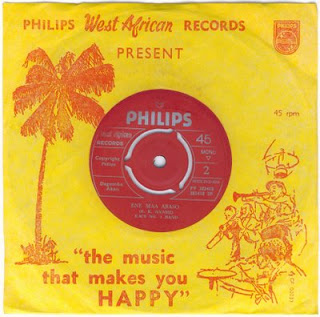
Origins
The Palmwine Guitar sound is a distinctive hybrid folk sound that originated in West Africa at the turn of the 20th century. The exact location from which it originated is still unclear, however what is certain is that it was prevalent along the West African coast. Portuguese, Spanish and Caribbean sailors whose merchant ships docked at the ports of Freetown (Sierra Leone), Lagos (Nigeria), Monrovia (Liberia) and Accra or Tema (Ghana) lent their guitars and style to their African shipmates, who formulated a unique new style that fused native rhythms with the Latin styles bequeathed by their benefactors - the result being an expressive, melodious guitar fusion.
The early African guitar pioneers played in an era before iPods or Walkmans. They played on ships in their spare time to entertain themselves - the output often raw and rudimentary. Nevertheless, a revolution was taking place. The guitars were often played to accompany native vocal renditions, varied in their content but often centred on themes of love and peace, praise singing, native wisdom, personal angst, satire and social commentary.
As time went on, the guitar moved away from being the exclusive domain of African sailors and the more adventurous musicians in port cities, and into the hands of the general populace. Until then, West African musicians had generally played traditional forms of music (using traditional instruments) at funerals, weddings and religious festivals and to entertain royalty in court. Western music had also already been played in West Africa, especially by Europeans and educated West Africans. This was largely in form of classical music. For instance, Lagos hosted a Handel Festival in 1888, organised by the Yoruba musicologist Professor R.A. Coker, while nationalist figure Herbert Macaulay organised classical concerts in the late 1890s. However, by the early 1920s, with the popular usage of the guitar by indigenous musicians, a new form of musical expression emerged in urban centres, occupying a social space that merged both western musical forms and indigenous traditional music. These guitarists played at social functions for the new urban elite (the native professional class of lawyers, doctors, engineers and businessmen), who demanded the best musical entertainment, ranging from classical pianists to this emerging group of modern musicians.
At the lower end of the social ladder were the bards and minstrels who would perform at local bars and houses in the evening, asking for a few pennies for their troubles. Their guitar heroics offered accompaniment to tales of joy and pain - and praise singing of their ‘clients’. Often walking several miles on this beat (a practice that continues today), these guitarists would move around solo or accompanied by native drummers, thumb pianists or a variety of other traditional instruments. For example, the famous Nigerian minstrel Irewolede Denge would walk through the old city of Lagos in the late 1910s and early 1920s, stopping at the famous Water House (home of the Afro-Brazilian millionaire Candido Da Rocha), to deliver a praise singing rendition for which he would be assured of at least a couple of pennies. He would then end his journey in Old Yaba in the Lagos Mainland - a distance of about 9 miles. In this way, minstrels would often play at palmwine bars all along the West African coast.
Palmwine, by the way, is a sweet, tangy, mildly intoxicating drink that has been popular in West Africa (as well as Asia) for many generations. It tapped from the bark of the palm tree, yeast-fermented for a few days and served straight from the tree in calabashes (gourds). The particular musical style that emerged in the bars where the drink was enjoyed became known as the Palmwine Guitar.
The Rise of Palmwine Guitar
The Palmwine Guitar style evolved over the years and fused with various other musical forms, specifically West African vocals and rhythms and Latin and Calypso melodies. The explosion of the Palmwine Guitar into popular culture was heralded by the first series of recordings of West African popular music, between 1925 and 1928, by RCA-Victor Records, under its specialist Zonophone sub-label. The genesis for these recordings was that immediately after the First World War (1914-1918), a significant African immigrant community had settled in the port cities of Britain, especially London, Liverpool and Bristol. These were mostly former dockworkers and labourers who had served the colonial War effort and remained behind afterwards. The Zonophone label therefore sought to service the entertainment needs of this potential market with recordings by West African musicians.
These were not the first West African popular music recordings, however. Already by 1922, Rev. J.J. Ransome-Kuti had recorded an album of choral hymns in Yoruba. The first set of popular music recordings consisted of performers like Nigerian lawyer Oladipo Solanke, Afro-Brazilian musician Justus Domingo (in 1925), Ghanaians George Williams Aingo and Nicholas Van Heer, and the duo of Frank Essien and Edmund Tagoe between 1927 and 1928. The styles played by these pioneer West African recording artists spanned from the furious Charleston guitar of the talented Tagoe to the more gentle Dixie-variant of Domingo. However, none of these embodied the classical Palmwine Guitar format - until the historic recording by the legendary Ghanaian group, the Kumasi Trio, led by Kwame Asare (aka Jacob Sam). This group recorded what could be described as the first Palmwine Guitar (or indeed Highlife) album from a live performance at London’s Kingsway Hall. Ghanaian guitarists were largely responsible for the creation of the classic styles of Palmwine Guitar, the most notable of which include the ‘Yaa Amponsah’ style made popular by the Kumasi Trio on its 1928 recordings, as well the variant Latin-influenced ‘Dagomba’ style and the ‘Native style’, a 6/8 progression, which was also first recorded by the Kumasi Trio in 1928.
A succession of Palmwine Guitar specialists was to emerge all along the West African coast over the next three decades. Notables names include Kwaa Mensah (Asare’s nephew), Nigerian musicians Irewolede Denge, Tunde King and Ayinde Bakare, and Ebenezer Calendar and Francis McFoy (aka Famous Scrubbs) from Sierra Leone, among many others. These gentlemen experimented with a variety of genres - Calendar and McFoy with calypso, while King and Bakare refined the Ghanaian ‘Dagomba’ sound with a stronger Latin accent, also introducing the electric guitar in the late 1930s and early 1940s.
It’s important to mention that at the same time in Central Africa (Congo to be precise), Joseph Wendo, using a similar format, recorded his legendary hit ‘Marie Louise’, which gave rise to the Rumba-Soukous genre.
In Nigeria, two exceptional guitarists emerged in the late 1940s and early 1950s, playing a pure form of classic Palmwine Guitar. Ambrose Adekoya Campbell and Julius Araba gained superstar status - at least in the old Colony of Lagos. Campbell was a member of the legendary Lagos Jolly Orchestra, a multi-ethnic band consisting of Yoruba, Ghanaian and Kru (Liberian) musicians, including the legendary piccolo player known as Piccolo Pete. Also in Nigeria, the Three Night Wizards, led by Israel Njemanze, recorded hit after hit using a Calypso-influenced style of Palmwine Guitar and singing in Igbo and English.
The late 1950s and 1960s saw another wave of Palmwine Guitar heroes all across the sub-continent. These include Fatai Rolling Dollar in Nigeria to Soliman E. Rogie in Sierra Leone, who had a massive hit with ‘My Lovely Elizabeth’, widely regarded as the biggest-selling Palmwine Guitar track in history. From Ghana came Thomas Osei Ampomah (of T.O. Jazz), as well as one of the most influential Palmwine Guitar exponents of recent times, Daniel Amponsah (aka Koo Nimo). Other stars include Okonkwo Asaa (aka Seven-Seven), John Ikediala and Celestine ‘Daddy’ Obiakor from the east of Nigeria.
Palmwine Guitar and Highlife
The advanced template of this hybrid became popularly known as Highlife, in turn an alloy of Big Band Jazz and the Palmwine Guitar fusion, typically boasting large brass and rhythm sections and clearly targeted to an elite African audience. One of the earliest superstars of this genre was the Ghanaian tenor saxman, E.T. Mensah and his Tempos Band, formed in the 1930s, whose popularity stretched far beyond Ghana. Highlife Music erupted all over West Africa, with bands emerging all over the sub-continent, including the likes of Bobby Benson, Victor Olaiya, Stephen Amaechi, E.C. Arinze, The Nigeria Police Band, Duke Onyina and his band, King Bruce, the Ramblers Dance Band and many more. Over the years highlife bands have evolved in many different directions. However, the guitar element remains constant, with the rudimentary influence of the Palmwine Guitar still recognisable, an enduring reminder of this melodic style of music.
In conclusion, the Palmwine Guitar is an extremely important part of the heritage of West Africa and part of the common musical currency of all of its people - despite differences in their subjective histories. Tribute must therefore be paid to the old masters of this phenomenal institution and indeed to the modern exponents who have sustained its pure format and taken the genre to another level - young masters like Oscar Elimbi N’Guime, Abdul Teejay, Piper Jay, Joe Mbule, Rene Lendjou, Kari Bannerman, Phil Dawson and several others. Through them, the Palmwine Guitar lives on - and so it should!


Most popular





Disclaimer: Music In Africa provides a platform for musicians and contributors to embed music and videos solely for promotional purposes. If any track or video embedded on this platform violates any copyrights please inform us immediately and we will take it down. Please read our Terms of Use for more.

Subscribe to our monthly Newsletter
Follow us on social media


Please log in to post a comment.