









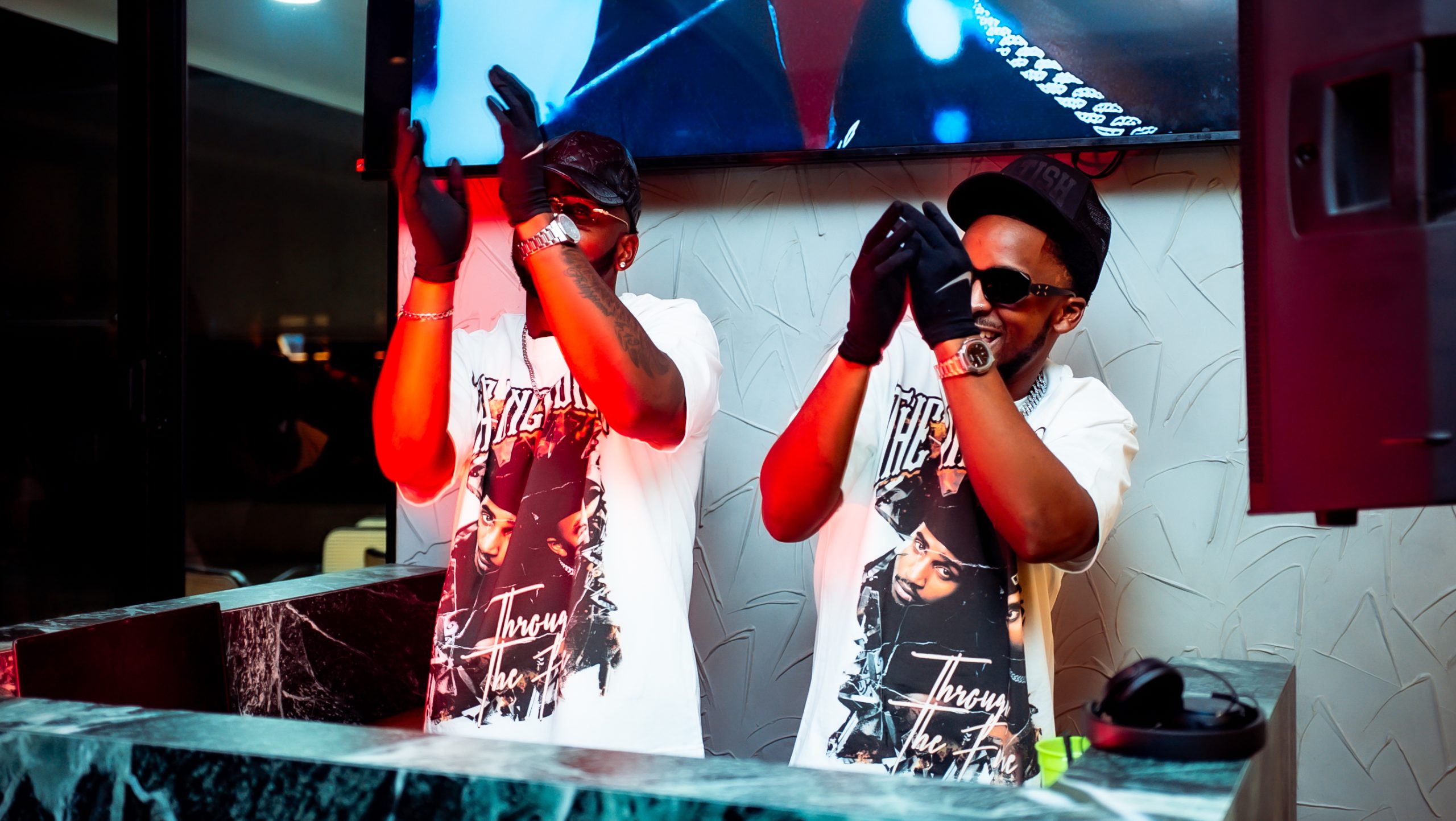

























Kerr Gi Family, a trio of brothers, has announced that they will launch their 8-track Extended Play (EP) record ‘Nataalu’ on 7 November at the Alliance Française along Kairaba Avenue.
The group’s lead vocalist, Baharama, spoke to The Voice Vibes about the launch and the group’s career.

The Voice Vibes: What is the idea behind ‘Nataalu’?
Baharama: Nataalu is a project that could be any project but since when we talk about Kerr Gi Family we have been recognized with a uniqueness. Because even by listening to our songs you realise that we are different from other artist in the way we compose our songs - the way we fuse our music with cultural instruments - because culture has always been our foundation.
We have been working for the past six years with our experiment. We realised we need to come up with a name, something that we can present to the people, promoters because we have been travelling from Gambia to Senegal for musical journeys. But whenever we meet people they ask us of our projects - so coming back home we ask ourselves since we calling ourselves musicians not only so called musical but musicians who are willing to do something and raise the Gambian flag to another level.
So that’s why we are starting our career now by producing something on our name - that’s when we decided on a mix tape but we realised that mix-tapes are rampant in the industry - why not we make something different from what we have been doing. That’s when we came up with this idea of the EP which means Extended Play—something that is bigger than a mix-tape but not to the level of an album. We are calling it an EP but it has the standard of an album.
The Voice Vibes: How many tracks are on the EP?
Baharama: An EP has a concept, that is, it can’t be more than nine songs - some are having three, five etc. So we decided to give the people a few touching songs because it’s not about the quantity but the quality. So it’s just eight songs but it will be educative and entertaining.
The Voice Vibes: Who produce the EP?
Baharama: We produced it ourselves by working with a studio call Jlive Music - they are two young guys of the same age with us that’s why we always have that chemistry together - that uniqueness and mutual understanding. They are the mature people in this project but nonetheless, we are also working with the other producers like Sunland and Genesis Music (GSC) Records in the UK and we are doing the programme with SFA, a French organization based in The Gambia and the Alliance Française.
The Voice Vibes: What genre of music do you guys do?
Baharama: Music is music and its one universal language, but sometimes if you are saying here is my boundary it will be like you are creating a barrier for yourself and we trying to represent the world. People have different choices, so we sometimes do western music - fused with the local instrument.
In order to make it sound different, for people that don’t know about the local music - so that they can say I can see myself in this song but the instrument is not part of me - that will make them research about the music. Right now we are doing music as a whole.
The Voice Vibes: What are the messages in your music?
Baharama: We teach and educate people because if you listen to our music we have this idea that since we doing positive music we don’t use abusive words or words that can bring negativity to the society… because both generations listen to our songs, so we sensitise about issues affecting the society, and we also advice.
The Voice Vibes: Why do you choose Nataalu among all the names?
Baharama: Here in our local language when we say Nataalu what goes in the mind of people is a picture. So we realise that as far as culture is what we are trying to stand for, it’s what we trying to defend, and the future generation, if not guided will forget about their culture because most of us are so assimilated to the western names.
That is the reason we bring our own names related to the local language, because we are even forgetting about our culture, and in order to keep culture still valuable we should keep it in a picture - to save it. We got to know or have an idea about yesterday, yesterday was put in a picture - even in Islam and Christianity as religions - if you see we still remember them it is because they are written and that’s a picture.
There is nothing here that can stay without a picture. Gambia use to have big people, legends for that matter, but we easily forget about them that’s why we always struggle to have a better future. That’s why we said this is going to be a ‘Nataalu’ - a reflection of true African beauty that’s going to display so many beautiful things about a picture itself - about the past trying to bring us to the present so the future will get to see and recognize it.
The Voice Vibes: Last year, Kerr Gi Family lunched ‘Flash’, what’s the difference between Nataalu and Flash?
Baharama: It [Flash] was a concept that we tried playing with because it’s always nice to be innovative. Now we choose Nataalu which is taking a picture – and in the processing of taking a picture when holding a camera the first thing that comes out is the Flash - that flash light from the device you are holding will turn into a picture - which is the Nataalu. Nataalu is the hard copy so that’s the process Flash was just a tip of what they should expect from Nataalu.
The Voice Vibes: What’s next for Kerr Gi Family, what’s in the pipeline after the Nataalu?
Baharama: We are not artists who just plan for one thing and don’t know what’s next on the pipeline. Even before this, we already knew what we were going to do next after this Nataalu. We have songs that are really educative that the people should get the message - these songs are trying to sensitise the people on so many things in society – about illegal migration, child rights and women empowerment. These are things that we really advocate for musician.
So immediately after this project, we are planning on a Senegambia tour - from The Gambia to Senegal… and whatsoever we have, it will be used in some important places that when the time comes you will get to know the reason why we going to Senegal. It is because Senegal and The Gambia are one but sometimes there is always a misunderstanding between the youths - so for us to bring the youths together – it is faster to use music to connect them.
Published in the 4 November edition of The Voice


Most popular

Top Naija songs of 2026
31 Mar 2026

Top Afrobeats songs of 2026
19 Mar 2026

Top amapiano songs of 2026
16 Feb 2026
Open call: CANEX Music Business Lab and Songwriting Camp
15 Oct 2026

Ghana: Mr Eazi and MOLIY’s ‘Comfort’ earns Urban Music Awards nomination
21 Oct 2026
Nigeria: CANEX WKND unveils 2026 programme
21 Oct 2026
Disclaimer: Music In Africa provides a platform for musicians and contributors to embed music and videos solely for promotional purposes. If any track or video embedded on this platform violates any copyrights please inform us immediately and we will take it down. Please read our Terms of Use for more.

Subscribe to our monthly Newsletter
Follow us on social media


Please log in to post a comment.