





























The music education sector in South Sudan is underdeveloped owing to the political turmoil that continues to plague the world’s youngest nation. Despite concerted efforts, the continuous power struggle between President Salva Kiir and his former deputy Riek Machar has adversely affected locals as well as neighbouring countries. This text explores music education in South Sudan.
South Sudan gained independence from Sudan on 9 July 2011, the outcome of a 2005 agreement that ended Africa’s longest-running civil war. It is made up of the 10 southern-most states of Sudan, and home to over 60 different major ethnic groups, most of whom follow traditional religions. Lual Akol Nhial, the education attaché at the South Sudan embassy in Kampala, says music education is very important because it is a tool of communication where plain words sometimes fail.
He further says that music has been used as a tool for social causes like the call for peace and reconciliation since it is a medium that is popular among a big divide of the population, so it is used as a channel for achievement of peace where other mechanisms seem not to achieve results.
To explain music history in South Sudan, Akol highlights the country’s history. “Before South Sudan separated from Northern Sudan, there were music schools in the North,” he recalls. These included the Khartoum International Community School[i] and the Sudan University of Science and Technology[ii]. With the separation, this meant that Northern Sudan retained the music education schools, while South Sudan had very few avenues to train future musicians.
Development of the institutions however is not prioritised as furthering a career in music is still a far-fetched dream and music is not considered a viable career choice. Akol, confirms this saying that not many nationals will go as far as singling out music as a subject to pursue.
It is important to note that despite the countries' complicated relationship with music, secular music, with social causes like call for peace, is heard everywhere in the media.
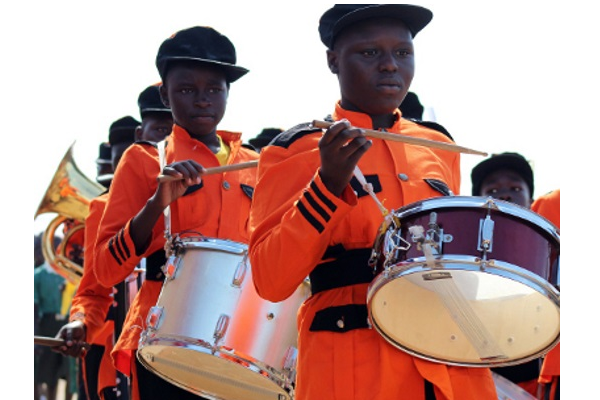
South Sudan’s education system is, however, still modelled after that of the Republic of Sudan. Primary education consists of eight years, followed by four years of secondary education, and then four years of university instruction. Often called the 8-4-4, the system has been in place since 1990. At primary and secondary school level, students are taught the basics about music. However, the curriculum does not adequately prepare students for a career in music.
Government primary and secondary school
The South Sudan Teacher Education Programme (SSTEP) initiated activities at the end of 2011, following independence. The SSTEP project was implemented by Export Development Canada (EDC), with partners Winrock International, Windle Trust and the Episcopal Church of Sudan. According to John Martin Opolot, an education consultant who helped set up the curriculum, the SSTEP project accomplished substantial results during its three years of operation, notwithstanding the extremely challenging conditions.
SSTEP supported important policy reforms, like the National Professional Standards for Primary Teachers, which helped establish the foundation for the education sector.
In addition, SSTEP led the design of an updated Unified Teacher Training Curriculum, including the revision of 90 in-service training booklets, training close to 3,000 teachers throughout the ten states in South Sudan, as well as 255 tutors supporting these teachers. Close to 1,000 teachers in the northern part of the country significantly upgraded their English language skills to improve delivery of the primary school curriculum.
While proud of its significant achievements, SSTEP was confronted with a series of challenges due to the ongoing struggles of the new government of South Sudan and the challenges confronting the education sector.
“Simply put, this new nation simply did not have adequate resources (human or financial) to fulfil its multi-faceted obligations. Ongoing disagreements with the Khartoum government in Sudan led to severe austerity measures implemented in 2012 that resulted in the education budget being significantly and chronically under-funded,” a report by USAID says in part.
University education
“By the time we got our independence, music in South Sudan was only taught at the level of university. We have a department of the arts at Juba University[iii]. We have many registered public universities but only one teaches music,” Akol explains.
The department of arts, students and lecturers alike at the Juba University is responsible for having composed South Sudan’s national anthem.
Music development programmes
Where formal training has failed, Non-Governmental Organisations (NGOs) and private institutions have stepped in to teach music. Africa Children’s Choir (ACC) is an example of the programme.
ACC focuses on teaching music through its Music for Life initiative. Music for Life began working in Sudan in 1993 while the country was still in the midst of a brutal civil war, and stories of the Lost Boys of Sudan had reached the West.
The ACC[iv] is a large choir and organisation made up of children, aged 7 to 12, from several African nations. According to Abraham Kiyingi, ACC’s public relations officer, the organisation has helped build schools and churches in South Sudan.
However, owing to turmoil, most of their activities have been disrupted. “But through the schools, we still teach Christian songs and Bible stories,” Kiyingi says.
Sarah Wanyana, ACC’s communications coordinator, explains that they have had educational programmes in South Sudan in recent years, working with refugees living in Adjumani refugee camps where ACC alumni and university graduates help teach music, dance and life skills.
“We run a weekly programme called Music for Life. The university students make outreaches in different community schools, working mainly with primary two students, teaching them songs, dances, Bible stories and verses, as well as life skills,” Wanyana explains.
ACC, beyond mentoring young children, is also helping to rebuild the entire educational infrastructure of Southern Sudan. In 2001 the ACC built Bright Star Academy (BSA) to accommodate the first group of pupils who graduated from the primary schools in the area.
Akol recalls first studying music during high school at Caltec Academy in Kampala in Uganda. Before that, he had not had the chance to study music because primary schools back home in South Sudan did not teach it.
“We studied the music to pass. We did not delve deeper but it is a subject that is important for anyone willing to pursue a music career,” he adds.


Most popular
Top Naija songs of 2026
31 Mar 2026

Top Afrobeats songs of 2026
19 Mar 2026

Top amapiano songs of 2026
16 Feb 2026
Open call: CANEX Music Business Lab and Songwriting Camp
15 Oct 2026
Open call: National Arts Festival artistic director in SA
15 Oct 2026
Ghana: Mr Eazi and MOLIY’s ‘Comfort’ earns Urban Music Awards nomination
21 Oct 2026
Disclaimer: Music In Africa provides a platform for musicians and contributors to embed music and videos solely for promotional purposes. If any track or video embedded on this platform violates any copyrights please inform us immediately and we will take it down. Please read our Terms of Use for more.

Subscribe to our monthly Newsletter
Follow us on social media


Please log in to post a comment.