






















































Spier festival pays tribute to SA musicians who passed away
09 Dec 2021 - 10:08


The 2021 Jazz and Classical Encounters Festival served up something special near Stellenbosch, South Africa, on 4 December. Rain was predicted for the day, significant rain, but between the organisers and Spier as the hosts, the amphitheatre was covered, shielding festival goers from the rain, which didn’t fall until we were all leaving the venue.
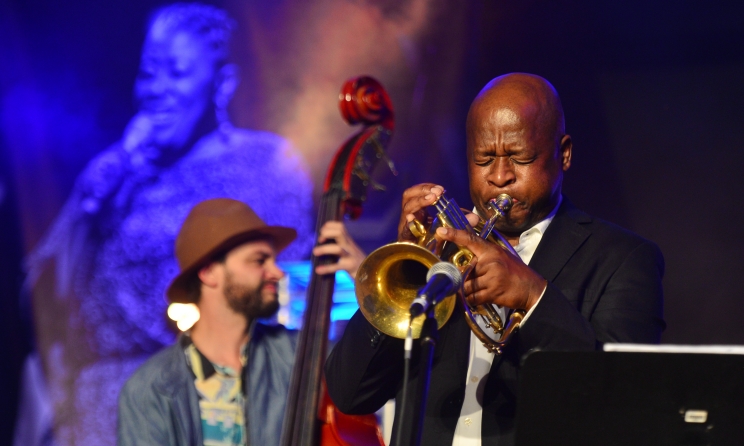
Featuring some of South Africa’s best jazz and classical artists, the programme paid tribute to the lives and works of musicians who died in the past 12 months, particularly the inimitable Sibongile Khumalo, and the remarkable talent of pianist Andre Petersen. This clip of Andre Petersen playing with Bokani Dyer was recorded at House on the Hill in Sophiatown on 13 April 2021, three months and 11 days before Petersen’s death. It was the last time he was filmed in action.
The opening act of a festival often sets the tone and lays down a standard for what is to follow. Taking charge from the first notes was the Bokani Dyer Trio, performing selections from Dyer’s most recent album Neo Native. A multi award-winning pianist, Dyer is superbly backed by Romy Brauteseth on bass and Sphelelo Mazibuko on drums. They’ve been playing together for five years, including gigs in Europe and an appearance at Ronnie Scott’s International Piano Trio Festival in London.
“I have consciously allowed all of the music which I have encountered to flow into my music to create a new idea of ‘world music’ where there is music with no borders,” Dyer says. The concept of music without borders, his interest in traditional styles of African music and a search for identity beyond geography create a palpable sense of closeness between the musicians. This makes it almost inevitable that the music forms an emotional bond with the audience.
Next up was soprano Zandile Mzazi. Before she came onstage, her accompanists, husband and wife team Yohan Chun and Francois Botha, sat down at the piano with a few giggles and performed a lively and spirited duet. When Zandile Mzazi came onstage, Chun stayed on the piano and Botha moved to the double bass. I’m not an opera fan, and operatic singing usually leaves me unmoved, but by the second number in the set, a beautiful rendition of Sibongile Khumalo’s ‘Thula Mama’, the tears were flowing down my cheeks and no rain drops falling to cover my emotions.
Zandile Mzazi is a slender woman, not the build I associate with sopranos, but what a sensational voice she has. The small audience was in rapture, and I was left pondering my prejudices about sopranos and opera. Her set seemed too short, but it left me, and maybe a few others, with a new perspective of opera.
The Elinor Speirs Quintet was unexpectedly ‘covidised’, in that pianist Brathew van Schalkwyk was in quarantine and unable to make the show. “It’s like losing the melody of the group,” Speirs said, but to the uninitiated and uninformed it made no difference to the energy or the performance of the rest of the band. With Speirs on violin, Brydon Bolton on bass, Jonno Sweetman on drums and Mark Fransman on tenor saxophone, the musical interplay was something to behold, particularly between Speirs and Fransman. The classically trained Speirs, feeling too constrained by the rigidity of classical music, has found her true home in improvisation and avant-garde jazz. Her bubbly and joyful personality fizzes and pops in exciting musical explorations. If ever she is performing at a venue near you, it’s worth making an effort to get there.
Kathleen Tagg, the fourth act of the festival, is a New York-based South Africa-born pianist. As with Speirs, who many years ago was her first paying student, Tagg has a classical background. If there is one single thing that defines her sound, it is the vast scope of her collaborations with leading musicians.
Her love of collaboration was evident on stage, not just because she said as much, but she called Elinor Speirs up for a duet, and a bit later, Shane Cooper – not to play his double bass but to play with an electronic gizmo to create strange soundscapes. Tagg’s musical explorations include using a cut-up cello bow that she wraps around the piano strings and draws back and forth. In short, she draws out sounds piano makers never designed the instrument to make.
Feya Faku’s set was, not surprisingly, dedicated to Andre Petersen. Back on stage after a two-year absence, Feya Faku’s 4tet – with Bokani Dyer on piano, Shane Cooper on bass and Ayanda Sikade on drums – set new standards of excellence and energy.
In the mid 2000s, Faku asked Andre Petersen to join his band. With Buddy Wells on sax, Kesivan Naidoo on drums and Chantal Willie on bass, this was, in Feya’s words, “one of the greatest quintets I’ve ever had”. It isn’t possible to compare a quintet with a quartet, but based on what was presented on Saturday night, this 4tet will live in the memory of the audience for a long time. They yelled and applauded long and loudly enough to get the tired musicians back onstage for an encore. Even the heavens applauded, by holding off with the threatened rain until we were back in our cars.
Grateful thanks to the Festival organiser and co-producer Aymeric Péguillan of Pegs Music Project – in association with Penny Lane Studios, Spier Wine Farm, Ian Burgess-Simpson Pianos and Fazioli – for the effort and organisation that goes into bringing this calibre of musicians to the stage.


Most popular

Top Naija songs of 2026
31 Mar 2026

Top amapiano songs of 2026
16 Feb 2026

Top Afrobeats songs of 2026
19 Mar 2026

Call for applications: ACCES 2026 Emerging Artist Spotlight Competition
01 Oct 2026

AFRIMA 2026: All the winners
12 Jan 2026
CAPASSO backs global principles for fair generative AI music licensing
06 Oct 2026
Disclaimer: Music In Africa provides a platform for musicians and contributors to embed music and videos solely for promotional purposes. If any track or video embedded on this platform violates any copyrights please inform us immediately and we will take it down. Please read our Terms of Use for more.

Subscribe to our monthly Newsletter
Follow us on social media


Please log in to post a comment.