

















































Gender@Work: Empowering women in the African music sector

09 Aug 2024 - 10:01

As the curtain fell on ACCES 2023 at the Mlimani City Conference Centre in Dar es Salaam, Tanzania, a group of young women donning black T-shirts bearing the word ‘CREW’ took to the stage with excitement. As they posed for a group photo, they shouted in unison: “Gender at work 2023!” Their smiling faces expressed a mixture of pride, relief, and a sense of accomplishment.
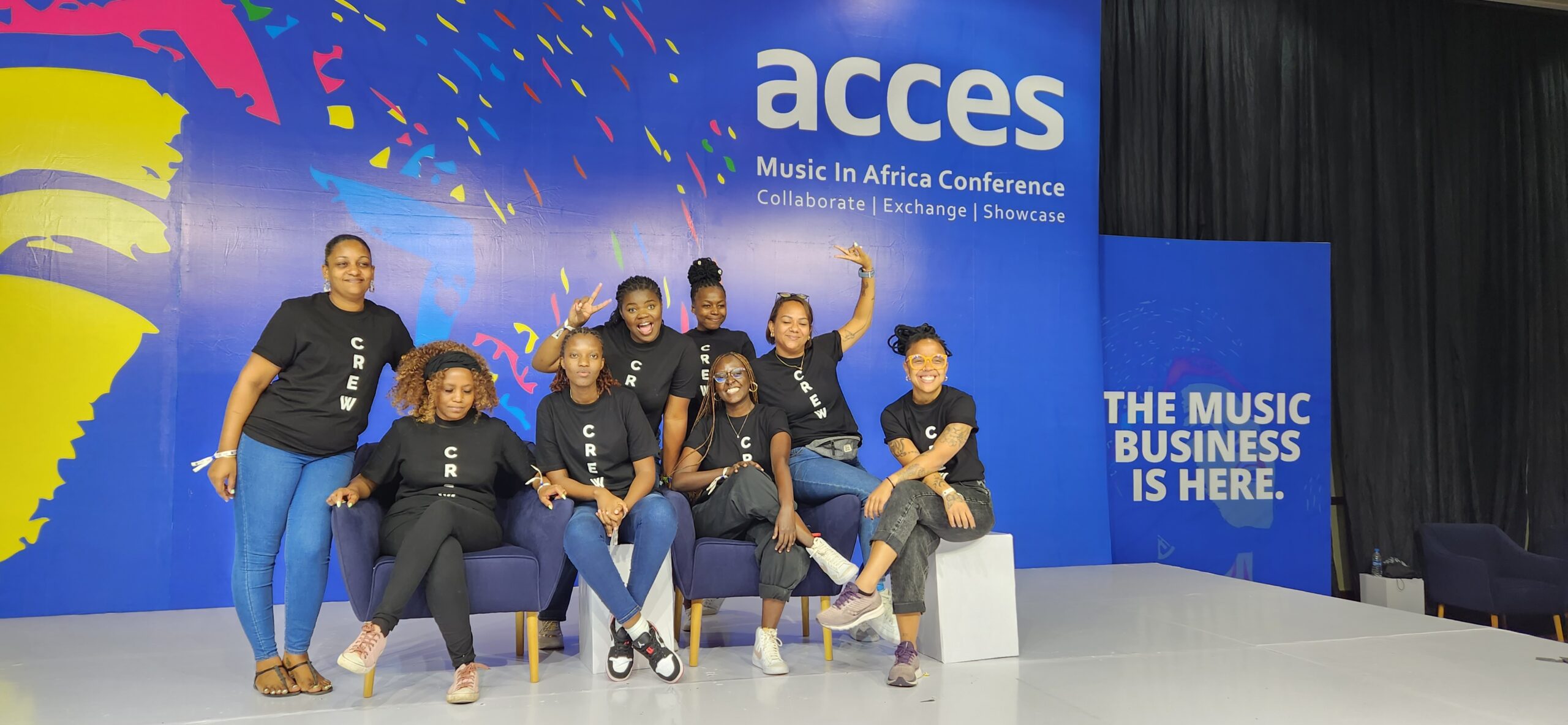
This group of girls is the 2023 cohort of a programme called Gender@Work, which consisted of 15 participants. The programme was first introduced by the Music In Africa Foundation in 2019 at its third ACCES edition in Accra, Ghana.
Gender@Work is a pan-African, female-focused technical skills development initiative aiming to empower women and to advocate for equal representation in the music and cultural space.
During the event in Dar es Salaam, the trainees were divided into two groups. The first group was assigned to support and ensure the smooth running of the knowledge-exchange side of the convention, featuring panels, workshops, and networking. Their tasks included on-site practical stage management, speakers and guests’ liaison and conference management
The second group was assigned the music showcases duties. Their tasks were not too dissimilar to their counterparts and included on-site practical stage management, artists’ liaison, hands-on sound and lighting management, as well as overseeing soundcheck prior to the shows.
Since its inception, Carine TredGold, a music professional and production manager from Zimbabwe, has been the lead trainer of the programme. Every year, different partners, trainers and guest speakers join the programme to share their expertise with the participants. For instance, Sophie ‘Soph’ Botta, a technical music professional (UK-Australia) and member of Women In Live Music, participated in the 2023 edition as the lighting and sound trainer.
To date, approximately 40 women from across the continent have participated in the initiative in three ACCES host countries (Ghana in 2019, South Africa in 2021, and Tanzania in 2022 and 2023). Through a partnership sealed last year with Scènes Australe, women from the Indian Ocean region are also eligible to participate. Thus, two participants from Mauritius and Seychelles were able to take part in the program in Dar es Salaam.
“MIAF and Scènes Australes are now joining forces to develop and expand Gender@Work into a fully fledged, sustainable international exchange and capacity-building programme,” MIAF director Eddie Hatitye declared while announcing the partnership.
“Gender@Work is a game-changer for women in the music industry that, if replicated in other regions, can have a long-term impact on the sector and drive socio-economic change,” Jerome Jalabert from Scènes Australes added. “Together, we can make a difference and build a more diverse and inclusive music industry by bridging the gender gap and empowering women across borders and cultures.”
A mix of theoretical and in-person courses
Gender@Work provides a mix of theoretical and in-person courses. The training programme takes place in two formats – a weeklong online course followed by another weeklong in-person classes, upon their arrival in the ACCES’ host city.
Last year, the music business online module was taught by Jonathan Shaw, a music professional, author and lecturer from South Africa. The in-person classes are a mix of practical immersive learning iterations as well as networking opportunities.
“For the first time, I knew 15 women from 13 African countries who were all joining us online for an extensive music business course. This is quite significant for a number of reasons. Firstly, a group of quite accomplished and intellectual women were getting the opportunity to explore music industry management. The course gave a wide overview of the three main sectors – recorded music, music publishing and live music,” Shaw told Music In Africa.
“Secondly, the range of experiences the ladies had in the music industries, both similar and different, enabled us to workshop the course content from a variety of perspectives. I enjoyed hearing about key music organisations that exist all over Africa, the vibrancy of live music everywhere you go, and how digital music is transforming supply chains,” he added.
Contacted by Music In Africa to share her experience of the programme, Angela T Mthembu, one of the trainees assigned to the conferences declared: “Upon applying for the Gender@Work programme my only priority was expanding my résumé in the South African live music scene. Little did I know that I would acquire so much more knowledge than I ever expected. Having been part of other workshops of this nature, none of them measure up to the Gender@Work programme simply because of the balance between the theoretical and practical information that was imparted by the various players that I had access to. Furthermore, it was so refreshing to be taught by two powerful women (Carine and Soph) on what it takes to create and run a successful festival which has me so excited about the work I am going to do with complete confidence in my territory. I am now able to not only connect a PA system and operate a light console, but I also understand the importance of the various equipment that I got to experiment on.”
Zimbabwean Ndomupeishe ‘Ndomzy’ Chipendo, a trainee assigned to the showcases, said: “The training was such an eye-opening experience for me. Although I’d been working already on some festivals back home, I’ve learned quite a number of skills that I have been applying to events here in Harare since I came back from the programme. During the showcases, I got to work as an artist liaison/hospitality backstage, which is one of my strengths. This helped me have a better understanding of my role and how to execute the work properly in a professional manner.”
Through a partnership with the International Music Council, Davide Grosso, came in and talked to the participants about IMC’s five music rights. “Bringing the five music rights to the attention of Gender@Work trainees was an incredible experience,” he said. “Our vision at IMC is that everyone in the music ecosystem should be aware of them and integrate such awareness in all aspects of their work. It doesn’t matter if you are a stage manager, an artist or a festival director. Gender@Work trainees represent the future and we were extremely pleased to have had the opportunity to plant the seeds for a healthier, fairer and more diverse music ecosystem.”
Besides the trainers mentioned above, different guest speakers shared their experience in the music industry. These included Islam Elbeiti, a Sudanese bass player and cultural curator, Jusnah Gadi (Women In Music Tanzania/Young Music), Marina Pommier (Sziget Festival) and Kimberley Oxide (MOMIX Mauritius).
It is worth noting that one of the highlights of the last edition is that, for the first time, one of the trainees designed and operated a full lighting show for a showcase band. Mwitikia Mwaura designed lighting for Kenyan artist Kasiva Mutua with guidance from Soph and Balle (the contracted lighting engineer). Both young women are from Kenya, and Carine Tregold hopes that this will open more collaborations and opportunities for Mwaura back home.
Another highlight was that the participants received hands-on, practical experience and training on lighting and audio equipment at HaddyPro, a rehearsal studio and gear supplier in Dar es Salaam.
Long-term objectives and goals
The objective of the Music In Africa Foundation is to make the Gender@Work programme more sustainable and impactful. One of the long-term goals is to create more opportunities for the programme’s alumnae and women in the sector in general, and to boost their mobility across continental festivals.
“I really hope that more women from across Africa will take part in this programme and learn as much as they can,” Ndomzy said as she encouraged more young women to apply.
Young African women interested in taking part in this unique programme are encouraged to apply here to join the 2024 cohort. Applications close on 15 August 2024.
The Music In Africa Gender@Work training programme is implemented in partnership with Scène Australes, with the support of the Institut Français and the French Development Agency within the framework of the Access Culture programme, Women In Live Music, Siemens Stiftung, Goethe-Institut, Région Réunion and Sony Global Justice Fund.


Most popular

Top Naija songs of 2026
31 Mar 2026

Top Afrobeats songs of 2026
19 Mar 2026

Visa appoints Fally Ipupa as face of Visa Pay in Democratic Republic of Congo
23 Sep 2026

Top amapiano songs of 2026
16 Feb 2026

AFRIMA 2026: All the winners
12 Jan 2026
Moses Matovu and the art of making music that lasts
30 Sep 2026
Disclaimer: Music In Africa provides a platform for musicians and contributors to embed music and videos solely for promotional purposes. If any track or video embedded on this platform violates any copyrights please inform us immediately and we will take it down. Please read our Terms of Use for more.

Subscribe to our monthly Newsletter
Follow us on social media


Please log in to post a comment.