





























































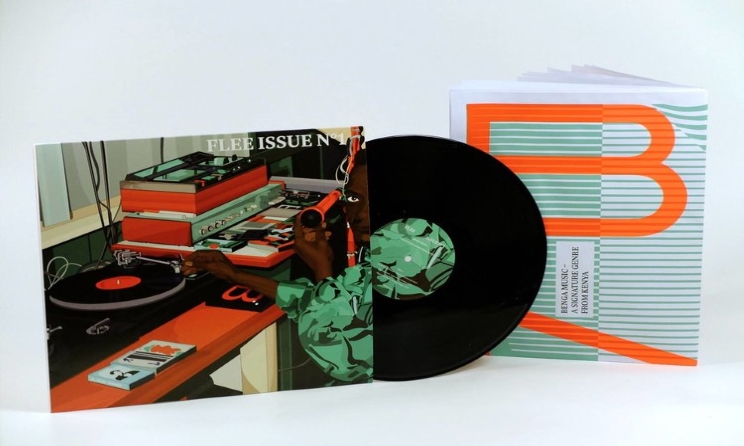
In October 2017, Flee, a cultural platform dedicated to the documentation and enhancement of hybrid cultures, launched Benga Music – A Signature Genre From Kenya. The compilation paid tribute to benga – a genre that represents the authentic Kenyan sound.
Benga first surfaced with the Luo community in the western part of Kenya between the 1940s and late 1960s and has since spread throughout the country. Charmed by its unique sound, the European collective opted to engage in the documentation of benga after one of its members spent a considerable amount of time in Kenya.
The compilation, which was released on vinyl and on the web, explores the diversity of benga using original songs curated and edited by modern-day artists. It also features a series of articles in French and English.
The success of Benga Music – A Signature Genre From Kenya has now prompted the release of a limited re-press set for 9 April.
Music In Africa had an opportunity to speak to one of Flee’s founders, Olivier Duport, about the production process of the project and the upcoming re-press.
MUSIC IN AFRICA: What is the concept behind Flee?
OLIVIER DUPORT: Founded by myself, Alan Marzo and Carl Åhnebrink, we function as a record label, publishing house and exhibition organiser. The purpose of Flee is to discuss and analyse different music genres and subcultures. Our objective is also forward-looking: we attempt to make the highlighted movements interact with contemporary artistic approaches.
We dedicated this issue to benga. We selected four songs that we believe represent benga in its ‘heyday’. We then gave those to four selected contemporary musicians and asked them to reinvent those songs. The four musicians include Jaakko Eino Kalevi, Nik Weston, Africaine 808 and us (Flee has its own music studio), who re-edited those classic benga songs. With six out of the eight songs, we released a record, which comes with a 16-page silkscreen printed journal with articles.
For the journal, we collaborated with journalists Emmanuel Mwendwa and Ondiso Madete from Kenya as well as Douglas Paterson form the US. We also involved illustrators and graphic designers, Olka Osadzińska and the U-Zehn Atelier, who got inspired by the benga iconography.
Which topics did you highlight in the magazine?
Our magazine touches upon several issues and mainly tries to tackle three key questions. First we try to understand and document the ups and downs of benga throughout the Kenyan history to take stock of the current situation. This is mainly embodied by a key question we ask: is benga really dead and what do we understand by ‘dead’?
Secondly, we try to look at the relationship between the new Kenyan generation and benga. Here, the reader discovers that many young Kenyans, especially in urban centres, aren’t really familiar with benga. There exists a dynamic where the school system in Kenya is still extremely influenced by the British curriculum and where a genre like benga is rarely mentioned in classes. The author raises several questions about the enhancement of local traditions and identity in Kenya.
Finally, we try to look at our own work in a critical manner. Here we assume that the concept of world music has been generally problematic because it created a sterilised, self-fulfilling prophecy. So we try to explain our attempt to celebrate the nature of benga, by making the genre interact with contemporary music genres – by giving context to the readers to better understand this iconic music genre.
We also wanted to put an emphasis on the hybrid nature of benga music, influenced by the electric guitar, the traveling Congolese musicians, the radios playing Elvis Presley, and so on. On the other hand, we were also critical of the new ‘exotic’ trends happening at the moment, where DJs play music from all around the world without knowing the history of those musical cultures.
How did you arrive to settle for four songs?
We actually spent a lot of time listening to a vast amount of tunes and did a preselection of songs we believed were not only good but also representative of the diversity inherent to Benga. After this first selection, we worked with local partners to identify the songs they could help us license properly on a contractual basis. At this stage we only had 20% of the songs left, out of which we got the four.
Do you own rights to the songs?
Yes. The entitled beneficiaries of those songs, most of whom are living upcountry, were paid upfront. The songs have also been licensed through the Kenyan producer we have been collaborating with.
Any interesting stories from your visit to Kenya?
I think there would be a lot of stories to tell [laughs]. We actually really enjoyed our fascinating encounter with very old benga musicians at the house of Ayub Ogada. In fact, while those retired musicians, much older than Ogada, had abandoned the nyatiti [traditional Luo lyre] traditional instrument to start exploring what would then become benga with electric guitars, it was extremely interesting to hear Ogada speak about his own journey, which went the other way round: moving from electric guitar riffs to the use of the nyatiti.
How did you conduct research into benga?
Before we started, one of our founders who did the research on the ground was already living in Kenya. He was already somewhat familiar with the country. In general we were extremely lucky to work with very committed and passionate people who really helped us go deep into the research, and this is particularly true with Emmanuel Mwendwa, who is incredibly passionate and knowledgeable about music in Kenya.
When we first spoke, you said benga wasn’t a well-known genre. How did you arrive to that conclusion?
This was my opinion. But it really depends on the indicators one decides to use. In fact, if you concentrate on the countryside and the old Kenyan generation, you can argue that the genre is still very much alive. On the other hand, if you focus on the amount of bands and clubs playing benga nowadays, the airplay and other indicators such as the familiarity of young Kenyan with the genre, I believe the trend is rather moving down.
It is also important to mention that with the excellent initiatives of organisations like the Alliance Française, Ketebul Music and DJs like Bengatronics, some argue that the bottom of the wave has now been reached and that benga is back, potentially under new forms.
What advice would you give aspiring Kenyan musicians who might think benga isn’t a marketable genre?
I am not sure we would have any legitimacy to give any advice to anyone, as we are a young platform and still learning a lot. Nevertheless, what I can say is that any music composed and played with honesty, passion and love – three features embedded in humans but often forgotten by societies – is susceptible to encounter success among the new generation of listeners.
Exploring the real and digital world, this new audience is less interested in the music genre than in the music itself, and so I hope the Kenyan musicians of tomorrow won’t have to care too much about the box they are susceptible to be put in.
What’s next after the re-press release of Benga Music – A Signature Genre From Kenya?
First, in an era where everybody speaks about African music, we would really like to thank Music In Africa in its diversity and challenge to the engraved Western stereotypes.
On what is next, we have already started our preliminary research on a Southern European music genre whose roots are not without links to North Africa. At this stage we can’t say more about it but we will get back to you on that very soon.
Pre-order the re-press version of Benga Music – A Signature Genre From Kenya here.


Most popular

Top amapiano songs of 2026
16 Feb 2026

Top Naija songs of 2026
31 Mar 2026

Top Afrobeats songs of 2026
19 Mar 2026

ACCES unveils stellar programme for 2026 edition
17 Oct 2026
Open call: 2026 Gender@Work music industry training in Johannesburg
09 Oct 2026

The big interview: Temwa Gondwe on CANEX WKND 2026 – part 1
19 Oct 2026
Disclaimer: Music In Africa provides a platform for musicians and contributors to embed music and videos solely for promotional purposes. If any track or video embedded on this platform violates any copyrights please inform us immediately and we will take it down. Please read our Terms of Use for more.

Subscribe to our monthly Newsletter
Follow us on social media


Please log in to post a comment.