


























































The importance of music in holistic education cannot be overemphasized. In Zambia, just like in many other African countries, the struggle to have musical arts education gain its equitable place in the national school’s curriculum has been hard-fought. This text gives an overview of music education at each level of the so-called ‘7-5-4’ education system of Zambia: seven years of compulsory primary education, five years of secondary education and four years of university, in an ideal situation.
Background
Like most of its neighbours, Zambia is a former British colony and as such, many sectors including education are influence by the former colonial regime. After Zambia got her independence on 24 October 1964, she inherited among many other things the colonial curriculum that had been used prior to independence.
Apart from the influence of indigenous Zambian music on music education, the church has also played a major role. Missionaries introduced western three- and four-part harmony in choral church music, along with hymns that became part of school activities, especially in mission schools. Some African teachers and church leaders learnt to read music notation, especially tonic solfa, which spread into both the schools and churches. As missionaries from various Christian denominations established themselves in different parts of the country, so did their music.
Some local music teachers and leaders, through government and cooperating partners over the years, went to study abroad and in other African countries. They later returned to enhance music in schools and churches, as well as work actively as Zambian ethnomusicologists and activists for musical arts education. Among these torch bearers in music education are Dr Mwesa Isaiah Mapoma, the late John Anderson Mwesa, the late Longino Mumpuka, Boscow Mubita, Dr Joseph N’gandu, Dr Kapambwe Lumbwe and Aloysio Mumpuka, among many others. The ground had been set and the future of music education looked bright.
Music education policies are fashioned by the broader national education policies. Most of the music taught in schools was biased toward European curricula and culture. The gap between local community music and ‘school music’ was obviously wide. There have, however, been strides towards correcting this status quo by calls to contextualize the music curriculum at all levels. The 1996 national policy on education, titled ‘Educating Our Future’, clearly shows government’s positive attitude and desire for the advancement of the arts in general . The policy document emphasizes how the arts should be cultivated in the young citizenry to inculcate patriotism, appreciate and propagate Zambia’s diverse cultural heritage.
Early childhood education
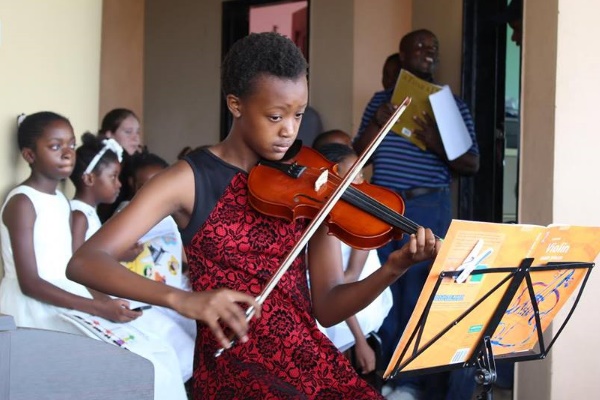
Until as recently as 2010, all early education (pre-school) institutions in Zambia were privately owned as government was not providing education at this level. In 2013, selected government schools (public schools) rolled out pilot classes in early childhood. Music at this level is taught under the Creative and Expressive Arts learning area umbrella, which is a combination of music, art, drama and physical education. The musical component of the curriculum is aimed at 'developing the child's social attitudes, patriotism and culture’. The teacher’s creativity and ability to make the learning area come alive is absolutely necessary at this level.
Primary school music education
Music at primary school level, as in the early years, is compulsory and taught under the Expressive Arts (formerly Creative and Technology Studies, or CTS) learning area, which is a combination of music, art, drama and physical education.
With the exception of singing, applied music and creative musical literacy are seldom taught in the classroom of government primary schools. This is generally because of a lack of necessary facilities, a largely incoherent music curriculum and generalist music teachers with relatively little musical knowledge or skills. However, there are many proactive teachers in the primary schools who find means - often using personal resources or outsourcing specialists - to teach ensemble playing with recorders, choral music and traditional Zambian song and dance.
The prescribed curriculum for public (government) schools is organized under the following activity areas:
- a) Applied music: singing, movement and dance, instrument playing and making and drama
- b) Creative musical literacy: the exploration of sound, rhythm, pitch, melody, harmony, form, music composition, notation, technical terms, signs and symbols (Zambia, 1990: 8-10).
At private and international schools in Zambia, music programmes vary from school to school, depending on the curriculum the school follows. Examples include flagship schools like Baobab College[i], the International School of Lusaka[ii], the American International School of Lusaka[iii] and the Lusaka International Community School (LICS)[iv], a British-style primary school that generally follow the International Baccalaureate (IB) curriculum. These usually follow international music teaching approaches, including the Suzuki method for instrumental instruction, and integrate Dalcroze Eurhythmics, Kodaly and Orff in general classroom music.
That being said, it is the top independent schools (mostly international) that have the best music teachers and resources, thus being able to provide a rich music education at primary school level. This includes weekly assembly presentations, chapel hymn singing (for Christian-inclined schools), termly and yearly musical productions and so on. Although obviously biased towards western musical styles, these schools generally have stronger music programmes mostly because of the reasons stated earlier, including the availability of a budget for the programme and to attract well-trained music teachers.
In the Copperbelt Province, which has several local private schools mostly owned and run by the mines, schools like Konkola Trust School, Nchanga Trust School and Kalulushi Trust School have been running good music programmes. The mines also usually attract and employ good music teachers, which translates into effective music teaching. Children not only have a weekly music class in a dedicated music room (usually with sufficient instruments), but also have opportunity to learn instruments as an extracurricular activity. Also situated in the Copperbelt Province is Lechwe School[v], which offers music training at primary level.
Secondary school music education
Secondary (high school) education in Zambia is divided into two levels: junior secondary (Grades 8 and 9), after which a national examination is written; and senior secondary (Grades 10, 11 and 12), after which the national school certificate examination is written.
At this level, music is an optional subject and the number of students who choose it is relatively low. While primary schools (previously known as basic schools) have a clearly defined music curriculum administered by the Ministry of Education, the high school music syllabus has had inconsistencies over the years. Following government’s decision to change the curriculum to focus on specific ‘career pathways’, schools have had to choose which career pathways they will offer. Very few schools have chosen the arts pathway that includes music.
At secondary level, music classes are intended for those learners who wish to use music in some way in their future careers. The music examination at Grade 12 level is mostly theory of music, but aspects of composition, aural tests and applied (performance) music are also incorporated.
Tertiary level music education
For over 40 years, Evelyn Hone College of Applied Arts and Commerce[vi] has provided music education at diploma level. The college is situated in the heart of Lusaka, the capital of Zambia. After the three public Universities in Zambia, Evelyn Hone is the fourth largest public institution in terms of student population and the number of programs offered. The institution offers a three-year Secondary School Music Teacher’s Diploma, primarily to train secondary school music teachers, with English as minor teaching subject. The music teachers’ diploma programme at Evelyn Hone College comprises both music courses and professional education courses, and a second teaching subject, English. Candidates in this programme are recruited based on the general minimum requirements and therefore do not undergo any music auditions or placement exams. The institution also offers a two-year Music Diploma for professional musicians who do not want to be teachers. Private tuition in instruments and theory is also available to those who might not want to enroll in the diploma programme. Performance ensembles of the music section include a concert band, choir, pop band and traditional dance troupe.
Rusangu University[vii] is a private institution with campuses in Monze and Lusaka, run by the Seventh Day Adventist Church. It is the only institution in the country offering full music programmes at Bachelor’s Degree level. Rusangu offers three different degree programmes: Bachelor of Arts (Music), Bachelor of Arts (Music with Education) and Bachelor of Education in Music (B.Ed Music). The Bachelor of Arts (Music) programme is a four-year course offered full-time to regular university music students who might opt to teach in schools or go into other areas of music. The Bachelor of Education in Music is targeted at serving music teachers from Evelyn Hone and other colleges who wish to upgrade to a Bachelor’s Degree. The university also offers a Secondary School Music Teacher’s Diploma. This programme is a balance of theory and applied music courses that was pioneered by prominent Zambian music educationist, the late John Anderson Mwesa, in 2006 with the help of adjunct lecturers. To date the programme has graduated over 50 music teachers and professionals (including the author, who was the first graduate from the programme) who are currently serving the country in various capacities, including as lecturers, teachers, studio engineers and producers, military bandmasters, composers and officers in the Ministry of Education. The music courses are taught by full-time and adjunct faculty with a minimum of a Master’s Degree in their fields of specialization.
Other music training programmes available for teachers are offered at the following institutions: the University of Zambia[viii], which runs a general Bachelor of Primary Education degree where music is taught as one of the subjects; the National In-Service Teachers College (NISTICOL) in Chalimbana[ix]; Northern College in Kasama, which offers music as a teaching subject at Diploma level; as well as at all Primary Certificate and Diploma Teacher Training Colleges, which offer music as a small component of the expressive arts learning area.
Other providers of music education
Ngoma Dolce Music Academy[x] in Lusaka’s Kabulonga residential area is a full-time conservatory-type music academy (the first of its kind in Zambia) run by professional musicians and supported by local and international partners. It has quickly earned a good reputation for music training, especially in western instruments. Ngoma Dolce is also currently the sole Associated Board of the Royal Schools of Music (ABRSM) examination centre in Zambia and one of its Directors is the Zambian representative. The academy principally uses the Suzuki method to offer instruction in several instruments to all age groups and prepares candidates for graded examinations. Ngoma Dolce also stocks music accessories for sale, including reeds, mouthpieces, music stands, strings, music books, CDs, practice manuals and sheet music, much of which was previously very difficult to find in Zambia.
In conjunction with Alliance Francaise Lusaka, the Lusaka Music Society and other cultural centres, several recitals and masterclasses by visiting musicians are hosted. A lot of local players associated with Ngoma Dolce get integrated into orchestras and other ensembles. The young music academy has helped change the face of classical music in Zambia, particularly in Lusaka, and hopefully will expand its influence to other parts of the country.
In terms of indigenous music education, Radio Chikuni[xi] makes use of special ‘listening groups’ to educate the rural Batonga community through broadcasts on a variety of topics, including music.
Though faced with challenges, Zambia has over the years developed a stable and comprehensive system for music education from pre-school to tertiary levels, one that other countries in Africa would do well to follow.
Further reading
- Kelly, M. J. 2006. The origins and development of education in Zambia - from pre-colonial times to 1996. Lusaka: Image Publishers.
- Mumpuka, A K. 2009. The status of music education in the selected high schools in Lusaka Province, Zambia.
- Zambia. 1996. Educating our future: National policy on education. Lusaka: Zambia Education Publishing House.
- Zambia. 1990. Basic Education Music Syllabus Grade 1 - 9. Lusaka: Curriculum Development Centre.
[i] www.baobabcollege.org/ [ii] www.islzambia.org/ [iii] www.aislusaka.org/ [iv] www.facebook.com/OfficialLICS [v] www.lechweschool.com/ [vi] www.evelynhone.edu.zm/ [vii] http://ru.edu.zm/ ; https://www.facebook.com/DepartmentOfMusicRusanguUniversity/ [viii] www.unza.zm/ [ix] www.chau.edu.zm/ [x] www.ngomadolce.org/ [xi] www.chikuniradiozm.org/
Disclaimer: Music In Africa's Overviews provide broad information about the music scenes in African countries. Music In Africa understands that the information in some of these texts could become outdated with time. If you would like to provide updated information or corrections to any of our Overview texts, please contact us at [email protected].


Most popular

Top Naija songs of 2026
31 Mar 2026

Top Afrobeats songs of 2026
19 Mar 2026

Ghana: Mr Eazi and MOLIY’s ‘Comfort’ earns Urban Music Awards nomination
21 Oct 2026

Top amapiano songs of 2026
16 Feb 2026
Open call: CANEX Music Business Lab and Songwriting Camp
15 Oct 2026
Nigeria: CANEX WKND unveils 2026 programme
21 Oct 2026
Disclaimer: Music In Africa provides a platform for musicians and contributors to embed music and videos solely for promotional purposes. If any track or video embedded on this platform violates any copyrights please inform us immediately and we will take it down. Please read our Terms of Use for more.

Subscribe to our monthly Newsletter
Follow us on social media


Please log in to post a comment.