































































“Another fab space taken down by the man .. onwards and upwards .. Bristol is waiting for us all when London eats itself and turns into a Lego city of bankers and endless pret-a-manger shops …” This comment was on Total Refreshment Centre’s (TRC) Facebook page, in response to the closure of TRC as an event centre in June 2018. It was posted by one Carl Hudson, who defines himself as a “keyboard gunslinger, electronics tinkerer and app programmer.”
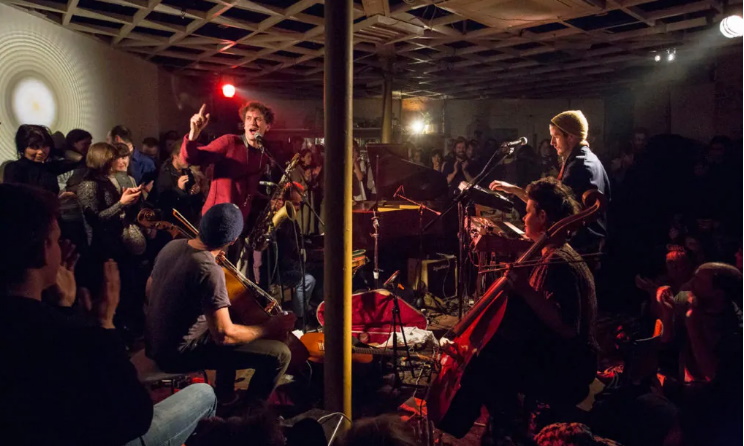
He was one of thousands of what author Emma Warren calls “musickers” who passed through the doors of London’s fabulously unlikely TRC venue over the years it existed. Warren believes that it’s not just musicians who create music, but also those who run the bar, lay the cables, do the door and buy the merchandise. They all create culture by their acts of musicking: the glue that held TRC together was not financial gain, but a passion for creating and maintaining an alternative space, where creative sparks could (and did) fly.
Culture cannot occur unless a suitable space is provided for it: Warren states this immediately in the title of her book. Make Some Space is a play on “make some noise”, a phrase readily used by contemporary DJs and musicians, which means “to advocate for and support in a very loud and obvious way”. She is certainly advocating for such spaces, but, as Hudson makes clear in his comment, musickers are up against systems and processes with little empathy for their cause, among them London’s gentrification: a London home now often costs about 10 times what it used to a few years ago.
TRC was set up in 2012 and included a large multi-use main space, a recording studio, rehearsal facilities and a variety of custom studio workshop spaces, adaptable to film, gallery events, theatre and photography. The main space was used for parties, gigs and events from not only Londoners, but performers from across the globe, who heard about it and came to add to it. In 2018 the main space was closed down by Hackney council, citing concerns over its lack of liquor licence, but the recording studio is still in operation.
TRC’s history
TRC derived its name from a Polo Mint slogan, and the venue itself was housed in a warehouse originally built to produce sweets. Warren meticulously outlines the history of the building: over the course of roughly a century it passed through various owners and was used, among others, to stock parts for cars and to manufacture shoes. Finally, it became the reggae club Mellow Mix, but it’s the origins of sweet-making and of the people living in Hackney that provide fascinating context.
The sugar for making sweets came originally from Britain’s colonies, particularly the Caribbean, and the wealth this created sparked Britain’s industrial revolution. The first owner of the building was Henry Davenport, who formed a partnership with the Maynard family dubiously called the Black Boy Chocolate Company. And the demand for the sweets coming out of factories like Davenport’s was created during the days of slavery and the sugar monoculture that crucified the Caribbean.
Half a century later, thousands of workers from the Caribbean Commonwealth were brought into Britain to help rebuild the shattered country after World War II, many of whom settled in Hackney. One of the first ships bearing them was called the Empire Windrush, and they became known as the Windrush generation. Since 2017 over 5 000 of these immigrants have found themselves homeless, denied healthcare and even deported as a result of the government’s “hostile environment” policy. This caused a scandal, the British home secretary resigned and 22 June is now designated as Windrush Day.
The children of Windrush, once more under siege, founded Mellow Mix in the shell of Davenport’s sweet factory in the '90s; they fixed up the venue, painted it in Rasta colours and ran it well into the 2000s. It was a hotbed of music where a pirate radio station ran for a time, genres such as lovers rock and grime were played and the doors were open to musicians from across the Caribbean.
Documenting culture
Warren is herself a musicker. The cover of her book Make Some Space started to fall apart as soon as I started reading it; the photos are tiny and grey, without true blacks and whites. That’s because it was paid for from the author’s own pocket. It’s not so much a 'book' as living documentation about something that’s just happened and is still happening, created without what she calls “the distorting safety of the past”, where it’s safe to look back and comment without being actually involved. Her documentation makes the point that the makers of culture do so with whatever materials come to hand: in her case, some friends and a credit card.
The chapters of Make Some Space are interspersed by what Warren calls “interludes”. These are quotes from musicians, technicians, organisers and artists who worked or played or helped out at TRC, gleaned from interviews the author conducted, which provide an inside view of the vibe that the place generated. Readers also gain an idea of the massive amount of work that went into keeping the venue going: several of the organisers suffered multiple burnouts. Some of the chaos that they had to negotiate is captured in the quotes: recording equipment that grew legs and somehow shifted from place to place (but never disappeared); paths that had to be cleared through cans left from the previous night’s party; walls that were erected or demolished overnight; entrances that were all but impossible to find.
The interludes give the book a journalistic feel, but Warren never tries to position herself as an 'objective' journalist. Instead she tells her tale, as she puts it, through the lens of her own experience and interests. She even volunteered to work at a couple of TRC events to see what that involved, in a direct, hands-on manner. She ends the book with a useful chapter about how she wrote it, called “How to document your culture”, to show the way forward for others. It includes how she gathered the archival material and how she found or was found by those who helped her in her journey into Hackney’s past. It’s refreshing and informal and helps break the mystical barrier between writer and reader, in the same way that TRC musickers broke the barrier between audience and performers; they would, at times, put musicians’ names into a hat and create 'bands' from what emerged (which would then perform immediately, sans rehearsal).
The value of cultural spaces
Hundreds of youth clubs have recently been closed in Britain, putting thousands of people out of jobs and depriving the youth of spaces to meet, share and create. According to The Guardian, English councils have slashed funding on youth services by 40% on average in the last three years, which puts youths in danger. World Travel Guide says in a story titled Is London losing its soul? that the number of live music venues in London has dropped by 40% in the last 25 years. This makes what TRC was doing even more valuable; priceless even.
Culture appears to be something that people create out of sheer love, but it can easily be killed by senseless laws and administrators who cannot see its value, who see it as mere hedonistic noise, who are more concerned about making money and maintaining order. This has also happened in South Africa: according to Fatima Shaobien, the Cape Minstrel show, kept alive for centuries by the diligent work of thousands of community members, is now being killed off by the party that runs Cape Town, the Democratic Alliance (DA). It inexplicably decided to move the New Year’s celebrations to December 30, creating widespread confusion. It also outlawed people camping on the streets in anticipation of the marches and introduced several administrative barriers such as permits that have to be applied for and are hard to obtain.
As in London, there’s a clash between commercial and cultural interests happening here. The DA would do well to learn from Brazil’s carnival ‘blocos’, where musicians, dancers and partygoers meet months before the carnival occurs to practice and plan their routes and moves. Brazil’s carnivals attract millions, and generate billions in tourism for the country. They also illustrate that the concept of space for creating culture need not be limited to buildings; it can also take place on the streets… it’s in our heads.
Leadership and local spaces
Another central feature Warren outlines that is essential for creating creativity and culture is strong leadership. Alexis 'Lex' Blondel provided this at TRC: he had the foresight necessary to create the space; he found ways to finance it (by leasing the recording spaces); and had the buckets of energy required to hold the crumbling, chaotic fort together.
Siyabonga Mthembu from The Brother Moves On has a very high opinion of Lex. He says that more than any other venue, TRC was responsible for the emergence of the new jazz scene in London. Warren dedicates an entire chapter of her book towards this process, which she says made jazz acceptable for people in their 20s for the first time. “TRC was such a magic spot!” Mthembu said. It served as his London base for years and enabled The Brother to do several fruitful collaborations with saxophonist Shabaka Hutchings.
Mthembu said that Johannesburg’s Drill Hall was perhaps the closest local equivalent to TRC. For a time, it served as a music and event venue, a recording studio and a library, thanks to cultural activists Rangoato Hlasane and Malose Malahlela, who, together with Bettina Malcomess, founded the Keleketla Library in the Drill Hall, which became a refuge for the youth in neighbouring Joubert Park. Another South African space where creative juices flowed freely, according to Mthembu, was Afrikan Freedom Station in Brixton, Johannesburg.
In 1972, photographer Brian Astbury founded The Space in Cape Town, widely regarded as South Africa’s first alternative anti-Apartheid theatre venue. Like TRC, The Space ran on a shoestring, and was kept alive by the spirit of volunteerism. It bore witness to the atrocities of the era and attracted a number of artists who later became household names, such as Athol Fugard, John Kani and Pieter-Dirk Uys. Many of them were interviewed in the feature-length documentary The Space – Theatre of Survival which was released in 2019. Astbury died in March 2020.
Sifiso Ntuli, who now runs Roving Bantu Kitchen & Treks in Brixton, has been running cultural hotspots like ‘Nuff Said Kollective and Dark City Jive for over 25 years. Ntuli isn’t doing it for the money – although he has to eat. For him, it’s more about energising people who are jaded. “I’ve always been moved by the concept of bringing people together, because together, we can create things. So you create a space, or a movement … what W.E.B. Du Bois called ‘temples of African freedom and friendship’. But your objective must be clear … and you must have belief.”
Art has a duty to correct all the wrongs that have been heaped on the African table, says Ntuli. “How do we create community in a society that apartheid broke apart? You have to lead by example, you have to create trust; our society is full of distrust. Biko said material want is bad enough, but coupled with spiritual poverty, it kills. We are so spiritually impoverished here … and there is so much desperation. Apartheid created that: we were like rats … there was distrust during the struggle, there was betrayal. And it’s still a fight for who is ‘in’ [who has access to state money], and who is ‘out’.
“The ANC is creating spaces, but without consultation, which is why they get trashed. Governments can never create people’s spaces.”
Footnote
After reading Emma Warren’s book, I started to wonder: how many South African artists have been forced to create without the benefit of cultural spaces? How many musicians have had their rehearsal rooms closed because of noise complaints? What sort of art would we be producing if there were such spaces provided? If some musical equipment was provided in these spaces, would it inevitably be stolen or trashed, as it was at the Zimology Institute?
This article first appeared on herri.org.


Most popular

Top Naija songs of 2026
31 Mar 2026

Top Afrobeats songs of 2026
19 Mar 2026

Top amapiano songs of 2026
16 Feb 2026

Open call: CANEX Music Business Lab and Songwriting Camp
15 Oct 2026

Open call: National Arts Festival artistic director in SA
15 Oct 2026

Ghana: Mr Eazi and MOLIY’s ‘Comfort’ earns Urban Music Awards nomination
21 Oct 2026
Disclaimer: Music In Africa provides a platform for musicians and contributors to embed music and videos solely for promotional purposes. If any track or video embedded on this platform violates any copyrights please inform us immediately and we will take it down. Please read our Terms of Use for more.

Subscribe to our monthly Newsletter
Follow us on social media


Please log in to post a comment.