



















































By Minette Mans
To understand music is to expand the universe of human discourse. Understanding more about music in Namibia can, therefore, contribute towards understanding of our people. This text provides a brief overview of some of the musical traditions of the country’s rich tapestry.
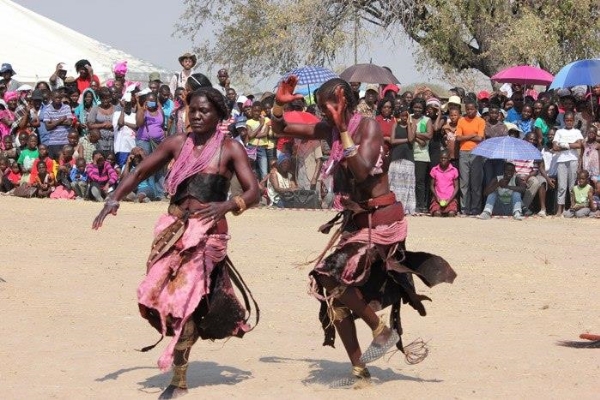
Music in Namibia is extremely diverse, partly due to the diversity of language groups and the artificial ethnic separation of the past (apartheid), which discouraged people from freely mixing. Namibian musical practices can probably be generalised following three broad (yet culturally mixed) bands across the region. Cultural sharing, migrations, political history and even agricultural practices are all inscribed upon bodies and revealed in dance and music.[i] Much of the music is sung in groups, mostly with dance and sometimes drums. Most solo songs are either with bows, lamellophones or unaccompanied.
Northern musical traditions
In the mainly rural northern band, stretching from coast to Kalahari and north of the ‘red’ veterinary border, musical traditions are well retained. Music is often practiced communally. It relates to specific daily or seasonal functions and displays distinct identities amongst different cultural groups. This means that music is made when there is a need, for example: when an infant is named, at weddings, funerals, harvests, at age-related transitions and for healings. Tonal systems of the music differ strikingly from west to east, as does the use of instruments. Agriculture forms an integral part of daily lives and many important musical events are regulated by season. This applies to the semi-nomadic herding people as well as the more sedentary crop farmers.
Healing songs are especially important amongst the Ju’/hoansi (n/om tzísì), !Kung (g!ai ǂi) and Kxoe (yeu /’i) of the north-east, the Lozi of Caprivi, and the Mbukushu, Gcririku and Kwangali people of the Kavango region. The latter four groups all use a set of three drums, combined with clapping and the shaking of grass skirts and shoulder pieces as accompaniment to the healer’s work, for example in nyakasanga (Silozi). The Ju’/hoan healing songs are practiced regularly as part of protection of the community against spiritual danger and healers enter a ‘dangerous’ trance to confront the danger in the spiritual form of eland. Damara spiritual healings in the north-west, called arub after the pot-drum they use, draw out the //gawarab (spirits) from an afflicted person during trance, accompanied by a semi-fixed repertoire of nine songs in which the group singing always starts with “!Haoros”, after which individual healers sing their individual healing songs with the others. Ovazimba and others in the Kaoko Region practice spiritual healings (olundongo) as well. This also involves someone going into trance to ward off evil spirits, but also give men strength for battle or a raid.
Entertainment (recreation) commonly includes song and dance as broad generic categories. In the east, siyamboka (Valozi) and udano (Kwangali) would thus include families of drums; uudhano (Ndonga) would include a single drum in central areas; omutjopa (OvaZimba) would have two drums; and ondjongo (Ovahimba) in the west would have none. Ondjongo, an Ovahimba dance-play with strong clapping of hands, has a unique tonal-harmonic pattern and timbre, while the clapping rhythms of the north-western /gais, a Damara form of play that tells many stories in its performance, are amazingly complex. Namas in the north-west sing and play Namastap to the accompaniment of guitar.
The Kwanyama traditional women’s transition, efundula, which used to incorporate huge ensembles of large, conical drums (eengoma) supported on a large cleft wooden branch, have all but died out. The songs, however, are still commonly sung by older women and young women who attend the ceremony across the Angolan border. This ceremony is called olufuko amongst Ndonga speakers and involved large numbers of women in the past, although currently few attend a re-invigoration of the ceremony in Outapi. Both take place over several days and involve gruelling pounding and song-dance challenges for women to prepare them for life and marriage. Amongst the Ju/’hoansi in the north-east, a girl undergoes a transition ceremony (tcòqmà) after first menstruation and is celebrated mainly in Eland songs. Similarly, young Damara and Nama girls undergo individual !khae-oms in the Sesfontein area and their ‘coming-out’ is celebrated in song and dance.
Praise songs are common to all the Aawambo and Herero groups. These songs can for example praise individuals and their lineage, or leaders and heroes, animals, or tell about historic events. Owambo men also sing ongovela to praise their cattle. Praise songs can be sung in groups or solo.
Central musical traditions
This more urbanised region, stretching from Walvis Bay in the west to the cattle-farming areas of the east, has long been multicultural. Since the establishment of Windhoek nearly one and a half centuries ago, European music and indigenous music both underwent changes here. The German population saw to the establishment of brass bands in churches and for entertainment, while every church had a choir to enhance services. Thus, even in the early 20th century there were violin ensembles practising even in select ‘black’ church schools, while the ‘white’ population attended classical concerts, mostly of smaller ensembles. Dance orchestras were also popular, playing ballroom styles of music and towards the Rehoboth area and other smaller towns, Afrikaans Boeremusiek and Orlams music was popular.
Central Damara communities adopted western harmonies at some unknown period in the past and consider their choral dance-step performances, commonly referred to as ‘concert songs’, as tradition. The Namastap dance accompanied by guitar and accordion was also adopted by the Damara people as their own. The concert songs of Damara people have a four-part harmony structure typical to Setswana and even Xhosa choruses of the same style. In the Setswana-speaking eastern area, coming-of-age songs (dipena tsa bojane) and cattle herding songs, all pentatonic, can be heard. In the township areas of the past, there were dance halls and shebeens where musical performances took place. Bands included saxophones, double bass strings, drums and guitars.[ii] This lively music scene was disrupted when the Old Location was forcibly flattened and residents moved to Katutura, a new segregated township.
Towards the east from Okahandja, across the wide grazing areas settled mainly by Herero people, one finds their characteristic singing-chanting tradition is almost identical to Ovahimba singing, as they are of the same ethnicity. OvaHerero singing includes a variety of free rhythm solo incantations, with a variety of different categories of praise songs and poems. Women’s songs, outjina, are sung especially at wedding ceremonies, but also for self-entertainment. Many of these songs tell evocative stories of their suffering at the hands of German troops in the early 20th century. Outjina are accompanied by a plank tied to one foot and stamped rhythmically on the ground (otjipirangi), while arms are raised like the horns of cattle. Men sing ehiya songs in a chanting style, with a woman’s chorus responding in a descending tonal pattern.
Afrikaans-speaking people in the region, including Rehoboth, used to perform folk songs and sing these as they performed volkspele. This practice has all but died out.
In parts of the central region one still finds ongovela songs performed by men who moved to urban areas in search of employment. The songs have a solo with a repeated chorus response, and sometimes rhythmic movements by a singer. There are different types of ongovela, but many praise their cattle and tell tales about the herding of cattle.
Southern musical traditions
The very arid south of Namibia’s population is thinly spread, with people settled in a few towns and across the land as small stock farmers. Rhythms in this area are simpler than those in the north, but the harmonies, similar to western four-part, are more of a focal point. The Orlam people of the south, whose forefathers migrated from across the Orange River, brought this history to Namibia in their music. Their ‘langarm’ dances often have a three-beat ‘Boerewals’ rhythm, is danced holding on to a partner, and accompanied by guitar, drum set and piano accordion or concertina. Nowadays these instruments have been replaced by electric keyboards but the music is still played in a characteristic style and rhythm. The annual celebrations of the /Khowesen Heroes’ Day in Gibeon recall the songs and dances of the original Orlam people, playing songs like “Saso ge ti so” (Women, you are mine), although the dancers do not sing.
The old traditional of large ensembles of bone or reed flutes played with song for Nama dances have died out except for a single tiny remnant in northern Sesfontein, and few can recall the original songs.
Bibliography


Most popular
Call For Applications : ACCES seeks a UK-based performer
10 Sep 2026

Top amapiano songs of 2026
16 Feb 2026

Top Afrobeats songs of 2026
19 Mar 2026
Open call: Goethe-Institut grants for Southern African creatives
08 Sep 2026

AFRIMA 2026: All the winners
12 Jan 2026
Open call: Ernst von Siemens Music Foundation 2026 funding programmes
04 Sep 2026
Open call: FAME Week Africa, Pressure Cooker Studios songwriting camp
09 Sep 2026
Disclaimer: Music In Africa provides a platform for musicians and contributors to embed music and videos solely for promotional purposes. If any track or video embedded on this platform violates any copyrights please inform us immediately and we will take it down. Please read our Terms of Use for more.

Subscribe to our monthly Newsletter
Follow us on social media


Please log in to post a comment.