















































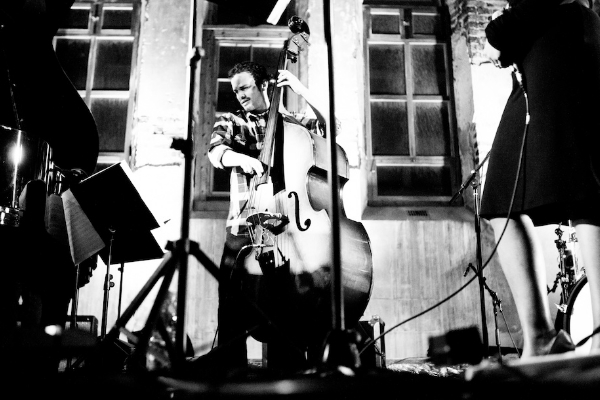
The best interview subjects often-times turn out to not only possess an affable personality, but also tend to express vast, in-depth knowledge in whatever the topic under discussion may be. Cape Town-based bassist Shane Cooper is one such character. A mainstay in bands like Babu as well as the Kyle Shepherd Trio, Shane also doubles as an electronic music producer, cooking up warped left-field beats with the dexterity of a digital marksman under his alter-ego, Card On Spokes.
He speaks as excitedly about Charles Mingus’s compositional genius as he does about, say, Sibot’s amazing live show. “Sibot’s set leaves a lot of room for improvisation, which I really admire. He’s seriously playing a lot of those beats live,” Cooper says. Recently, he got awarded the Standard Bank Young Artist Award in the jazz category. The awards, now in their 29th year running, are not without their critics. We decided to pick Shane’s brain on South African jazz in particular, and the jazz world in general.
Who is the one bassist you look up to in jazz?
There’s a whole bunch of different things. Mingus is a huge influence, especially compositionally. Pattitucci, Ray Brown for some old school stuff and Ron Carter as well for the real traditional playing, and then the way Ron Carter took it to new things with Miles. There’s a whole host of guys. I guess I look to different cats for different things, so there’s some guys I’ll look to just for the way they play the blues, and I’ll look to another guy for the way they play more odd time signature stuff. Look at Derrick Hodge who plays with Robert Glasper, and the way he plays hip-hop, but hip-hop in a jazz band … he’s bad-ass, his sound and choice of notes and stuff. It’s amazing, he hits the nail on the head! It’s the same kind of thing I get from Pino Palladino who played on D’angelo’s “Voodoo” album; it’s just the perfect placement of notes for hip-hop stuff. And just jazz guys in general, a whole bunch of different composers and new guys that I like. A lot of the inspiration for the new guys comes from the old guys as well.
You’re from Port Elizabeth, which is in the Eastern Cape. The Eastern Cape has a whole lineage of amazing jazz cats. Were you familiar with the scene when you were coming up?
Yes, I was. There were a lot of guys that I discovered only later they originally come from PE and the Eastern Cape at large. But when I was coming up I was playing with a guy named Gerard O’Brien who’s originally from The Genuines, an old Ghoema-punk band from the 80s (with Hilton Schilder and Mac McKenzie). I played with him and this guy named Graham Beyer when I was sixteen, in bars and clubs around PE. I really cut my teeth with those guys, that’s when I started learning a lot more about how to really play in a jazz group. We connected with guys; there was a small scene there but there were a lot of guys who were passionate about it. But many of the jazz musicians have moved to other cities. It was a cool place to grow up, but creatively there’s a very limited bunch of venues you can play at.
So why did you move to Cape Town?
Well I wanted to study jazz, and I was looking at different universities. The Cape Town one (the SA College of Music at UCT) looked like a good option. And then I had a couple of mates here that I’d met that said I should come by and we can work on some stuff. It kinda seemed like the obvious choice, and I’d always really liked the whole scene here, everything that I’d heard coming out of Cape Town in jazz, electronic music and everything was cool. So I was pretty easily swayed.
How does the relationship between musicians work in the collaborative projects that you have been involved in, like Babu and the Kyle Shepherd trio for instance?
Kyle’s group is a good example of something where Kyle is the composer and the leader and the vision of the group, it’s his whole concept. And he came and basically contacted Jonno (Sweetman, drums) and myself. I can’t remember exactly when we started playing together. When someone invites you to come and play their music, it’s not a definite that anything’s gonna happen. It might just sound okay, and then you do one or two shows and it kinda ends there. The first couple of shows are really the test to see if there’s chemistry. We played, and I feel like we had a definite chemistry from the get-go, and it developed into a really good working relationship over several years, and Jonno and I have a really good core connection as bass and drums, which is really important. You can have a good bass player and a good drummer who don’t connect, and then the whole thing falls apart. Jonno and I really work well together; I think Kyle felt that from the beginning, that this thing is working and we had a connection. That’s really the main thing, and then the rest is all the work that Kyle has put into the project, and bringing us into his space, then us rehearsing and working on the stuff. But fortunately we had a natural musical connection from the beginning. And then a lot to it is also, I think, liking similar things and different things. There’s a lot of stuff that we listen to together to get inspiration; when we’re on the road together we’ll watch DVDs, stuff of bands that we dig. At the same time there’s stuff that I listen to that the other guys don’t like, and vice versa. But that also informs my playing and brings out something that they can connect with vicariously.
So you got awarded the Standard Band Young Artist Award for 2013 in the jazz category. Where were you when you received the news?
I was in studio working on some mixes, and they called me up. It was a big surprise, I didn’t expect it. It was pretty weird as well because I was in the studio and they were like “don’t tell anyone yet until it’s announced,” so I had to be quiet. I was really stunned by it, I didn’t expect that call at all! It was a huge honour to get it.
Has it changed anything? For instance, are you getting more bookings than previously?
What it really comes down to is that they’ve given me some shows at the Grahamstown Festival. I’ve been writing music for several years, jazz music that I’ve performed in different groups, and I’ve been waiting to put together my own group under my own name. But I’ve never got to it yet because I’ve been really focused on the collaborations that I’ve been in, stuff like Babu. I was in this band Restless Natives for several years, Closet Snare and stuff. So a lot of my writing energy and efforts in the jazz world were focused on those collaborations. It was always something at the back of my mind: okay, soon I’m gonna put together my own group. And then they gave me that award and were like “we’ve got some shows for you in Grahamstown.” So we’re recording a record at the end of April, it’s got Kesivan (Naidoo, drums), Reza (Khota, guitar), Bokani Dyer on piano, and Justin Bellairs on alto saxophone. And then I’m gonna do two collaborative shows at Grahamstown with some international guys (from Europe) as well. So that’s the main thing, they give you a showcase there. It will amount to some more shows that come up over the year with my band hopefully.
Originally published on 7 February 2013 at Africa Is A Country.


Most popular

Top Naija songs of 2026
31 Mar 2026

Top Afrobeats songs of 2026
19 Mar 2026

Top amapiano songs of 2026
16 Feb 2026
Open call: CANEX Music Business Lab and Songwriting Camp
15 Oct 2026
Open call: National Arts Festival artistic director in SA
15 Oct 2026
Ghana: Mr Eazi and MOLIY’s ‘Comfort’ earns Urban Music Awards nomination
21 Oct 2026
Disclaimer: Music In Africa provides a platform for musicians and contributors to embed music and videos solely for promotional purposes. If any track or video embedded on this platform violates any copyrights please inform us immediately and we will take it down. Please read our Terms of Use for more.

Subscribe to our monthly Newsletter
Follow us on social media


Please log in to post a comment.