
























Majek Fashek and King Sunny Ade lessons for Wizkid and Davido
16 Nov 2017 - 17:03


By the early 1980s, master juju musician King Sunny Ade was courting western audiences, similar to what Wizkid and Davido can be said to be doing at the moment.
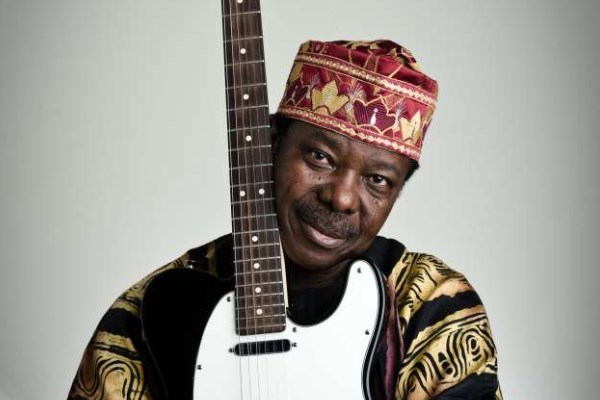
Born in 1946, King Sunny Ade, at this time, had formed a successful band and released several albums. Then he got signed by Island Records, primarily because, in what would strike the Nigerian ear as absurd, the label was looking for a replacement for Bob Marley after the Jamaican's death in 1981. Island wanted Fela's signature, but the Afrobeat man went to Arista Records.
As it turned out, a former French journalist working as Fela's manager heard KSA's music and nudged him to Chris Blackwell, head of Island Records. Blackwell then put together a collection of KSA's previously released music, gave it the flat title Juju Music, and brought it to the western market in 1983. Considering KSA's outsider status, the album was well received: it reached 111 on the pop chart.
Another album released a few months later climbed into the top 100, coming in at number 91 on the chart. Perhaps KSA thought it time to make an aggressive bid for the western market. He enlisted Stevie Wonder to play harmonica on Aura, his third international album. The album was released in 1984, and despite Wonder’s contribution, Aura flopped, failing to find an audience. (Three decades later, Wizkid might have made the same mistake KSA did: he too relied on stars made in America—Chris Brown, Drake, Trey Songz—on his Sounds from the Other Side album. As with Aura, SFTOS flopped in the US.)
Interestingly, American and British audiences would push Stevie Wonder’s own work in the same year to the top of the charts. His song ‘I Just Called to Say I Love You’ from the film ‘Woman in Red’ reached number 1 in both the UK and the US. Same song won the Oscar for Best Song in 1985. By then, King Sunny Ade’s journey to the west had come to an end. His music had gotten into a few US movies including a lesser work by critic's darling Robert Altman, but it couldn't save him. Island Records dropped the juju man. The KSA experiment had come to an end.
The entry of Majek Fashek
Then came the 1990s, when it was Majek Fashek's turn to receive western attention. Clearly a reggae artist, Majek, too, was spoken of in terms of Bob Marley. Along with Ivory Coast’s Alpha Blondy and South Africa's Lucky Dube, Majek was the avatar of reggae on the continent.
All three were so successful their music had received an audience so wide they were popstars. Majek was big on melody, for which he was praised, but western critics were far from impressed with his songwriting. In 1990, in a comment about Majek Fashek’s first international album Prisoner of Conscience, the Washington Post pitted Majek against Fela.
“Fashek's songwriting also grows repetitive as he tries to stretch out simple political chants and minimal melodies into five- and six-minute songs," said the newspaper. "He obviously longs to emulate the extended political commentary of his fellow countryman Fela Anikulapo Kuti within the reggae genre, but Fashek lacks Fela's fertile musical imagination.”
A few months after the Washington Post’s verdict, the New York Times acknowledged Majek’s charisma and “gift for catchy riffs” and his “promising hybrid style”. But like the Times, the Post faulted his writing: “There's not much depth to his messages,” wrote the Post. “His political statements are either bromides—unspecific and uncontroversial denunciations of poverty, apartheid and injustice—or matters of faith…”
These mixed notices notwithstanding, two years later, Majek Fashek opened a Tracy Chapman concert. This time, he received praise for his enthusiastic stage performance, a stark contrast to Chapman’s sober approach. “Bright, lively and full of positive messages about racial harmony,” the Times critic wrote, “his music seemed to start under his skin and spread into the farthest corners of the theatre. Dancing around in baggy black pants and combat boots, employing call-and-response vocal techniques, his every move and word seemed intent on drawing the audience in.”
Critical reception of Majek Fashek’s second international album Spirit of Love went the way of his first. Once again, his gift for melody would be mentioned and praised; once again his songwriting would be panned. “Just ahead of the onrushing momentum of African talking drums, electric guitars, female vocals and percolating bass is Fashek's handsome, persuasive tenor,” goes the 1992 review, before adding: “Unfortunately, his songwriting, with its vague appeals to universal peace and brotherhood, is too shapeless to take full advantage of his talent.”
On the flipside, the talk show host David Letterman had declared Majek Fashek “terrific” before a performance by the Nigerian in the same year. “This one man,” Letterman said jokingly, “does the entertainment work of a group.”
The language issue
It is perhaps noteworthy that Majek may have escaped scrutiny had he employed a local Nigerian language. But by singing in English, it proved impossible to divert critical attention purely to his sound, which was mostly commended.
In any case, one of Majek’s last major events in the USA was an ensemble festival—comparable perhaps to the recent One Music Festival held in the US. The 5th Africa Mondo Festival, which held in 1996, also featured fuji-man Adewale Ayuba. In reviewing the concert, the New York Times’s Jon Pareles wagged a finger in the direction of Majek Fashek. “The festival's letdown was Majek Fashek,” said Pareles. “A reggae singer from Nigeria, who performed with a smaller band than usual, a quartet, and spent too much of the set in aimless guitar solos.”
In spite of these less than glowing reports, it is difficult to tell what exactly prevented Majek from conquering the US. Perhaps it was a combination of these mixed notices and the man’s own self-destructive streak. From the highs of global attention, he would be reduced to near-destitution. Attempts at rehabilitation would fail so that for many fans, it is difficult to reconcile the young Majek with the current one.
When he was introduced at the monthly Afropolitan Vibes concert in December last year, part of the excitement of the audience must have been partly due to relief and nostalgia. “Don’t call it a comeback,” hollered concert organiser Ade Bantu. Majek’s own song ‘So Long’ may have been a suitable soundtrack: “Remember, remember, long long time ago when we used to live like prince and princess…”
The coming controversies
Since Majek Fashek’s heyday, Nigerian music has not been quite in the news as it is now. Minus the peculiarities of this time, Wizkid is in the position Majek Fashek and KSA were at some point in their careers. He is in front of the western push of Nigerian music, Davido by his side.
Wizkid has managed to work with foreign artists without paying for the favour. At a press conference held months after the release of his sophomore album Joy, he told a roomful of journalists his policy for international collaborations: the artist has to like Wizkid’s own music. If Wizkid is believed, then his approach has paid off and set him apart from the others.
And yet, Wizkid will not go it alone. He may have received the Drake co-sign but it is Davido who got the cover of US magazine FADER. Davido was also first to agree a deal with Sony Music. It is a great time to be a prominent Nigerian artist. Now more than any time in the past decade, there is the chance of the global spotlight reaching one’s work.
This attention has not come without its downsides. As a recent Music in Africa interview with South African great Ray Phiri shows, it has always been a fraught exchange whenever the west turned its eye to African music. Phiri was among the local musicians who worked with Paul Simon on the latter's Graceland album. Simon received garlands and Grammys for his work. He was also accused of taking advantage of South African artists, a view Phiri shares. "If Paul Simon is a great composer and songwriter why does he not have another Graceland, or an album as successful as Graceland?" asked Phiri. "He took a gamble. All he did was prey on the innocence of people who love making music. And it looked like he gave them an opportunity. He never did that. The music of South Africa gave him an opportunity to revive his career."
For Nigerian music lovers, perhaps nothing is more infuriating than the naming of Nigerian pop ‘afrobeats’, a corruption of Fela’s Afrobeat and an attempt to put all of Africa's contemporary sounds in a single box. With attention on the sound bound to increase over the next few years, there is a chance that as far names go, the country’s music is stuck with ‘Afrobeats’. Already some of the sound’s proponents have given up. When Don Jazzy welcomed the Nigerian-American artist Jidenna, whose work incorporates Nigerian elements, he tweeted: “Jidenna, you have now joined afrobeat gang.” He skipped the terminal ‘s’ but his intention seemed clear enough. In an interview featuring Don Jazzy, Doctor Sid and DJ Jimmy Jatt, Don Jazzy appeared resigned to the new tag, while Jimmy Jatt said the name afrobeat is “limiting.”
Lessons for Davido and Wizkid
Beyond the name of the genre, there are problems which are rather foreseeable giving the history of both King Sunny Ade and Majek Fashek. There is a chance that an aggressive incorporation of the sound of the west may derail—or delay—the ascendancy of Nigerian pop. Which was perhaps part of the problem with KSA.
Already there is evidence that this is a route that Wizkid may follow. On the song ‘Shabba remix’ featuring Trey Songz, Chris Brown and French Montana, on the song’s verses, Wizkid barely sounds like the artist who recorded ‘Pakuromo’, ‘Ojuelegba’ or his verses on the excellent Jimmy Jatt tune ‘Feeling the Beat’. He appeared to deploy a certain R&B quality to his vocals. Since then he has remade a Kent jones song, an LL Cool J track and a song by Yung Thug.
While this means he is preparing to take a position on the global scene, it could also be indelicately suggestive of some insecurity. As Don Jazzy says of American music professionals who have contacted him in the aforementioned interview, “I can give you your sound, but then I would now be no different from a Timbaland or Pharrell.”
The other issue concerns songwriting. It is generally acknowledged in Nigerian critical circles that Nigerian pop is not strong in the writing department. What the country’s musicians have is an incredible talent for crafting hooks and choruses, for setting something infectious to a danceable beat. That talent has seen our music displace American music from the playlist of the country’s clubs. It has also enriched our pop acts. The populace has embraced the current crop of artists. While this patriotism is admirable, it appears to have lead Wizkid and company down a path of lyrical complacency. If the local audience loves it, it must be right.
Unfortunately, as the Majek Fashek example proves, there is a chance—perhaps a slim one—that the west may require something more for any sort of longevity in that scene. For Nigerian music as it exists to survive harsh western criticism, it will have to improve its songwriting especially as both Wizkid and Davido have a chunk of their lyrics in English, pidgin or otherwise. If not, there is the chance that Nigerian music will have to depend on exploiting the gap between the critical community and the general audience—which given how dance-ready the sound is may not be very difficult.
These Great Expectations
Going by the coverage from the mainstream western media, there is an expectation that Nigerian music might accomplish what it failed to get in the time of Majek Fashek. The efforts of those past artists has made it easier for the expected penetration of Nigerian music. New publications may be getting to Nigerian music in this generation. The old ones quoted above are at the very least familiar with music from this part of the world.
The buzz is so much that the Washington Post has asked a question: Is this the year that African music will conquer the United States? Although covering more than just Nigerian music, the article makes much out of Davido and Wizkid foray into western radio.
“As U.S. mainstream success beckons these African artists,” it says, “more tantalizing are the collaborations with artists in this country that introduce both sides to millions of new fans. For Davido, that means co-signs from Meek Mill and Major Lazer, or Wizkid recently announcing that he was in the studio with Sean Paul.”
It is a tantalising prospect for Nigerian music as two of its well-known representatives are on the cusp of global success. To truly conquer, both Davido and Wizkid would need to negotiate the future by keeping their eyes on the past.


Most popular
Top Naija songs of 2026
31 Mar 2026

Top amapiano songs of 2026
16 Feb 2026

Top Afrobeats songs of 2026
19 Mar 2026
AFRIMA 2026: All the winners
12 Jan 2026
Call for applications: ACCES 2026 Emerging Artist Spotlight Competition
01 Oct 2026

Goethe-Institut Kenya brings Ghanaian and Kenyan artists together for MobiArts concert
05 Oct 2026
Disclaimer: Music In Africa provides a platform for musicians and contributors to embed music and videos solely for promotional purposes. If any track or video embedded on this platform violates any copyrights please inform us immediately and we will take it down. Please read our Terms of Use for more.

Subscribe to our monthly Newsletter
Follow us on social media


Please log in to post a comment.