






















































Michael Mosoeu Moerane was a pioneering composer in South Africa. A new book is restoring his place in history
18 Feb 2025 - 15:38


By Gwen Ansell
Composer and educator Michael Mosoeu Moerane (1904-1980) is probably best known for a few evergreen choral works, including ‘Della’ and ‘Sylvi’a, still sung by choirs across South Africa today.
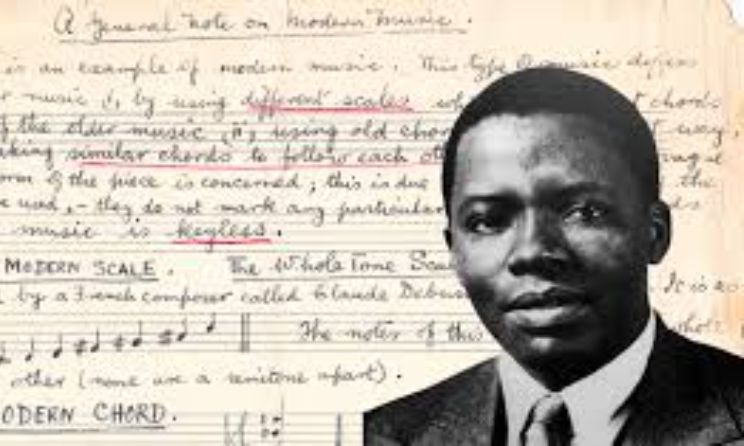
And, of course, for his orchestral piece ‘FatŠe laHeso (My Country)’. It had the distinction of being recorded by both the British and South African public broadcasters in an era when white minority rule denied even the existence of Black classical musicians.
Apartheid held the identity of Black people in South Africa to be unchangingly simple, rural and tribal. Sophisticated activities such as orchestral composing were both beyond their capacity and dangerously subversive.
But, as South African author and music scholar Christine Lucia’s biography of Moerane, The Times Do Not Permit, reveals, there was more to Moerane’s work than those few compositions. And a far more nuanced relationship with his oppressive political times. Moerane was vocal against the system, yet secured white university supervision. He was consulted by white ethnomusicologists. Yet still he was stereotyped and confined by apartheid rules.
I am a researcher into South African jazz and other genres and a teacher of writing. (Jazz, incidentally, was a genre that Moerane detested). From my own work, I recognise many similarities between his story and the lives of jazz musicians I have studied: genteel homes with a piano in the parlour; after-dinner family music hours; the risk of instant dismissal for schoolteachers heard discussing anti-apartheid politics.
I recognise, too, the gaps in his music story that Lucia finds: the questions that scholars did not ask while more people were still alive to answer them.
Her book matters because, at last, it asks and answers those questions. In how it assembles the answers, it helps us to start mapping the undiscovered continent of Black classical music under apartheid.
The book’s nearly 300 pages offer a detailed account of Moerane’s life, based on research and conversations with family and still-living contemporaries.
Lucia takes us through Moerane’s various roles in turn (student, teacher, choralist and more). It also analyses his compositions and their treatment of themes that range from spirituality and tradition to love and loss.
A reader can view Moerane’s life though these different lenses; together they add up to an intricate, multidimensional portrait.
Who was Michael Moerane?
Born in the Eastern Cape province and educated there and in neighbouring Basutoland (today Lesotho), Moerane stitched a music-teaching career together that moved between the two countries.
His own radical Africanist politics, the activism of family members, his marriage across apartheid-defined ethnic barriers (he was Sotho, his wife Xhosa) and the simple fact of being a Black composer exploring unconventional, modernist music meant he was often in the sights of repressive authorities in both countries. Lowering his profile every now and then (a new school, a more obscure place to live) was his best protection.
There’s real fear in some of his letters that all these moves would mean his written compositions would be lost or scattered. Yet remarkably, through all this, he managed to hold a family together, establish music ensembles and a reputation, and graduate with a music degree from the University of South Africa in 1941, a time when it was almost unknown for Black South Africans to receive a university education outside segregated black colleges. He was supported, through a unique arrangement, by supervision from the all-white Rhodes University College in his home province.
His external examiner, William Henry Bell, said of FatŠe laHeso (Moerane’s examination piece) that he “never had expected such a work to be written in South Africa and less so by a Native”.
Lucia’s account of how Moerane got there, and of the many compositions and long music teaching career that followed, is made even clearer through a rich variety of material. There are geographical, historical and musical road-maps, extracts from his manuscripts, evocative photographs of people and places, and probably the most complete catalogue of Moerane’s works to date.
The catalogue was put together from both archive records and fragments of sheet music surviving in the family piano-stool, where they were stored. It’s a poignant reminder of how much Black South African history is no longer available because of how apartheid repeatedly uprooted people and communities, with little chance to save family memorabilia.
White minority rule didn’t only restrict where Black South Africans could live and work but even how they could learn music. Tuition for Black music students was limited to writing in tonic sol-fa (doh-re-mi) notation. Excluded from the notation used in classical music, composers and performers who would have occupied concert stages were limited to community choirs and brass bands. That was part of Moerane’s story too.
A masterful book
The book traces the defiant survival and originality of this important figure and restores him in the country’s history. It adds detail and clarification to what was already known. It corrects confusions about dates and place names. If that were all the book had done, it would already have been a worthwhile contribution.
But Lucia’s way of telling the story adds significantly more. It brings Moerane alive through the texture of human voices and human detail, creating a read that is academic but far from dry. We hear, for example, his children recalling how strict he was during daily piano practice: “You would scramble to get a slot when my father wasn’t at home.”
But more: South African music under apartheid is often shown as the “soundtrack” to history. Or often the history is seen as mere “background” to the music. But Moerane’s music was not a soundtrack to history: it was part of history. His times were not a background to his music, they were an ingredient. Not so much because of the work but because of who he chose to be – and who he could not be.
The title, The Times Do Not Permit, is taken from a 1966 letter written by Moerane to music academic Percival Kirby, in polite response to a request for detailed information about his life:
Please be satisfied with the bare statement that the times do not permit.
That may seem cryptic to anybody who has not felt the iron heel of state repression. For those who have, it’s obvious: the more the authorities know about you, the more power they have over you.
So Lucia’s book allows us to enter a world that is distant from today’s experience and rejoice that such a full life was led and that now we know about it. But it also forces us to mourn the opportunities lost for him – and by earlier scholars looking into his life. How many other Black South African musicians have had their lives and legacies obscured like Michael Mosoeu Moerane’s was?
Gwen Ansell is an associate of the Gordon Institute for Business Science, University of Pretoria. This article first appeared in The Conversation.


Most popular

Gambia: Suntou Susso announce UK tour for ‘The Path of a Griot’
09 Oct 2026

Top amapiano songs of 2026
16 Feb 2026
Open call: 2026 Gender@Work music industry training in Johannesburg
09 Oct 2026

Top Afrobeats songs of 2026
19 Mar 2026

Call for applications: ACCES 2026 Emerging Artist Spotlight Competition
01 Oct 2026

Top Naija songs of 2026
31 Mar 2026
Disclaimer: Music In Africa provides a platform for musicians and contributors to embed music and videos solely for promotional purposes. If any track or video embedded on this platform violates any copyrights please inform us immediately and we will take it down. Please read our Terms of Use for more.

Subscribe to our monthly Newsletter
Follow us on social media


Please log in to post a comment.