




























































More female musicians breaking barriers in Zanzibari music

17 Aug 2021 - 14:16


While the music profession in Zanzibar tilts the balance towards men, more and more women have been breaking barriers and injecting their talent into the perceived sound of the Indian Ocean archipelago.
One of the earliest examples of a female musician who broke away from the constraints placed on women in Zanzibari music was the late Siti binti Saad (1880-1950), who established taarab music as a performing art and a voice for women in East Africa. Before her, the genre was performed by educated men who sang in Arabic – the language of Zanzibar’s small elite. Siti binti Saad, who had no formal education, was the genre’s first well-known female singer and popularised taarab by using Swahili. She later became the first East African woman to release music commercially after the UK’s Gramophone Company took her to Bombay, India, to record.
Then there was Bi Kidude (1910s-2013), who also became a taarab sensation and the ‘queen of unyago music’. These two artists inspired many musicians and opened the way for modern female taarab musicians. One such musician is Siti Amina, who is the lead singer and founder of Siti & the Band – a contemporary group of young musicians that blends traditional taarab with Western and Indian Ocean influences. Amina uses her music to call attention to women’s rights and has become a role model for female performers who are seeking a career in music.
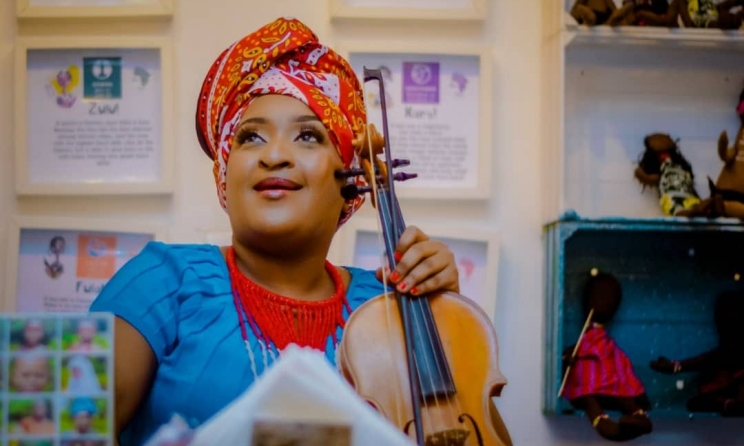
Nowadays, it’s easier to find all-female bands in Zanzibar, like the Rahmah Ameyr-led Uwaridi Band. The band was created last year and its 11 members meet weekly to rehearse at Stone Town’s Dhow Countries Music Academy, where most of them studied music. They play an array of instruments traditionally associated by men, including the accordion, tabla, cajon, ngoma, zeze, rimba, sanduku, vidumbaki and rika. Apart from taarab, the band explores Afro-fusion, muziki wa dansi and kidumbaki.
Simply by being part of this ensemble, these women challenge Zanzibar’s long-held social norms, and through their lyrics, they confront topics such as the empowerment of women and their immediate realities.
Ameyr, a devout Muslim, says there is little consensus on why there are so few women in Zanzibari music, but what is evident is that women still face many challenges in terms of their expected roles: getting married, staying at home and bearing children while the men take charge as breadwinners. But she says that these roles are slowly changing as more women gain financial independence through entrepreneurial activities, like seaweed farming.
“The vision that I have for this band is to prove that music can be for education, entrepreneurship and occupation,” Ameyr, who is a former member of Siti and the Band, says. “To those who are still held back by traditions and religion, I want them to know that all they need is confidence. What we’re doing is not wrong. It’s an art, and we’re doing it in a good way. We respect our traditions and religion.”
Aisha Bakary is another female musician who is challenging Zanzibar’s customs. The 24 year old, popularly known as the Hijab DJ, has amassed a decent following in the dance space and received the Women Future organisation’s 2019 Women of the Year Award for her ability to navigate the challenges of being a female DJ in Zanzibar.
When Aisha began deejaying in 2016, many in Zanzibar branded her activity as haram, or forbidden. At first, her mother would not allow her to play music, which caused tension at home.
“My mum was not happy that I was playing in places with music and alcohol,” she says. “I have faced a lot of criticism, especially from men and religious quarters who considered music to be an ignoble pursuit for a Muslim girl. Others suggested that I am doing this to earn attention.”
But this did not dissuade Bakary from following her passion. “I have always been pushed out but that has not made me a bitter person, as you can see. I love the world. I love the people. Alhamdulillah, Allah has given me space, a platform where I can now educate the world and open people’s minds.”
She believes that music is an important voice for the marginalised and an art form that offers strong voices a chance to spur public discussions about contentious issues. Through her art, she aspires to inspire Muslim women from the younger generation to take up music and render their lived experiences through it. For her, music offers an effective form of peaceful resistance that can create a lasting impact.
“The road to success is levelled for everyone regardless of age, race or religion,” she says. “No one should be afraid to be different. Many young women wish to go against this tradition and explore new ideas, but they are scared of what people will say.”
Bakary also aims to venture into music production, another space that is heavily dominated by men. She says the assumption that men are more interested in technical roles than women is misguided. Her advice for young women looking up to her? “Keep going and keep fighting until you earn your spot. Muslim women, especially here in Zanzibar, must follow their dreams. Religion is not based on how someone looks. It’s about what is in your heart. I don’t need them to be a DJ, but they can be doctors, pilots, lawyers and much more,” she says.


Most popular

Top Naija songs of 2026
31 Mar 2026

Top Afrobeats songs of 2026
19 Mar 2026

Ghana: Mr Eazi and MOLIY’s ‘Comfort’ earns Urban Music Awards nomination
21 Oct 2026

Top amapiano songs of 2026
16 Feb 2026

Open call: CANEX Music Business Lab and Songwriting Camp
15 Oct 2026
Nigeria: CANEX WKND unveils 2026 programme
21 Oct 2026
Disclaimer: Music In Africa provides a platform for musicians and contributors to embed music and videos solely for promotional purposes. If any track or video embedded on this platform violates any copyrights please inform us immediately and we will take it down. Please read our Terms of Use for more.

Subscribe to our monthly Newsletter
Follow us on social media


Please log in to post a comment.