
























































Article on death of popular Nigerian Keyboardist, Demola Olukotun.
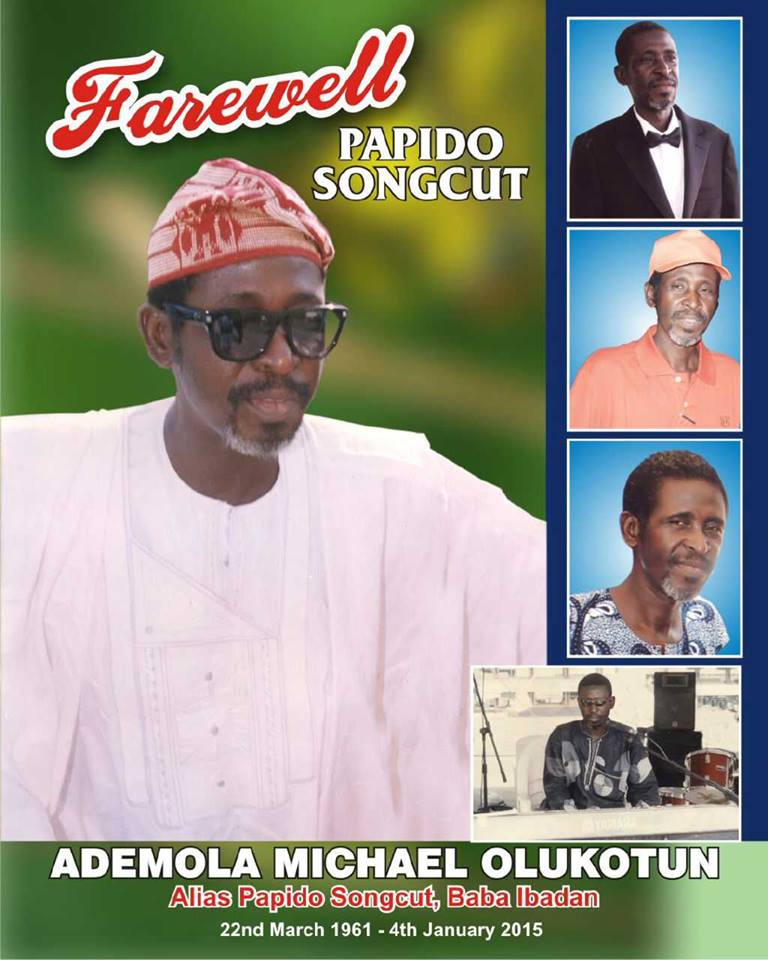
Music in Africa received a telephone call yesterday morning, conveying the shocking news of one of its friends in Nigeria, the hugely gifted and greatly loved Keyboardist and Singer, Ademola Olukotun, who passed away after a brief illness, on wednesday 7 January 2015.
Olukotun, or "Baba Ibadan" (father of the city of Ibadan- Western Nigeria) as he was popularly called, was an institution in the Lagos and Ibadan live music scenes. A die-hard advocate of old-school Highlife music, but with enough gravitas and flexibility to competently execute Jazz and Rhythm and Blues standards. Playing at various times in a number of ensembles and latterly, as a trio with veteran, virtuoso Drummer, Eddie Offeyi (formerly of Headzfunk, Christy Essien Gold-Train) and Bass prodigy Michael Idowu (formely of Lagbaja and Ikenga), he blazed a uniquely individual trail in the nation's live music venues. Whilst there is no record of an individual album release, he produced a number of grassroots artistes and composed scores for Television, notably the popular Instrumental piece used as signature tune for Nigerian network Televisions Saturday Sports programmes in the 1990's.
Olukotun, who had a degree in Electrical Engineering, was described almost unanimously by long-time friends and associates, Muyiwa Majekodunmi, as a fiercely independent, principled man, who never suffered fools, but would spend his last penny for those he cared for.
He is scheduled to be buried on Friday 16 January, at the Ikoyi Cemetery in Lagos. He is survived by his widow, Mrs Dammy Olukotun. Music in Africa wishes peaceful repose to this great servant of African music and strength to those he left behind. In tribute to this accomplished musician, published below, is an interview with him, in the Nigerian Guardian of 9 October 1999, conducted by the veteran Music Journalist and Music in Africa contributor, Benson Idonije. This was quintessential Olukotun.
"Demola Olukotun and the true sound of piano
By Benson Idonije
In recent times, the "Keyboard" has become a loose terminology for representing the piano and organ. This tradition was legitimised by ex-Miles Davis pianist, Herbie Hancock in 1973 when he made a monumental hit of Head Hunters, the LP. But because it is a simulated put-on, aimed at achieving commercial success, it has become increasingly difficult to differentiate between genuine artistic players of these instruments and exponents merely hiding their basic inabilities under cover of technological innovation. But one artiste who is at present being identified with the execution of the instrument in its natural form is Demola Olukotun.
Not that Demola's technique is more grounded or progressive than that of the like of Emmanuel Ngomalio, a piano player who combines the styles of Oscar Peterson, Red Garland and Wynton Kelly to forge his individuality. But Demola has continued to hold his own with the various outfits billed by Jazz Network Africa, laying on the chords for the various side men to find their progression.
Demola has been fronting a combo at Jazz ville as resident band since 1991 in a business relationship that was motivated by friendship. Said he, "I came to Lagos because I had a friend in Muyiwa Majek who owns Jazzville". Continuing, he said, "Majek didn't exactly write me to come down; but I went to his club one day and had a session with a group there. And from my performance, he felt I was good enough to do business with. I told him I had a band in Ibadan where I came from and he asked if I could bring the group for the next show. And I did. We struck a deal with Jazzville which brought me to Lagos, this was in 1991. Since then, it's been a regular gig at Jazzville".
However, the band was resident for four years - from 1991 to 1994. This is a long period for any aggregation; especially in these times when artists are restless and unpredictable. But Demola stayed on because he had a definite focus. He had a mission to accomplish - in terms ofestablishing a forum for jazz. But the band eventually stopped being resident because he could not help the situations."One of the major reasons why I could not continue to be resident was that some members of the band at one time had to leave. Another was that the pressure was too much, too demanding on the band to continue to play at the same venue as the resident band. We discovered that we had to do more rehearsals in order to play new songs every other week". This was almost impossible when some of the musicians had other things to do. For instance, they had lawyers and advertising experts as members of the band for whom music was not really a chosen profession even though, they were talented and played to professional standards.
Demola thinks that "the time has not come, not even in the nearest future for musicians to rely solely on playing music for a living", adding that "being a musician does not make you sign a pact with poverty. If lawyers can ride cars, there is no reason why musicians should not". Demola hangs it on lack of understanding on the part of the clientele and goes further to ask: "Why should a friend write you to play an engagement and expect that it will be free?"
Musicians who rely solely on the profession for their existence may not be many today, but they were numerous when the music industry was vibrant. When the economy was still booming in the 50s, 60s and 70s the like of Bobby Benson, Victor Olaiya, Rex Lawson, Eddy Okonta, Fela Ransome-Kuti and all the highlife exponents lived on their music. Even the like of Akeeb Kareem, Johnny Haastrup, Bongos Ikwe, Sunny Okosun among others whose ideas were different survived on their music. Ideally, one or two hit records in the market is enough to make a musician in this country. With the population of over 100 million, a culturally conscious Nigeria should be able to produce one million buyers who would automatically turn a hit making musician into a millionaire.
However, Demola's band now plays strictly for parties and corporate organisations. And though they no longer play as regularly as they used to do at Jazzville, the band has limited its outing to special programmes. The last time the band performed was two months ago when they provided formidable backing to Laitan Adeniji nicknamed Heavy wind; perhaps because of the big sound his tenor saxophone creates in terms of tonal conception. This was on the occasion of Africa Jazz Network's outing.
Demola who has been involved in numerous exciting and memorable shows was born into a music family."My father was a church organist. He still plays the organ, which is the king of all instruments. He is still playing. I virtually grew up playing it at home. He also had a small piano class which he taught. I was one of the students in the 60s. He taught me classical music, but I grew up to adapt the experience to dance music". Like every musician or artist, Demola was influenced on the piano by musicians that he constantly looks forward to as models. He admires Joe Sample of the Crusaders, a group that plays an amalgam of blues, rock, soul and jazz. He also loves Richard Tee.
According to him, he was influenced in Nigeria by Ayo Bankole Jnr., a young musician whose technique is amazing. He is as talented and unassuming as his late father who was a great organist and composer. Demola also admires the late Art Alade and Sid Moss, one of the finest modern jazz pianists that ever existed in Nigeria. Demola admits that there are good musicians on the Nigerian scene but says that there is no music industry. Blaming it on the media that promote bad music, he says: "They have been promoting a lot of mediocrity in this country. They cannot differentiate between bad and good music". Pointing fingers at the Performing Musicians Employers Association (PMEAN) which is serving as the musicians union, Demola saysthat they are not working in the interest of the musicians. "I will like to see a body of musicians which would come together to analyse the problems of musicians in order to find solutions to them. But PMEAN does not know its right from its left. They are like blind men leading the people". He would like to see a musicians' union that would, among other things "determine a minimum amount the musicians get paid for engagements. But right now, you discover that out of hunger, a lot of musicians receive peanuts. And this ruins the chances of more serious and deserving musicians". Continuing, he says "we need an ideal musicians union. I don't belong to PMEAN because they have not done anything tangible other than looking for engagements at Abuja. They have never addressed the problems of musicians".
A graduate of Abubakar Tafawa Balewa University, Bauchi, Demola started playing music professionally in 1985. He played piano for a group called "Afro links", a Jazz ensemble, at Ibadan. He later teamed up with a group called Midweek Band because "we played every Wednesday. And with Femi Adepegba on bass, Dapo Olaore, drums and my humble self on piano, we played jazz and African music. We also played highlife occasionally". According to Demola, the band played to an enthusiastic audience that followed them wherever they went - from the "Bamboo Corner" and 'JKIC' to Kave Club and Segi Restaurant - all based in Ibadan."


Most popular
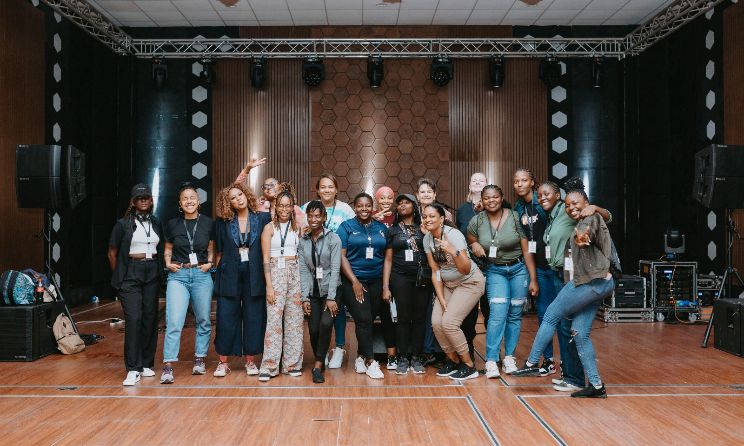
Open call: 2026 Gender@Work music industry training in Johannesburg
09 Oct 2026

Top amapiano songs of 2026
16 Feb 2026

Gambia: Suntou Susso announce UK tour for ‘The Path of a Griot’
09 Oct 2026

Top Afrobeats songs of 2026
19 Mar 2026

Top Naija songs of 2026
31 Mar 2026

Call for applications: ACCES 2026 Emerging Artist Spotlight Competition
01 Oct 2026
Disclaimer: Music In Africa provides a platform for musicians and contributors to embed music and videos solely for promotional purposes. If any track or video embedded on this platform violates any copyrights please inform us immediately and we will take it down. Please read our Terms of Use for more.

Subscribe to our monthly Newsletter
Follow us on social media


Please log in to post a comment.