




























































Southern Nigeria covers a geographical area of over 206 000 square kilometres and is home to over 130 ethnic groups, many with different languages and dialects, with tonal influence on the varied forms of music prevalent in the sub-region. As a result, the traditional music of these areas is as diverse as the peoples therein. However, the common ethnomusicology of the varied peoples of southern Nigeria is as striking as its ethnic diversity.
Music in traditional societies in southern Nigeria was employed for the broad purpose of socio-cultural expression. It is deployed in virtually all areas of interaction – work, social events from birth to death, religious and ritual ceremonies, state and court ceremonies, leisure and entertainment, and even for martial (military) purposes.
The common instrumental platform of West African music in general, of which southern Nigerian music is a part, is the rhythm. Rhythmic influence is at the heart of the music of this region, with the drum being the key instrumental driver of the traditional music of Southern Nigeria. Almost every traditional form of music in southern Nigeria has the drum as a central force. While exceptions do exist, these are few and largely found in purely vocal arrangements.
Traditional instruments
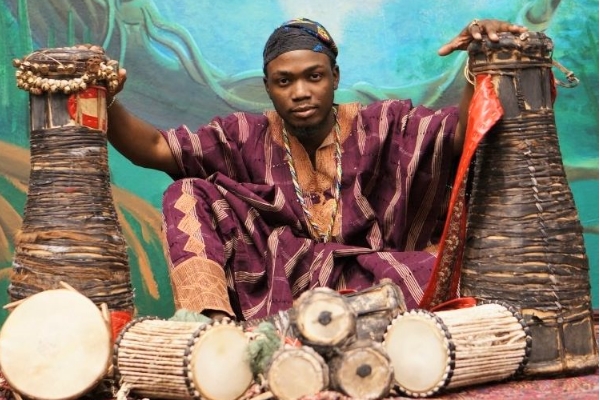
Traditional instruments in southern Nigeria naturally display regional variations in form and tone, based on the specific ethnic origins of a people. There are different drum types in Southern Nigeria, which vary in both design and sound. In the Yoruba-speaking part of south-western Nigeria, the most common drum is the Talking Drum (Gangan/Omele), a medium-sized drum consisting of a wooden core and leather-skinned on two ends. The drum is designed to produced tonal variations (the voice), based on the manipulation of leather strings, verged in even length across the span of the wooden core and attached to the edge of both sides, which produced sound variations when struck with the curved wooden drum stick. The other drum-type unique to Yoruba-speaking southern Nigeria is the multi-drum composite called the Bata drums. Historically these drums are believed to have been designed and played for the Yoruba God of Thunder, Sango, who would perform an eponymously named dance, known as the Bata.
Other drums indigenous to the region are the Sakara drum, a flat circular drum played with the fingers or a stick, either by a single performer or as part of a larger drum orchestra, driven by the Gangan. In areas occupied by the Egun people (bordering with the Republic of Benin) can be found the giant Sato drum - a 6-foot tall, cylindrical drum played by groups of drummers and dancers in unison, according to ancient ritual. In Edo land of mid-western Nigeria, the most common drum-type is the Ema, a medium-sized, hollow drum similar in length to the ubiquitous Djembe.
In the Igbo-speaking part of south-eastern Nigeria, the most common drum is known as the Igba, a medium-sized, hollow tom-tom drum, played with sticks or hands, mostly in a larger drum orchestra. Another drum type in this area is the Ikoro drum, which can vary from medium to giant sizes. The largest example of an Ikoro drum was an eight-foot specimen at Umunze, which was sadly destroyed by Christian missionaries in the 1950s due to its association with sacrificial rituals in the late 19th century.
Amongst the Efik and Ibibio peoples (two very distinct ethnic groups in south-east Nigeria), the most common drum types are the Ekomo (Efik) and the Ibid (Ibibio). Both are medium-sized, leather skin tom-tom drums, a variant of which is also used by the Ijaw people of the Niger Delta. Other commonly used drums in the south-east are the clay bass pot known by the Igbo’s as Udu and the Ibibio’s as Abang. This instrument is used almost exclusively by these two ethnic groups, as well as the Ijaw’s.
Percussive Instruments are usually applied either as an adjunct to drum rhythms or in limited instances as a stand-alone accompaniment to voice. In Yoruba speaking south-west Nigeria, the key percussive instruments are the shekere (shakers) - generally a circular calabash bounded by a complex string of cowrie shells and Agogo (gongs), also known as Ogene. There is also the wooden block instrument with a hollow slit, known as Ekwe by the Igbo and Obodom by the Ibibio.
In terms of melodic instruments, the region’s main wind instrument is the five-stop Lara (traditional flute). Also popular in the region are the three-stop flute known as Oja and the Okike (elephant tusk trumpet), as well as the Uta (cow-horn trumpet) of Ibibio-land, which is capable of producing a four-part harmony.
Other melodic instruments include the Ubo Aka (thumb piano), used in Igbo-land and the Niger Delta. The oldest example is a 1000-year old piece discovered at Igbo-Ukwu in Anambra State and held in a museum in the same town. The Ikon (xylophone) is used in Ibibio-land and although it produces melodies, it is often classified as an idiophonic (or percussive) instrument. In the same genre is the Agidigbo (large thumb piano box) of Yoruba-land, which though capable of producing melodic sounds possesses the tonal character of a percussive instrument.
Traditional genres
In general, southern Nigerian traditional music is classified differently from Western music, particularly in terms of the instruments influencing the classifications of genres, as well as the specific purposes for which the music is intended (for example court, martial music, funeral dirges, celebrations, sport and recreational music, and ritual music. There were also musical forms, stylised to indigenous dances of the various peoples of southern Nigeria, which have acquired the form and stature of genres in the various areas. This is notable especially in music generated to support the dances of the various masquerade groups that are prevalent across southern Nigeria.
Among the Yoruba of south-western Nigeria, genres include Bata music, named after the ancient dance; Gelede, ceremonial music performed during a festival and dance of the same name; Biripo, a dance performed by the Ikale people; and Totogiri, music played in Owo-land during celebrations like birth and marriage.
Aside from dance music, in this same area hybrid forms influenced by Islamic religious practices arose over time. These included Were and Ajisari, musical forms used to rouse the faithful for prayer during Ramadan. Sakara and Apala, on the other hand, are more recreational in purpose.
In Edo-land in the mid-west of Nigeria, Ekassa music emerged in the 16th century, a prime example of a traditional dance giving rise to a musical genre, having been devised as a royal dance by the legendary Queen Mother Idia.
In south-eastern Nigeria, the predominant influence on genre classification was the influence of dance. With dance being an extremely important vehicle of cultural expression, music has long been an essential counterpart to it. Examples of this being among the Igbo people. Various musical forms adapted to dance would have the indigenous prefixes “Egwu-” (‘the music of..’) or “Igba-” (‘the drums of..’). For example, Egwu-Igede represents the backing music of the Igede dance of northern Igbo-land, while Igba Ndi-Eze represents the backing drum music played to the dances of kings. The Ikprikpi Ogu (war dance music of the Ohafia-Abam people) is another example of this. Sometimes genres would be classified according to the masquerade group they support, such as the Egwu Ijele, the music played in accompaniment to the dance of the 10-foot tall and fearsome Ijele masquerade eminent in many parts of central Igbo-land.
This is much the same in other parts of south-eastern Nigeria, with the dance-influenced pattern of music classification also seen in the Ekombi music of the Efik people, the Ukwa war dance music and the recreational Mpok-eto music (made popular recently by contemporary artiste Iyanya) of the Ibibio people. Among the Ijaw people of the Niger Delta, this trend is seen in the Owigiri and Ekegene dance music which are largely celebratory dance music.
There are certain distinct traditional forms, however, that are not necessarily related to dance, such as Ekpili music, which is music played in the Anambra area using the Ubo Aka (thumb piano) and distinctly narrative in character. The players being more focused on transmitting oral traditions and idioms (in the style of the Griots of West Africa).
Traditional music in a modern context
Despite being the product of an evolutionary process over hundreds or even thousands of years, traditional music continues to occupy an important cultural position in the lives of the people of southern Nigeria. It has been at the heart of musical innovations over the years, including emerging popular music hybrids such as highlife, Fuji, Afrobeat and even modern Nigerian hip-hop. Nonetheless, there are several rare forms of southern traditional music that have already been rendered extinct by the sheer pressure of societal change, one prime example being the Dadakuwada of south-western Nigeria. This in itself remains the key challenge to Nigeria’s cultural stakeholders – to prevent the extinction of other traditional genres - for in it lies the ancient cultural DNA of the region’s people.
References:
- Akpabot, S. 1986. Foundation of Nigerian Traditional Music.
- Omojola, B. 2014. “Yoruba Music in the 20th century”. Identity, agency and practice.
- Nzewi, M & O. Nzewi. 2008. A contemporary study of Musical arts informed by African Indigenous knowledge systems.


Most popular
Gambia: Suntou Susso announce UK tour for ‘The Path of a Griot’
09 Oct 2026

Top amapiano songs of 2026
16 Feb 2026
Open call: 2026 Gender@Work music industry training in Johannesburg
09 Oct 2026

Top Afrobeats songs of 2026
19 Mar 2026

Top Naija songs of 2026
31 Mar 2026

Call for applications: ACCES 2026 Emerging Artist Spotlight Competition
01 Oct 2026
Disclaimer: Music In Africa provides a platform for musicians and contributors to embed music and videos solely for promotional purposes. If any track or video embedded on this platform violates any copyrights please inform us immediately and we will take it down. Please read our Terms of Use for more.

Subscribe to our monthly Newsletter
Follow us on social media


Please log in to post a comment.