


















































The band Dark Suburb is an anomaly in Ghanaian popular music: a creative voice playing with images and sounds that invoke local prejudices to reveal themselves while challenging the region’s music industry to rethink the dominant models for popular music - no small task for a rock band in West Africa.
Since their official launch in February, their goal has been to create an awareness and appreciation for rock in a place where most people either have no exposure to, or hold a negative opinion of, the genre. With only three shows to their name as of June 2015, the attention they have received attests to the appeal of their sound, the intrigue of their stage personas, and the power of marketing and social media.
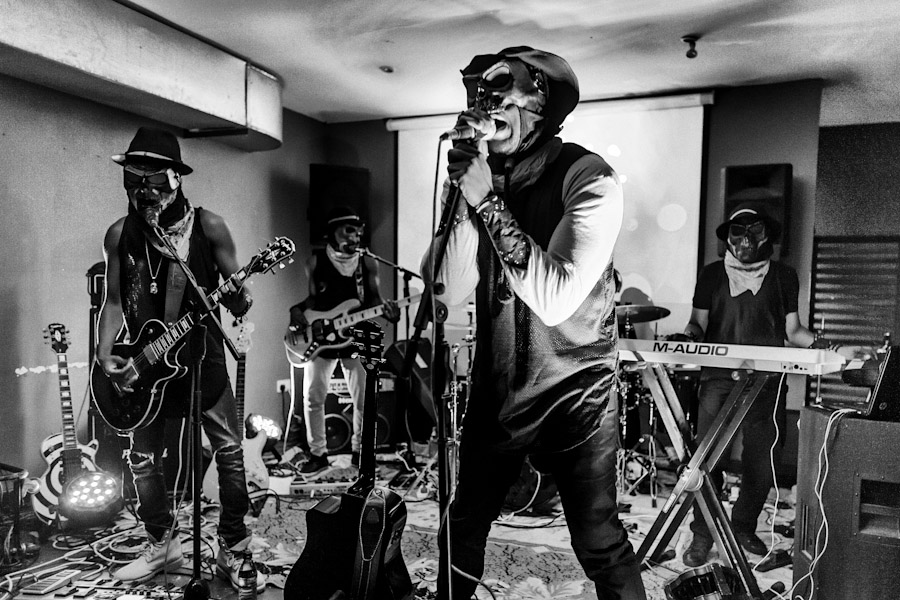
The first thing you notice about the band is their image: the five musicians wear skull masks and black clothes and are presided over by a tall staff carrying figure with a shrouded head. Their performance at the 16th annual Vodafone Ghana Music Awards (VGMAs) began with a monolog by the band’s “chief priest” recounting how he had raised the group from the underworld to create a revolution in music. The performance also included painted acrobats, fire breathers, and their dwarf “minion” - imagery that is largely absent from contemporary popular music in West African.
The band’s last performance took place tucked between the bar and pool table room at the Accra sports bar Champs. Fog machines added to the gothic mood as the five musicians strode onto stage. The band looked out at the sparse crowd through their masks, their gargoyle-like silhouettes setting a somber though theatrical mood. Drenched in red lighting with the band’s logo projected on the back of the stage, they played a solid two-hour set, largely comprised of originals sung in Pidgin English and local languages that stylistically nodded to contemporary pop-rock acts such as Linkin Park. Compared to the well-attended launching concert at Alliance Française d’Accra, the audience was smaller than expected, though their dedication was apparent as they sang along and danced.
In the US, this scene would be commonplace. In Ghana, it signals a significant shift. Ghana’s music industry is a relatively small one, often cast in the shadows of more active music producers such as Nigeria and South Africa. Ghana’s capital, Accra, is dominated by hiplife and azonto hits by local artists such as Sarkodie and EL and Naija (Nigerian) artists such as Wizkid, Davido, Burna Boy and Yemi Alade. In a place where artists generally find mainstream success through corporate sponsorship, creative deviations from the norm are rare. As Dark Suburb’s singer put it, “If [corporate sponsors] think the masses love you then they put you on their platform and pay you and that's basically the only way you can make money. It pushes a lot of artists who are doing righteous music - if you like to call it that - to move into popular music or dance music to survive.”
The band’s policy of remaining anonymous also contrasts with ego-touting model of artist promotion and performance. As the singer stated in an interview, his aim is for Dark Suburb to stand for “something bigger than the individuals involved.”
Despite their intimidating stage personas, the band advocates a social perspective that looks beyond the confines of Ghana’s highly class-, gender-, and ethnicity-structured society. The “We are all skeletons” slogan looks to bones, not as symbols of death and warning, but as a fundamental characteristic joining all humanity - a basic structure that cannot easily be categorized in terms of race, nationality, sexuality, or religion. As the singer searched for a theme to communicate these ideas, he eventually asked himself: “What's the one thing that makes people the same? It's the blood and the skeleton - the frame. Of course I can't represent blood in any image, so I chose the skeleton.”
Conservative backlash
The band’s image has fueled both interest and public criticism. Ghana is a country where religious devotion permeates the average person’s consciousness as well as the city’s landscape. Pastors can capitalize on the fear of witchcraft to explain problems ranging from bad health to general misfortune to currency deflation.
Recently, the Prophet Daniel Asamoah-Larbi, founder of the House of God International Ministry and President of the Worldwide Council of Prophetic Alliance, came out against Dark Suburb and rock in general, citing none other than British legend David Bowie as “proof” of the music’s demonic orientation. He claims that during the band’s VGMA performance he witnessed a “change in atmosphere” and “he could feel the presence of demons.” When the band’s website temporarily went offline due to a lapse in domain name renewal, Larbi said: “Dark Suburb has taken off its website from public domain and I don’t know what really made them do this and what they are trying to hide. Are they scared of their own identity and ideology?”
He continued by warning: “If Ghana embraces them, doom will befall the country. It is dangerous for our youth. As an ordinary person, you will say their style is unique, artistic, creative etc., but spiritually, they are satanic.”
The attacks from Larbi have only helped the band’s visibility (and likely Larbi’s as well). The singer says the accusations have actually drawn in curious listeners who then encounter music “talking about love, talking about oneness, unity and the like” - not themes that readily invoke the presence of Satan.
At the Champs concert, one Ghanaian fan recounted how a “white friend” took him to see the band at the Alliance Française. He was opposed to seeing a rock concert but afterwards changed his stance and now follows the band. A Facebook group has also formed called the Dark Suburbans and has nearly 200 followers who refer to themselves as “skeletons”. The movement is growing, but time will tell if Ghana will accept this new direction in the music scene.
* The members of Dark Suburb requested that their names not be used in this article.


Most popular

Top amapiano songs of 2026
16 Feb 2026
Call for applications: ACCES 2026 Emerging Artist Spotlight Competition
01 Oct 2026
Open call: 2026 Gender@Work music industry training in Johannesburg
03 Oct 2026

Top Naija songs of 2026
31 Mar 2026

Top Afrobeats songs of 2026
19 Mar 2026
AFRIMA 2026: All the winners
12 Jan 2026
Disclaimer: Music In Africa provides a platform for musicians and contributors to embed music and videos solely for promotional purposes. If any track or video embedded on this platform violates any copyrights please inform us immediately and we will take it down. Please read our Terms of Use for more.

Subscribe to our monthly Newsletter
Follow us on social media


Please log in to post a comment.