























































How three Nigerians are working to stop free music downloads
27 Apr 2016 - 17:17


By Muyiwa Matuluko
MyMusic.com.ng is an online retail platform that lets Nigerians pay to download high quality music using a convenient payment channel they’re all familiar and very comfortable with—mobile airtime. In this interview they discuss how they hope to end the reign of free digital music downloads in Nigeria.
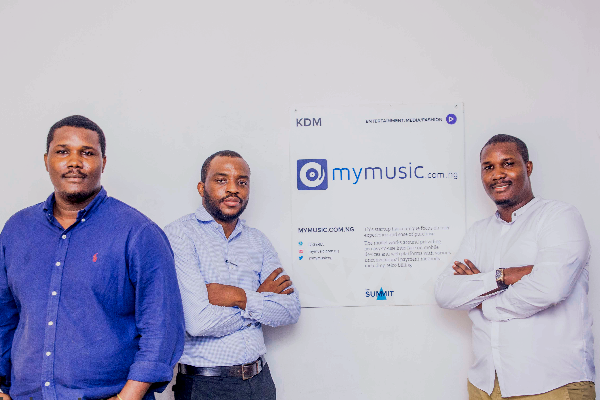
Could you give us a brief description of yourselves and the roles you play in MyMusic?
Damola: My name is Damola Taiwo. I am the Chief Operational Officer and Co-founder of MyMusic. Most of what I do revolves around speaking to, and sourcing, partners. I also do some tech stuff, design and branding sometimes.
Tola: My name is Tola Ogunsola. I am the CEO and Co-founder of MyMusic. Most of what I do is liaising with partners and seeing to the day-to-day operations of the company and business development I also work with Damola on content acquisitions from record labels and independent artistes.
Dolapo: My name is Dolapo Taiwo. I am Co-founder and also double as CTO for MyMusic. Most of my work revolves around third-party tech integrations. I also oversee a lot of development work.
What is the story behind MyMusic?
Damola: We met at Babcock University where we were all studying Computer Science. While in school, we were very involved in web development and computer clubs. Tola especially was the kind of programmer everybody wanted to know when they had assignments. We also had similar interests in music. I play the bass guitar, Dolapo plays the keyboard.
Two years after leaving school in 2004, we came together to nurse an idea—a music store for selling Nigerian CDs online to people abroad. But it didn’t fly so we all moved on. Dolapo and I went on to found Unotech Media, which we initially ran from our uncle’s garage in Ibadan. Years after, we reunited again to share experiences of the things we had done with technology in our personal lives. We saw how the Nigerian music industry was so fragmented and we thought we could do something about it. We decided we would build a digital music downloads platform. That’s how it all started.
But you were entering a saturated space at a time when most local players had tried and failed. What made you so confident that this was the way to go?
Damola: When Steve Jobs started iTunes, Napsters was the P2P music sharing platform everybody was using to download free music. No one ever believed that iTunes could become such a commercial success. What that taught us is that, as long as it is convenient, people don’t mind paying for digital music downloads.
Granted, the tech industry in Nigeria is still very young; quite a sizeable number of consumers are yet to embrace tech. Someone in the know told me that there are no more than 200,000 Nigerians who use their debit cards online. But these are the same people who, even though they download songs for free from music blogs, will pay N50 ($0.25) a month for CRBTs (caller tunes). So we researched on how we can match that experience. If we could find a way to make people pay just by the click of a button, then we had a solution. The only reason why we started MyMusic was because we thought we had the solution.
But it took us 3 years to come up with that solution. Downloads on MyMusic cost only N30 ($0.15) per track. Now you can press a button and the song is sent directly to your phone, N30 is deducted from your airtime and you receive an SMS receipt with a link to re-download the song if it fails.
That sounds like a lot of work. I imagine it’s been very challenging.
Dolapo: It sure is a lot of work. To achieve what we are doing, there are an awful lot of third-parties involved. Because of the way the music industry is structured, getting the attention of record labels is quite difficult. Manoeuvring around 12 record labels and numerous individual artists, just to get them on one platform is a bit of a challenge. But we’ve been able to surmount most of it.
Tola: It’s almost like we are a unification of 3 different industries; music, tech and communications. You could also add payments into that mix. So for a typical everyday user that lands on MyMusic, from point zero to download, it is just 2 clicks. But for us it takes us connecting to about 5 entities, which you are not aware of. Because we have to seal so many partnerships, there is a lot of friction and so many potential points of failure.
What we have going for us is that even though we all have a technology background, we’ve made a conscious effort to shift the focus from the technology to what users are used to and want.
Have you raised any investments so far?
Tola: No we haven’t. When we started, we had an interesting number of people reach out to us. At that time the issue was that some of the suggestions from the prospective investors sounded like doing exactly the same thing competitors have done and failed at. Eventually, we found an investor but they tried to change too much. So we decided at that point to take a break from seeking for investors. Currently, we are bootstrapping the company to a point where we build enough traction to start talking to investors again.
Damola: Just to clarify. It’s not like there is some stack of cash somewhere we can constantly pump into the business. We all have other businesses that we are running which serve as the performance engine for fueling MyMusic. I can tell you it has been extremely difficult; we are literally giving it all we have. Can you imagine what it’s like pumping all money you make into a venture that is not making any profit?
Have any of you ever got to point when you felt like throwing in the towel?
Damola: To be honest, I never thought it was going to be this difficult or take this long. However, we have gotten to a stage where we cannot go back. I think what has allowed us to stay resilient up to this point is that fact that we all have our personal things going on for us. So we are not looking at this thing as a short term venture or a major revenue stream. I mean, if you think about it, it is almost impossible to bootstrap what we are doing because it is a very expensive project. I would advise entrepreneurs out there to at least have some source of personal revenue that will help you to have a higher staying power.
Tola: For me, it has never really gotten to that point of giving up outright. Interestingly, whenever it seems like we are getting close to our breaking point, something always happens—like finally sealing an important partnership we’ve been chasing for months—at the nick of time that is just about enough to keep us going.
Dolapo: We are convinced about what we are doing so we cannot give up even though it is a painful process. I just find something to do; sleep, take a vacation, whatever I can to keep my sanity.
In your position as an intersection of both industries, what do you think the Nigerian tech industry can learn from the more successful music industry?
Damola: The other day, we had a discussion with one of the biggest artiste managers in Kenya and she made some key observations. Nigerian music videos have been able to match up to international standard. So if Jay Z uses a Ferrari in his video, you can be sure Davido will use a Porsche. Or Wizkid will use a Lamborghini. They’re also wearing the same kind of designer apparel and shooting at similarly fantastic locations. People watching these music videos like to be inspired. If you cannot inspire them, they see you as a local artist. Phyno is rapping in Igbo but people are listening to his music all over the world because people feel it’s international. The content is local but the outlook is international. A lot of it is just what is fashionable to do. But as long as it is excellently done, people will be attracted to it. A passion for excellence is very important. That’s what I see the Nigerian music industry has tapped into and that’s why it is so big.
Tola: Jimmy Iovine, one of the biggest music execs in America and Co-founder of Beats with Dr Dre, said one of the things that always struck him when he had a meeting with Steve Jobs was that tech people were always over confident. On the other hand, the music industry people don’t have any confidence.
It’s the same here in Nigeria. People in the music industry are always focused on the money. They recognize that what they’re doing is a business. Tech people on the other hand are way too confident and focused on tech. It’s like they get kicks out of using the latest tools to build stuff that nobody’s going to use it, because it solves a problem that doesn’t exist. Tech people in Nigeria need to remember that fundamentally they are in a business.
Finally, based on your experiences, what pieces of advice do you have for aspiring entrepreneurs?
Damola: I see a lot of young people now who, once they finish university, believe the next thing is to sign up at some hub. Don’t venture into startups just because everyone is doing it. It took me almost 9 years to start this startup. The only reason why you should be running a startup is because you have the conviction that you can solve a problem. Not because startups are the next thing to do to make money for yourself. You can work for somebody, maybe another startup, or you can volunteer to work for a big company for free. Maybe after 6 months they can employ you. You could become bigger than someone who is into startups and doesn’t really know why he is doing it.
And once you decide the time is right to start a venture, focus more on the product. When you have a compelling product that solves a real problem, the right forces will align; money will come, investors might come, solutions will come, partners will come. That’s if you focus on your product and you’re solving a real problem.
Tola: I think that there’s a lot of glamour around startups and it is obviously because of success stories around the world. But people always forget that are startup is essentially a business. If you don’t have a compelling product or you’re not differentiating just don’t bother starting because, you’re going to face a lot of challenges, especially in the SSA market. Naivety is good. You’re fresh out of school, pumped up and you think you can take on the world. But your reality should always be balanced. You can’t come out with a software that will change the banking industry in Nigeria without first understanding the banking industry.
Dolapo: The reason why Olamide is so successful is because he is local—street ti take over. Go local but use the resources around you to do whatever you’re doing to the highest level of professionalism. If what you are doing is not part of Nigerian realities, it’s a joke. But if it can appeal to the average man on the streets , then you know that you’re doing something right. For a second, take off your tech cap and just think like a normal human being. When you do that, you start to see that things have a different view entirely. You are no more just building stuff that is high tech. You are building stuff that people need. Because at the end of the day, nobody cares whether your code is written in PHP or C#. What people care about is what problems it solves and how can it can impact the vast majority of people out there.
This interview was first published by Techpoint on 21 March


Most popular

Top Naija songs of 2026
31 Mar 2026
Ghana: Mr Eazi and MOLIY’s ‘Comfort’ earns Urban Music Awards nomination
21 Oct 2026

Top Afrobeats songs of 2026
19 Mar 2026

Top amapiano songs of 2026
16 Feb 2026
Open call: CANEX Music Business Lab and Songwriting Camp
15 Oct 2026
Nigeria: CANEX WKND unveils 2026 programme
21 Oct 2026
Disclaimer: Music In Africa provides a platform for musicians and contributors to embed music and videos solely for promotional purposes. If any track or video embedded on this platform violates any copyrights please inform us immediately and we will take it down. Please read our Terms of Use for more.

Subscribe to our monthly Newsletter
Follow us on social media


Please log in to post a comment.