




















































Traditional music and instruments in Botswana
18 Jul 2018 - 16:53


By Modirwa Kekwaletswe
Botswana is a large country with a sparse population. The eastern region of the country, where rainfall is more reliable, is more densely populated than the western side, which is comprises mainly the vast Kalahari Desert. Because of these environmental differences, as well as the differing musical traditions of the various cultural groups that make up the country’s population, the traditional instruments found in Botswana vary from region to region. However, since the gaining of independence in 1966, Botswana has lost many indigenous instruments to rapid urbanisation. Except for a few mainstays, many traditional instruments have disappeared, as people have lost the ability to play or make them[1].
Community singing
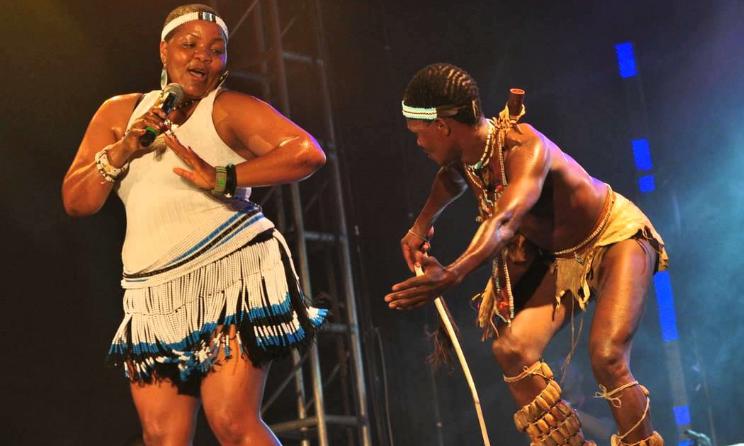
Community singing is a core musical tradition in Botswana. Sometimes performed in age groups or along gender lines, community singing is either predominantly a capella or performed with minimal instrumental accompaniment. Drums and wind instruments such as whistles and lepatata (made from kudu horn) are occasionally used to add to the performance, particularly in the case of male groups[2].
Like much of the country’s traditional music, the central formal characteristic of community singing in Botswana is the ‘call and response’ pattern. The leader (motlhabeletsi), usually the most experienced and knowledgeable in the group, ‘calls’ out a single-line melody, and the group answers with a choral ‘response’[3].
Traditional choirs perform hunting songs, mourning songs, initiation songs and many others to express the rituals and activities of daily village life. Men traditionally sing dikoma, songs in which the main themes concern hunting, conquering enemies and commemorating other important social events in the life of the community. Women sing ceremonial songs, such as birth and initiation (bojale) songs, as well as occupational songs as they execute their daily chores such as weeding, harvesting, winnowing, pounding and stamping sorghum. They also sing lullabies to soothe their babies. Mixed choirs, popularly known as dikhwaere, are common in the south of the country in villages such as Mochudi, Kanye, Moshupa, Molepolole and Tsabaong, as well as in the Bobirwa region[4].
Esteemed community singing groups in Botswana include Rangers Marena, Tsa Malwelwe (known for the song 'Mahala'), Zebras, Maphoi and the Naro Giraffe Dance Group[5].
Soloists
In addition to community singing groups and traditional choirs, Botswana also has a rich tradition of solo artists. These musicians are well-known in their respective communities and will perform at public gatherings and social occasions, such as mantsho a ngwana (birth) celebrations, or at the kgotla (the public meeting forum)[6].
Some of the most celebrated musicians in Botswana are soloists – including Speech Madimabe, George Swabi, Stampore Malefho Mokwa, Ratsie Setlhako, Omponye ‘Sheleng’ Ositile, Boruru Oageng, Lonaka Matlapeng and Solly Sebotso – who play a mixture of traditional and adapted instruments.
The most commonly adapted instrument is the guitar. This is because guitars are cheaper than instruments such as the piano or saxophone, and – above all – because folk musicians can improvise and make their own guitars using industrial wires as strings, a gasoline container as a resonator and pieces of wood for the neck and tuning pegs[7]. This improvised ‘tin guitar’, known locally as the motontonyane, is not only a revered traditional instrument but has brought about a unique guitar tradition in Botswana. Over the years, a succession of folk musicians have strung and played only the bottom four strings of their guitars, resulting in a ‘four-string guitar’ tradition characterised by bassy rhythmic patterns and three-note chords[8].
Traditional instruments in Botswana
As mentioned, traditional instruments are not uniform among the various cultural groups of Botswana. In fact, only a few instruments are common throughout the country.
For example, despite being simple to construct, the musical bow is only common among the Basarwa (San) people of Botswana. Considered one of the oldest musical instruments in the world, the musical bow – traditionally made of a bended branch, joined at both ends with a piece of sinew – is said to have been around since the advent of the hunting bow.
Idiophones (self-sounding instruments) found in Botswana include leg rattles (matlhowa), bones (marapo), clapping pieces (yikandiso) and bells (ngendjo). These often form the accompaniment to vocal music, as do a selection of drums such as the moropa and kika. There is also a rich collection of wind instruments, such as lonaka-la-phala, lepatata, lonaka la tholo and lengwane, and these are traditionally made from reeds and pieces of fluted bone. Common chordophone (stringed) instruments in Botswana include the segaba, a type of single-stringed violin, the lengope (mouth bow) and the segwana, which is made with a calabash.
The decline of traditional instruments post-independence
From the notes of musicologists such as PR Kirby and Ike Norborg, we know that some traditional Batswana instruments, such as the reed flute known as the mokoreje, began to disappear from as early as the 1930s. However, the extinction of traditional instruments in Botswana gained momentum in the years following independence, as the country rapidly urbanised[9].
Because traditional instruments were never mass-produced in Botswana, and therefore never standardised, each instrument needed to be constructed by a skilled craftsman (usually the musician), who made it to suit his or her own taste and musical style. Thus, each instrument was uniquely made using locally available materials. This tradition proved vulnerable to the effects of urbanisation, as older generations were not able to pass on these highly specialised skills to their children and grandchildren. The availability of materials was also threatened by increased industrialisation[10].
An interesting case in point is the segaba, nicknamed the 'one-string violin'. Found throughout the country, it is estimated that at the time of independence, there were more than 100 segaba players in Botswana. Although these numbers have declined drastically, compared to other traditional instruments, the segaba has managed to survive due to the relative simplicity of its construction.
Preserving traditional instruments
Encouragingly, there have been efforts made to preserve and revive traditional instruments in Botswana[11]. One significant initiative is the Botswana Music Camp, an annual workshop held since 1986. The camp draws participants from a variety of fields, such as music teachers, students, administrators and practicing musicians. It has played a significant role in teaching participants how to make, restore and play traditional instruments such as the segaba and the setinkane (finger piano).
Even more significant has been the advent of the President’s Day Competitions, which were first introduced in 2008. Held at local, regional and national levels, these popular music competitions have led to a revival for the segaba, setinkane and four-string guitar players across Botswana[12].
Finally, efforts have been made to notate the segaba to make it easier to teach in school curricula throughout the country, and small workshops have been established to produce these instruments and make them available to the next generation of Batswana musicians[13].
Resources and citations:
- [1] https://allafrica.com/stories/200708070565.html
- [2] Denbow, J. & C Thebe, P (2006). Culture and Customs of Botswana. Greenwood Press.
- [3] https://folkways-media.si.edu/liner_notes/folkways/FW04371.pdf
- [4] ibid.
- [5] https://festival.si.edu/2011/peace-corps/botswana/smithsonian
- [6] https://www.degruyter.com/downloadpdf/j/genst.2018.16.issue-1/genst-2018-0006/genst-2018-0006.pdf
- [7] http://www.dailynews.gov.bw/news-details.php?nid=40837
- [8] http://www.sundaystandard.info/book-offers-insight-botswana%E2%80%99s-four-string-guitar
- [9] https://www.jstor.org/stable/41235988?seq=1#page_scan_tab_contents
- [10] https://www.jstor.org/stable/1214791?seq=1#page_scan_tab_contents
- [11] http://www.mmegi.bw/index.php?sid=7&aid=705&dir=2013/february/Friday1
- [12] http://www.botswanaguardian.co.bw/style/item/2064-trio-retains-allure-of-traditional-instruments-in-music-repertoire.html
- [13] https://www.jstor.org/stable/40980244?seq=1#page_scan_tab_contents
Disclaimer: Music In Africa's Overviews provide broad information about the music scenes in African countries. Music In Africa understands that the information in some of these texts could become outdated with time. If you would like to provide updated information or corrections to any of our Overview texts, please contact us at [email protected].
Editing by David Cornwell


Most popular

Top amapiano songs of 2026
16 Feb 2026

Top Afrobeats songs of 2026
19 Mar 2026
AFRIMA 2026: All the winners
12 Jan 2026

Open call: Goethe-Institut grants for Southern African creatives
08 Sep 2026

Top Naija songs of 2026
31 Mar 2026

Call For Applications : ACCES seeks a UK-based performer
10 Sep 2026

Sun-El Musician confirmed for ACCES 2026 in Joburg
15 Sep 2026
Disclaimer: Music In Africa provides a platform for musicians and contributors to embed music and videos solely for promotional purposes. If any track or video embedded on this platform violates any copyrights please inform us immediately and we will take it down. Please read our Terms of Use for more.

Subscribe to our monthly Newsletter
Follow us on social media


Please log in to post a comment.